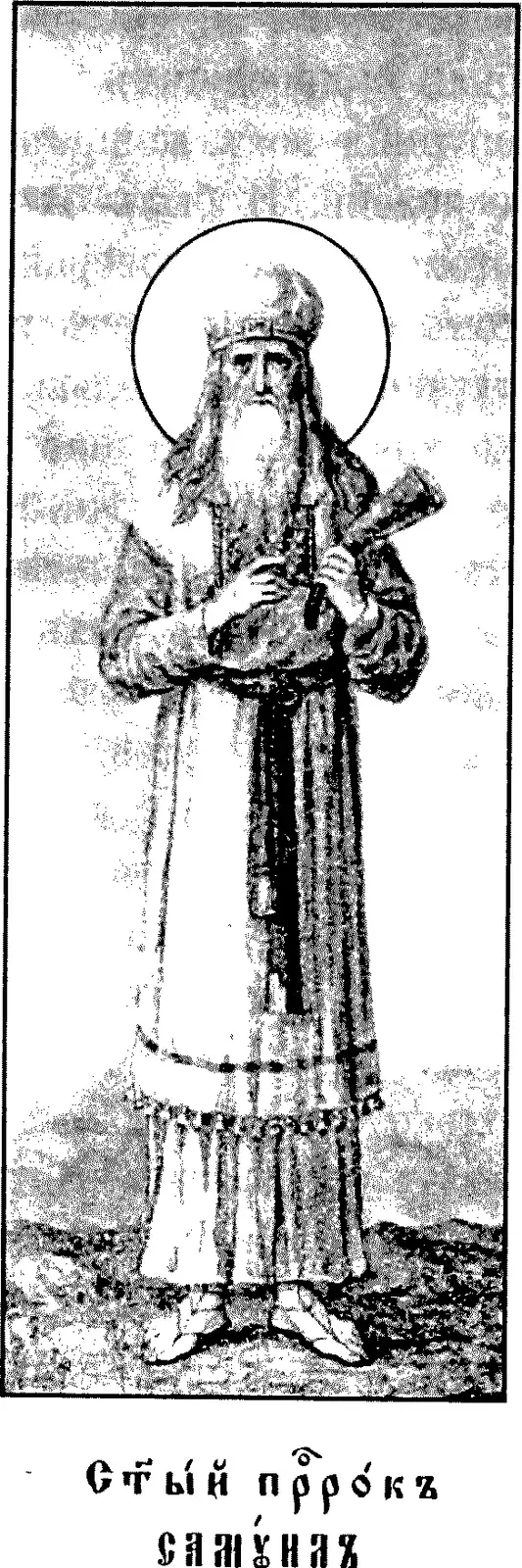
Saint Samuel the Prophet
Before the reign of David; dates unknown
- Parents
- Elkanah, of Ramathaim in the hill country of Ephraim, and Hannah 3
- Name
- Explained in Scripture from Hannah's having asked the Lord for him; the name itself means "name of God" 3
- Died
- Mourned by all Israel and buried in his city, Ramah 13
Saint Samuel was the boy who heard his name called in the night at Shiloh and answered, "Speak, for your servant is listening." 5 He grew up to be the last judge of Israel and a prophet whose words, Scripture says, never went without effect, and at God's command he anointed Israel's first two kings, Saul and David. 251418 The Roman Martyrology commemorates him on August 20. 18
Asked of the Lord
Elkanah, a man of Ramathaim in the hill country of Ephraim, went up every year to sacrifice at Shiloh, where the sons of the priest Eli served. 3 His wife Hannah had no children, and his other wife taunted her for it year after year. 3
At Shiloh she stood before the Lord and prayed so silently that Eli, watching her lips move, took her for drunk. "I was only pouring out my troubles to the LORD," she told him. 3 She had vowed to give a son back to God "for as long as he lives." 3 She bore a son and called him Samuel, "since she had asked the LORD for him." 3 The New American Bible notes that this explanation fits the name Saul, which means "asked," more directly; Samuel means "name of God." 3
When the child was weaned she brought him to Shiloh and left him with Eli. 3 There he served before the Lord in a linen apron, and every year his mother made him a little garment and brought it when she came up to sacrifice. 4
"Speak, for your servant is listening"
Eli's sons, meanwhile, were robbing the people who came to sacrifice, and they ignored their father's warnings. 4 One night the boy, sleeping in the temple where the ark of God was, heard his name and ran to Eli: "Here I am. You called me." 5 It happened three times before the old priest understood and told him what to say. When the call came again, Samuel answered, "Speak, for your servant is listening." 5
The first word he received was a hard one: judgment on Eli's house. 5 In the morning he was afraid to repeat it, but Eli made him tell everything, and accepted it: "He is the LORD. He will do what he judges best." 5 From then on the Lord was with Samuel, "not permitting any word of his to be without effect," and all Israel from Dan to Beer-sheba knew him as a prophet. 5
Benedict XVI, speaking of this story at the Angelus in 2012, drew attention to Eli more than to the boy. The figure who matters, he said, is the one who helps another "to recognize God's voice and to follow it," and from that night "Samuel learned to recognize God's words and became his faithful prophet." 17
Judge of Israel
Eli's sons were killed when the Philistines defeated Israel and captured the ark, and Eli died. 1 The ark was eventually returned and kept at Kiriath-jearim for twenty years. 16 Samuel told the people to put away their foreign gods if they meant to return to the Lord, and gathered them at Mizpah, where they fasted and confessed their sin, and "it was at Mizpah that Samuel began to judge the Israelites." 6
When the Philistines marched on the assembly, the people begged him to keep praying for them. He offered a lamb and "implored the LORD for Israel, and the LORD heard him"; the Philistines were thrown into confusion and routed. 6 Samuel set up a stone and named it Ebenezer, "stone of help," saying, "To this point the LORD helped us." 6 For the rest of his life he judged Israel, making a yearly circuit through Bethel, Gilgal and Mizpah and coming home to Ramah, where he built an altar. 6
A king for Israel
In his old age Samuel made his sons judges, and they took bribes. 7 The elders came to Ramah and asked for "a king over us, as other nations have." 7 Samuel was displeased and prayed, and was told: "It is not you they reject, they are rejecting me as their king." 7 He warned them what a king would take from them, and the people insisted. 7
The book tells the rise of Saul in more than one way. In one strand a young Benjaminite looking for his father's lost donkeys comes to the seer, who privately anoints him with oil. 89 In another, Samuel assembles the tribes at Mizpah and Saul is chosen by lot, found hiding among the baggage, and acclaimed king. 9 The New American Bible's note says these traditions "portray the events and their motivation quite differently." 7 Bechtel, writing in the Catholic Encyclopedia, argues instead that the account as it stands is "natural and well connected." 1
Samuel then solemnly laid down his office. 1 "Whose ox have I taken? Whose ass have I taken?" he asked, and no one could accuse him. 10 He did not withdraw his care with his office: "As for me," he told them, "far be it from me to sin against the LORD by ceasing to pray for you and to teach you the good and right way." 10 The Catechism quotes that sentence as Samuel learning "the cost and consequence of intercession." 16
Saul rejected, David anointed
Saul did not last. Bechtel sums up his reign as "elected, found wanting, and rejected in favour of David." 1 Samuel announced his rejection a first time after a war with the Philistines, and finally after the war against Amalek, when Saul spared King Agag and the best of the livestock he had been ordered to destroy. 111 Samuel answered Saul's excuses: "Obedience is better than sacrifice." 11 The New American Bible's note adds that Samuel was disapproving of sacrifice offered in defiance of God, not of sacrifice itself. 11
The chapter ends with Samuel killing Agag at Gilgal. 11 The same note is blunt about the command to destroy Amalek: the interpretation of God's will "here attributed to Samuel" is in keeping with "the abhorrent practices of blood revenge" among seminomadic peoples, and "the slaughter of the innocent has never been in conformity with the will of God." 11 Samuel "cried out to the LORD all night," and though he never saw Saul again, "he grieved over Saul." 11
God cut the grief short: "How long will you grieve for Saul?" and sent him with a horn of oil to Jesse of Bethlehem. 12 There he looked at the eldest son and thought he had found the king, and was told, "Not as man sees does God see, because man sees the appearance but the LORD looks into the heart." 12 Seven sons passed before him. The youngest was out with the sheep; Samuel sent for him and anointed David "in the midst of his brothers." 12 The Martyrology's entry closes on this anointing, since from David's line Christ would be born. 18
Death, Endor and the relics
Samuel died, and all Israel mourned him and buried him in his city, Ramah. 13 Before Saul's last battle, with no answer from God by any means, the king went in disguise to a medium at Endor and asked her to call up Samuel. 13 She saw "an old man who is rising, clothed in a mantle," and Samuel told Saul that the kingdom had gone to David and that by the next day he and his sons would be dead. 13
Sirach takes the scene at its word: "Even when he lay buried, his guidance was sought," and "from the grave he raised his voice as a prophet." 14 The New American Bible's note is more careful. The living cannot summon the dead at will, it says; "if we are to credit the reality of the apparition," it was God's doing, and the woman "merely furnished the occasion." 13
Centuries later his bones were moved. Jerome, writing against Vigilantius, says that "at the present day" the emperor Arcadius "has conveyed the bones of the blessed Samuel from Judea to Thrace," and that crowds from Palestine to Chalcedon met them "as if they beheld a living prophet in the midst of them." 20 They were honoring Christ, Jerome insisted, "whose Levite and prophet Samuel was." 20 The 1897 Martyrology adds that the relics were deposited at Constantinople, near Septimus. 19
Who wrote the Books of Samuel?
The two books carry his name because he is the leading figure of the first and because he anointed David, whose history fills the second. 2 The Talmud attributed the whole work to Samuel, and Bechtel notes that Gregory the Great followed it. 1 Bechtel concludes that the author is unknown, and the New American Bible says the same of the final editor. 12 Acts names Samuel at the head of the prophets: "all the prophets who spoke, from Samuel and those afterwards, also announced these days." 15
What is Saint Samuel the patron saint of?
Saint Samuel's feast day
Saint Samuel's feast day is August 20. The Roman Martyrology, as the Italian bishops print it, keeps the commemoration of Saint Samuel, prophet, on that day: called by God as a child, a judge in Israel, who anointed Saul and then David. 18 The 1897 English edition of the Martyrology also had him on August 20, "in Judea, of St. Samuel, prophet." 19
Praying with Saint Samuel
Samuel's story begins with someone else's prayer. His mother prayed for him in tears, silently enough to be mistaken for drunk, and then gave him away. 3 The Catechism traces his own prayer to her and to Eli: standing before the Lord, and listening. 16
He did not recognize God's voice at first. He ran to the wrong man three times before an old priest with a failing household told him whose voice it was. 5 Benedict XVI pointed to that night as a picture of how a vocation is usually heard, through someone who helps. 17
Much of what he heard was unwelcome: judgment on Eli, a people who wanted a king, a king who had to be rejected. 5711 He grieved over Saul, and he went on praying for a people who had set him aside, calling it a sin to stop. 1011
The last of his acts the Martyrology names is the anointing of a shepherd boy nobody had thought to send for. 1218 The Church remembers him on August 20 for that, and for the call he answered as a child. 18
Saint Samuel the Prophet, pray for us.
Sources
- 1.Florentine Bechtel, "First and Second Books of Kings," The Catholic Encyclopedia, vol. 8 (New York: Robert Appleton Company, 1910).
- 2.Introduction to the Historical Books and the Books of Samuel, The New American Bible, as hosted by the Holy See.
- 3.1 Samuel 1, with notes, The New American Bible, as hosted by the Holy See.
- 4.1 Samuel 2, with notes, The New American Bible, as hosted by the Holy See.
- 5.1 Samuel 3, The New American Bible, as hosted by the Holy See.
- 6.1 Samuel 7, with notes, The New American Bible, as hosted by the Holy See.
- 7.1 Samuel 8, with notes, The New American Bible, as hosted by the Holy See.
- 8.1 Samuel 9, The New American Bible, as hosted by the Holy See.
- 9.1 Samuel 10, with notes, The New American Bible, as hosted by the Holy See.
- 10.1 Samuel 12, The New American Bible, as hosted by the Holy See.
- 11.1 Samuel 15, with notes, The New American Bible, as hosted by the Holy See.
- 12.1 Samuel 16, The New American Bible, as hosted by the Holy See.
- 13.1 Samuel 28, with notes, The New American Bible, as hosted by the Holy See.
- 14.Sirach 46, with notes, The New American Bible, as hosted by the Holy See.
- 15.Acts of the Apostles 3, The New American Bible, as hosted by the Holy See.
- 16.Catechism of the Catholic Church, 2578, Libreria Editrice Vaticana.
- 17.Benedict XVI, Angelus of January 15, 2012, Libreria Editrice Vaticana.
- 18.Roman Martyrology, entry for August 20, "San Samuele, profeta," Santo del giorno, Conferenza Episcopale Italiana (in Italian).
- 19.The Roman Martyrology, August 20 (Baltimore: John Murphy Company, 1897).
- 20.Jerome, Against Vigilantius, 5, translated by W. H. Fremantle, G. Lewis and W. G. Martley, Nicene and Post-Nicene Fathers, Second Series, vol. 6 (Buffalo: Christian Literature Publishing Co., 1893), as hosted by New Advent.
Saints to turn to next
Others in this collection who are turned to for some of the same things.