Saint Sabas the Goth
Died April 12, 372
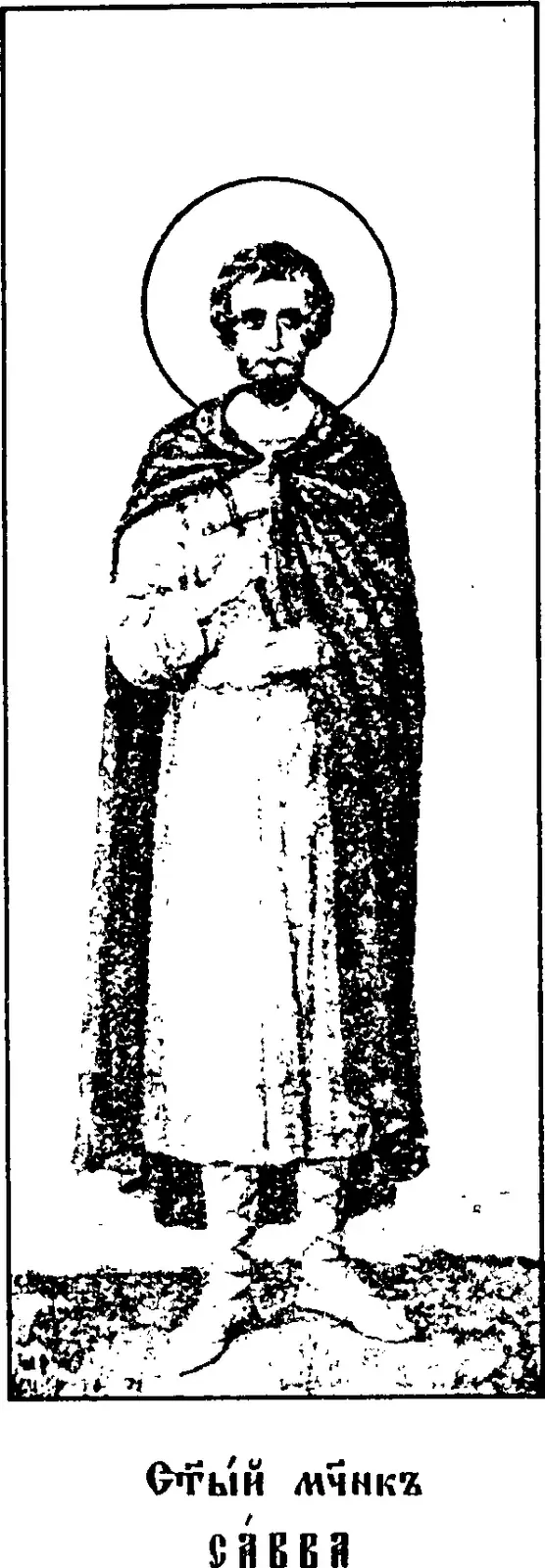
- Died
- Drowned on April 12, 372, in the river Musaeus, says Butler 1; in the Buzau, says Santi e Beati 5
- Account
- A letter from the church in Gothia to the church of Cappadocia, sent with his body 1
Saint Sabas the Goth was a Christian among the Goths beyond the Danube who would not eat meat sacrificed to the gods, would not let his neighbors swear falsely that there were no Christians in his town, and was drowned for it on April 12, 372. 15 The church in Gothia sent his body to Cappadocia with an account of his death, and Saint Basil the Great wrote of the martyr who had come to him "from wild regions beyond the Danube." 12 His feast is April 12. 7
A persecution among the Goths
Athanaric, ruler of the Goths, began a persecution of the Christians among his people in 370. 15 Butler says the Greeks commemorate fifty-one martyrs who suffered under him, of whom the most famous are Nicetas and Sabas. 1 Santi e Beati places it in ancient Dacia, roughly the Romania of today. 5
The Christians of Gothia had received the faith, Butler says, from priests and other captives the Goths had carried off from Galatia and Cappadocia in their raids in the reign of Valerian. 1 The account of Sabas's death was addressed to the churches of Cappadocia, where Saint Basil was metropolitan. 1
Sabas
Sabas was a Goth by birth, converted to the faith in his youth. 1 Butler, drawing on the letter of the church in Gothia, describes a man who was "affable to all men, yet with dignity; a lover of truth, an enemy to all dissimulation or disguise, intrepid, modest, of few words, and a lover of peace." 1 His great delight was to sing the praises of God in the church and to adorn the altars, and he often spent whole days and nights in prayer. 1
The meat and the oath
The persecution took the form of a test: Christians were made to eat meat that had been sacrificed to the gods. 15 Some pagans with Christian relatives found a way round it. They arranged with the officials to serve their kinsmen ordinary meat instead, so that the Christians could be seen to eat and the decree be satisfied. 15 Sabas would have none of it. He refused the meat and said aloud that whoever ate it had renounced the faith. 1 Butler says this kept many from falling and angered others, who drove him out of the town, though he was allowed back some time later. 15
When an officer of the king came looking for Christians, some of the townspeople offered to swear on the sacrifices that there were none in the place. Sabas stepped forward. "Let no man swear for me: for I am a Christian." 15 The leading men hid the other Christians and swore that there was only one. The officer had Sabas brought before him, asked what he owned, and was told he had nothing but the clothes he wore. "Such a fellow can do us neither good nor harm," he said, and let him go. 1
Santi e Beati reads the two episodes as evidence of how reluctantly the local officials sometimes persecuted their own neighbors for reasons of state. 5
Easter, 372
The persecution was renewed with greater force in 372. Butler places the renewal "before Easter"; Santi e Beati says it came two years after the first. 15 Sabas set out to keep the feast with a priest named Gouttica in another town, but on the road, Butler says, he was warned by God to turn back and keep it with the priest Sansala instead. 1
On the third night after Easter a band of armed men under Atharidus, the son of a local chief, broke into Sansala's lodging. They bound the priest and threw him on a cart, and dragged Sabas from his bed naked over thorns and briars, beating him as they went. 1 In the morning he asked them to look at his feet and his back for wounds, and they could find none. 1
They tied his outstretched arms to the axle of a cart and his feet to another, and left him like that through most of the night. 1 When they had gone to sleep, the woman of the house untied him. He did not run. He spent the rest of the night helping her prepare food for the household. 1
By water and wood
The next day Atharidus had him hung from a beam and sent him and the priest meat from the sacrifices. Both refused, and Sabas said: "This pernicious meat is impure and profane, as is Atharidus himself who sent it." 1 One of the slaves drove the point of a javelin against his chest so hard that everyone thought him dead. "Do you think you have slain me? Know, that I felt no more pain than if the javelin had been a lock of wool." 1
Atharidus ordered him killed. Sansala was let go, and Sabas was led to the river, praising God the whole way. 1 At the bank the men taking him began to say to each other that he was innocent and that Atharidus would never know if they let him go. Sabas asked them why they were delaying. "I see what you cannot: I see persons on the other side of the river ready to receive my soul." 1 They threw him in with the axle still fastened about his neck, and he drowned. 1
The letter of the church in Gothia, as Butler gives it, says he died "by water and wood, the symbols of baptism and the cross," on April 12, 372, when Valentinian and Valens were emperors. 1 Butler calls the river the Musaeus, in Wallachia. Santi e Beati names it as the Buzau, and puts the place probably near Targoviste, northwest of Bucharest. 15
A letter to Cappadocia
The body was left on the bank, and the Christians of the place kept birds and beasts away from it. 1 Junius Soranus, duke of Scythia, "a man who feared God," had it carried to his own country, Cappadocia, and with it went the letter describing the martyrdom. 1 It ends, in Butler's version: "Wherefore offering up the holy sacrifice on the day whereon the martyr was crowned, impart this to our brethren, that the Lord may be praised throughout the Catholic and Apostolic Church for thus glorifying his servants." 1
Butler identifies the writer, "in all appearance," as Ascholius, bishop of Thessalonica, because Saint Basil, bishop of Caesarea in Cappadocia, wrote to Ascholius to thank him for an account of martyrs and for a martyr's body. 1 Basil's letters survive. In one he thanks Ascholius for a letter that put the martyrs' "good fight so plainly before me that I seemed actually to see it," and for "a martyr" who "travelled to me from wild regions beyond the Danube, preaching in his own person the exactitude of the faith which is there observed." He recalls "the block and the water whereby the martyrs died." 2 In another he writes that Ascholius has honored the land of his birth by sending it a martyr, "just as a grateful gardener might send his first fruits to those who had given him the seeds." 3 Basil does not name the martyr. 23
Butler adds that Soranus was a relation of Basil, and that Basil had written to him to ask for relics of the martyrs of that persecution. 1 The letter Butler means carries no address in the translation read for this page, but it ends: "If you send the relics of the martyrs home you will do well; as you write that the persecution there is, even now, causing martyrs to the Lord." 4
What is Saint Sabas the Goth the patron saint of?
Saint Sabas the Goth's feast day
Saint Sabas the Goth's feast day is April 12, the day he died. 17 Butler says both the Greek and the Latin Martyrologies mention him. 1 The 1897 English edition of the Roman Martyrology enters him on April 12 "in Cappadocia," where his relics went, adding that many orthodox Goths, "as is attested by St. Augustine," were martyred at that time. 6 The current Roman Martyrology, as the Italian bishops print it, keeps him on the same day: in the persecution of Athanaric, three days after Easter, having refused to eat the meat offered to idols, he was thrown into the river after cruel torments. 7
Praying with Saint Sabas
The story of Sabas turns on a meal. His neighbors had found a way to make it harmless, a quiet exchange of meat that let everyone keep the law and keep the faith, and he refused it and said why. 15 It cost him his home for a time. 1
He did the same thing over the oath. The town was ready to lie on his behalf, kindly, and he stepped out and named himself. 15 The officer looked at a man with nothing but his clothes and decided he did not matter. 1
The night before he died the woman of the house untied him. He did not escape; he spent the hours helping her cook. 1 At the river his guards wanted to spare him, and he would not let them. 1
Basil, reading the account far away in Caesarea, felt that he had gone back to the early Church, when "the blood of the martyrs, watering the Churches, nourished many more champions of true religion." 2 The letter from Gothia asked that the story be told so that God would be praised throughout the Church. 1
Saint Sabas the Goth, pray for us.
Sources
- 1.Alban Butler, "St. Sabas the Goth, M.," April 12, in The Lives of the Fathers, Martyrs, and Other Principal Saints, Vol. IV (Dublin: James Duffy, 1866).
- 2.Basil of Caesarea, Letter 164, to Ascholius, trans. Blomfield Jackson, Nicene and Post-Nicene Fathers, Second Series, Vol. 8 (Buffalo, 1895), revised for New Advent.
- 3.Basil of Caesarea, Letter 165, to Ascholius, trans. Blomfield Jackson, Nicene and Post-Nicene Fathers, Second Series, Vol. 8 (Buffalo, 1895), revised for New Advent.
- 4.Basil of Caesarea, Letter 155 (without address), trans. Blomfield Jackson, Nicene and Post-Nicene Fathers, Second Series, Vol. 8 (Buffalo, 1895), revised for New Advent.
- 5."San Saba il Goto," Santi, beati e testimoni (santiebeati.it) (in Italian).
- 6.The Roman Martyrology, April 12 (Baltimore: John Murphy & Co., 1897).
- 7.Roman Martyrology, entries for April 12, Santo del giorno, Conferenza Episcopale Italiana (in Italian).
Saints to turn to next
Others in this collection who are turned to for some of the same things.