Saint Roque González de Santa Cruz
1576 - November 15, 1628
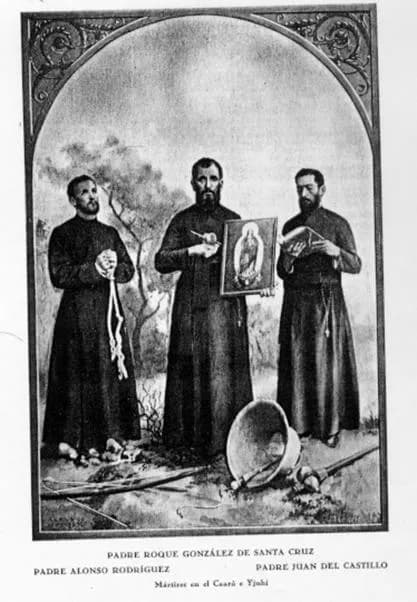
- Died
- November 15, 1628, at Caaró, killed with Alfonso (or Alonso) Rodríguez; Juan del Castillo was killed two days later 235
- Canonized
- May 16, 1988, by John Paul II at Asunción 1
Saint Roque González de Santa Cruz was a priest of Asunción who gave up a parish at its cathedral to become a Jesuit, and spent the next twenty years founding mission towns for the Guaraní along the Paraná and Uruguay rivers. 146 He was killed at Caaró on November 15, 1628, and when John Paul II canonized him in his own city in 1988 he became the first saint of Paraguay. 12 Two Spanish Jesuits died with him, Alfonso Rodríguez and Juan del Castillo, and the Church keeps the three together. 13
A priest of Asunción
He was born in Asunción in 1576. 14 ACI Prensa records that he showed his piety early, leading a Eucharistic procession through the woods at the age of fourteen. 4 As a boy he learned Guaraní alongside Spanish, which mattered for everything that followed. 8
He was ordained young: at twenty-two according to ACI Prensa, at twenty-three according to Aleteia. 48 Bishop Martín Ignacio de Loyola soon made him parish priest of the cathedral of Asunción, and John Paul II, preaching in that city almost four centuries later, still introduced him to the crowd as their cathedral's parish priest. 14 Meg Hunter-Kilmer, writing for Aleteia, says his ability marked him early as a likely bishop, and that he joined the Jesuits partly to escape that prospect, since Jesuits were seldom made bishops. 8 He entered the Society of Jesus on May 9, 1609. 4
The reductions
The Jesuits reached Paraguay in 1587. 9 Anton Huonder, writing for the Catholic Encyclopedia in 1911, explains why they turned from traveling missions to settled towns. The obstacle was the encomienda, which in its harsher form made the natives "yanaconas, or slaves," of the colonists, and taught them to hate the religion of their oppressors. 9 The new watchword was "liberty for the Indians," and the method was to gather converts into separate villages run by the missionaries alone, with the settlers kept out. These were the reductions. 69
Two years after entering the Society, according to ACI Prensa, Roque was made superior of San Ignacio Guazú, which it calls the first reduction in Paraguay. 4 Bert Ghezzi, whose account appears on IgnatianSpirituality.com, presents San Ignacio as the first reduction Roque established and quotes his own description of it. The town "had to be built from its very foundations," Roque wrote, and he laid it out "in the style of the Spaniards, so that everyone should have his own house, with fixed boundaries and a corresponding yard." 6 Mass on Sundays came with a sermon and catechism, adults were taught in separate groups of about 150 men and as many women, and after lunch there were two hours of reading and writing. 6 Baptisms were spaced out by the farming year. "Among the 120 or so adults baptized this year," he reported, "there were several elderly shamans." 6
More towns followed. On March 25, 1615, by the date in one ACI Prensa account (March 22 in another), he founded the reduction of Itapúa, on the site of present-day Posadas in Argentina; it was later moved across the river to what is now Encarnación, Paraguay. 45 Concepción followed in 1619 and Candelaria in 1627. 4 John Paul II listed the places that entered history through Roque and his companions: Itapúa, Santa Ana, Yaguapoá, Concepción, San Nicolás, San Javier, Yapeyú, Candelaria, Asunción del Yjuhí and Todos los Santos Caaró. 1
The pope credited Roque with speaking for the rights of the Indians before the authorities of Asunción and the Río de la Plata, and with helping to end the yaconazgo, a form of personal servitude, in that region and to curb the abuses of the encomienda. 1 ACI Prensa quotes a letter to his brother Francisco in which he says, in substance, that the Jesuits were working for justice, and that the Indians were exempt by natural, divine and human law from the slavery and harsh personal service they were living under. 4
The Society of Jesus's own page on him stresses the language. He learned Guaraní well enough to teach it to other missionaries, tried to understand how the people lived and thought, and was regarded by them "as a father who lavished himself on their behalf." 7 Ghezzi prints the testimony of a cacique named Guarecupi after Roque's death: "All the Christians among my countrymen loved the Father and grieved for his death because he was the father of us all." 6
The Conquistadora
Roque carried a painting of the Virgin Mary with him and preached with it held in front of him. 5 He called her the Conquistadora, the one who won hearts, and ACI Prensa reports a tradition that he sometimes had only to raise the picture and people would be converted without a word being spoken. 4 John Paul II said that all three martyrs invoked Mary under that title, Virgen Conquistadora, in their longing to win souls for God. 1
Caaró, 1628
In 1628 Roque was working with two Spanish Jesuits, Alfonso Rodríguez, born at Zamora, and Juan del Castillo, born at Belmonte in Cuenca. 1 (The homily and the Martyrology call the first Alfonso; ACI Prensa and Ghezzi call him Alonso. 1256) They had begun a reduction on the Ijuí River and another at Caaró, in what is now southern Brazil. 56 Not everyone welcomed them. ACI Prensa names Ñezú, the Guaraní cacique of the Ijuí district, who refused to live in a reduction and set himself against Roque. 5
On November 15, 1628, Roque said Mass near Caaró. 4 He and Alfonso Rodríguez were killed that day with a stone hatchet, and their bodies were thrown into a fire. 45 The Roman Martyrology says they were ambushed by the hired killer of a sorcerer, and that they died for having brought the dispossessed native peoples to Christ through the reductions. 2 Two days later Juan del Castillo, left in charge of the reduction Roque had founded that year, was tortured on the same sorcerer's orders and stoned to death. 35
ACI Prensa adds that none of the Jesuits martyred in the region died at the hands of Guaraní from the reductions; they were killed by people from other groups who did not know them, or by the Paulistas, slave hunters from São Paulo who treated the missionaries as enemies because they defended the Indians. 4
The heart
Roque's body burned, but his heart was found whole. 45 ACI Prensa relays the testimonies recorded afterward, in which some of those present heard a voice that seemed to come from the heart, calling them to repent, and each heard it in his own language. 5 The heart, still incorrupt, was taken to Rome along with the stone hatchet; it came back to Paraguay in 1960 after a short stay in Argentina, and both are kept in the Chapel of the Martyrs at the Colegio de Cristo Rey in Asunción. 45 A plaque in the same chapel lists twenty-three Jesuit missionaries martyred in the region. 4
John Paul II spoke of the heart in his homily, calling it an eloquent image of a Christian love able to overcome every human limit, even death. 1 Pope Francis prayed before the relic on July 12, 2015, and his spokesman, Fr. Federico Lombardi, said afterward that Francis had a particular devotion to Roque, as pope more than as a Jesuit. 5
What is Saint Roque González the patron saint of?
ACI Prensa calls Saint Roque González the founder and patron of two cities, Posadas in Argentina and Encarnación in Paraguay, since both trace themselves to the reduction of Itapúa he founded in 1615. 45 No source read for this page names him patron of a cause or a profession. John Paul II proposed him and his companions as models of evangelizers, and called him the first saint of Paraguay. 1
Saint Roque González's feast day
Saint Roque González's feast day is November 15 in the Roman Martyrology, which enters him with Alfonso Rodríguez on the day they died. 2 Other sources give other days. ACI Prensa says the Church celebrates him every November 16, and Aleteia calls November 17 his feast day. 58 November 17 is the date on which the Martyrology enters Juan del Castillo. 3 He was beatified in 1934 according to Ghezzi, in 1931 according to ACI Prensa, and canonized at Asunción on May 16, 1988. 146
Praying with Saint Roque González
A great deal of his life went on things that are not usually called prayer: laying out house lots, pleading for the Indians before the colonial authorities, teaching the alphabet after lunch. 16 In a letter of October 8, 1613, which John Paul II quoted at the canonization, Roque wrote that however busy they had been, the missionaries had never once dropped their spiritual exercises. 1 The pope set beside it a line of Saint Ignatius, that the means which join the instrument to God are more effective than those which fit it for dealing with people, and said the reductions were possible because of that union. 1
He went to the Guaraní in their own language. The Jesuit page on him dwells on how hard he worked to understand how they lived and thought, and Ghezzi preserves the testimony of a cacique who called him "the father of us all." 67 Guarecupi said it after Roque was dead, and added that this was what the Indians of the Paraná River called him. 6
And he was killed anyway, by people who saw the reductions as a threat. 15 The homily insists that he never sought death with gestures of arrogant defiance, and that the martyrs accepted it because their love, built on faith and hope, would not give way under the blows of their executioners. 1 The story of the heart that spoke to its killers is told as testimony, and what the voice is said to have asked of them was repentance. 5 Nothing in the sources says whether any of them listened.
Saint Roque González de Santa Cruz, pray for us.
Sources
- 1.John Paul II, homily for the canonization of Roque González, Alfonso Rodríguez and Juan del Castillo, Campo Ñu Guazú, Asunción, Paraguay, May 16, 1988 (in Spanish).
- 2.Roman Martyrology, entry for November 15, "Santi Rocco González e Alfonso Rodríguez, sacerdoti," as printed in "Santo del giorno," Conferenza Episcopale Italiana (in Italian).
- 3.Roman Martyrology, entry for November 17, "San Giovanni del Castillo," as printed in "Santo del giorno," Conferenza Episcopale Italiana (in Italian).
- 4."San Roque de Santa Cruz y Compañeros Mártires," Santos, ACI Prensa (in Spanish).
- 5."Hoy celebramos a San Roque González de Santa Cruz SJ y compañeros mártires del Paraguay," ACI Prensa, November 15, 2025 (in Spanish).
- 6.Bert Ghezzi, "St. Roque González, SJ (1576-1628)," from Voices of the Saints, IgnatianSpirituality.com (Loyola Press).
- 7."Saint Roque González," Society of Jesus (General Curia), based on the letter of Fr. Peter-Hans Kolvenbach, SJ, Superior General, April 22, 1988.
- 8.Meg Hunter-Kilmer, "St. Roque Gonzalez: A model of blending Christianity and culture," Aleteia, November 11, 2017.
- 9.Anton Huonder, "Reductions of Paraguay," The Catholic Encyclopedia, Vol. 12 (New York: Robert Appleton Company, 1911).
Saints to turn to next
Others in this collection who are turned to for some of the same things.