Saint Romanus the Melodist
c. 490 - after 555
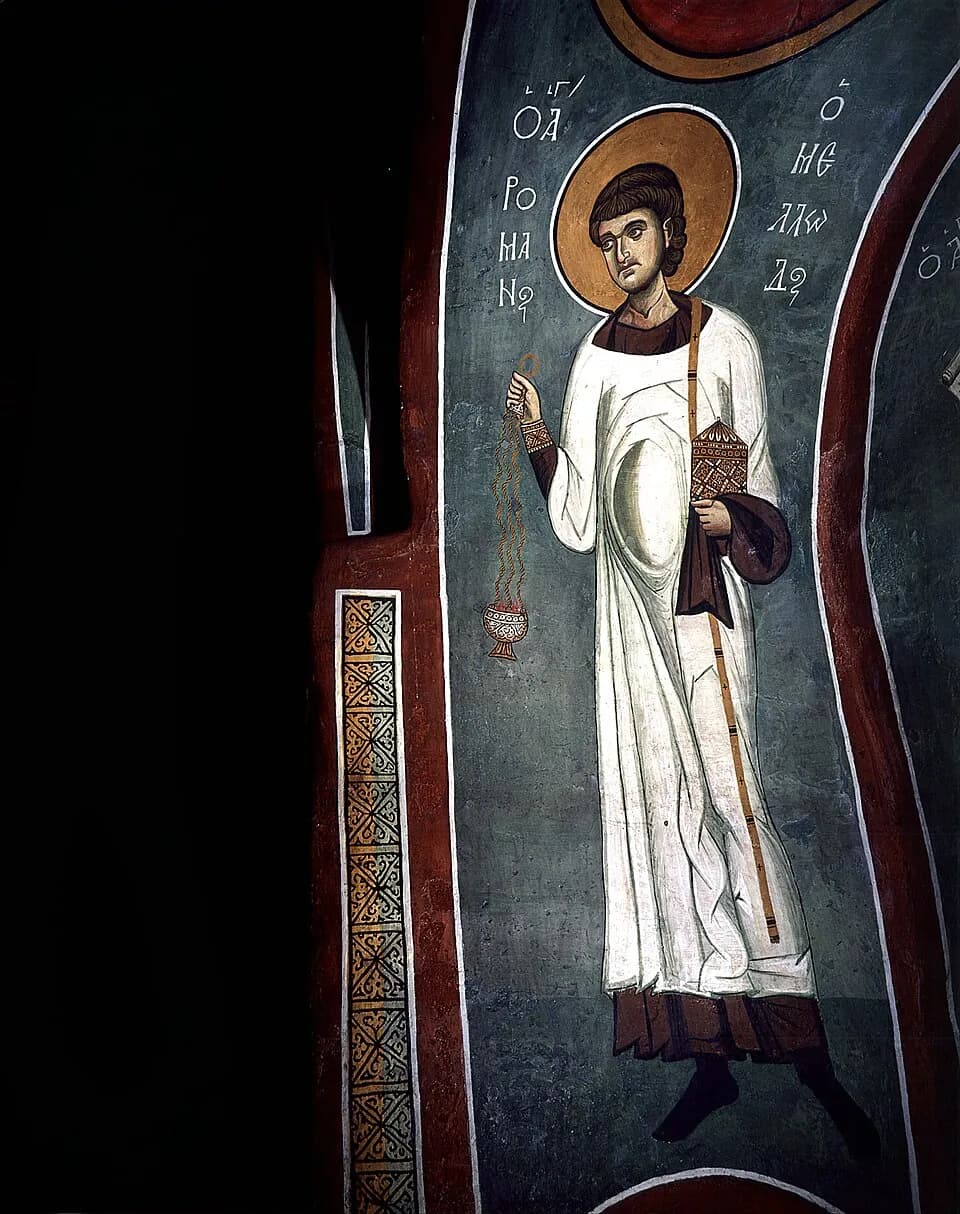
- Born
- About 490, at Emesa (today Homs), Syria, according to Benedict XVI; the Catholic Encyclopedia says only that he was a Syrian 12
- Died
- After 555, according to Benedict XVI 1
- Feast day
- October 1, according to the Catholic Encyclopedia 2
Saint Romanus the Melodist was a Syrian deacon in sixth-century Constantinople who preached in song, composing long hymns in verse called kontakia and singing them from the ambo. 12 The 1912 Catholic Encyclopedia calls him the greatest of Greek hymn writers, and records a critic's verdict that he might one day be acclaimed "the greatest ecclesiastical poet of all ages." 2 Benedict XVI counted him among the theologians who "transformed theology into poetry." 1 The encyclopedia gives his feast as October 1. 2
From Syria to Constantinople
Benedict XVI says he was born about 490 at Emesa, the city now called Homs, in Syria. 1 The encyclopedia says only that he was a Syrian by birth, and adds that the one real authority for his life is a short entry in the Greek service book for October. 2 Benedict draws the same account from the Synaxarion, the Byzantine book of saints' lives. 1
He learned Greek and Syriac culture at home, Benedict says, and then moved to Berytus, modern Beirut, to finish his classical education and his training in rhetoric. 1 He was ordained a deacon there, which Benedict dates to about 515, and preached in Berytus for three years. 12
He then went to Constantinople, during the reign of the Emperor Anastasius. 12 The encyclopedia explains that scholars had argued over which Anastasius was meant, and that Karl Krumbacher made it "fairly certain" it was Anastasius I, who reigned from 491 to 518. 2 Benedict XVI dates the move to about 518, near the end of that reign, and says Romanus settled in the monastery beside the Church of the Theotokos, the Mother of God. 1
The scroll
The entry in the service books tells a dream, and both sources pass it on as the Menaion or the Synaxarion records it. 12 After a retreat at Blachernae, the encyclopedia quotes, Romanus returned to his church, "and one night in his sleep saw a vision of the Most Holy Theotokos, who gave him a volume of paper, saying, 'Take the paper and eat it'." 2 He swallowed it in the dream. 12
He woke on Christmas morning, the account continues, went up into the ambo and began to sing. 12 Benedict XVI gives the opening line of that first hymn as "Today the Virgin gives birth to the Transcendent." 1 From then until his death, Benedict says, he was a "homilist-cantor." 1
The encyclopedia adds a later history to the story. 2 Until the twelfth century the Christmas hymn was still sung at the imperial banquet on the feast by a double choir drawn from Hagia Sophia and the Church of the Holy Apostles. 2
The kontakion
Benedict XVI explains that in his time the homily was nearly the only instruction in the faith most people received, and that Romanus made his homilies into song. 1 He preached in a sanctuary on the edge of the city, from an ambo in the center of the church, and Benedict says he pointed to the paintings and icons around the ambo as he went and even used dialogue. 1 The word kontakion, Benedict suggests, comes from the "little rod" around which a scroll was wound. 1
Each hymn was a set of strophes built on the pattern of the first, with a refrain at the end of each. 12 The encyclopedia gives the usual form as twenty-five strophes of about twenty-one verses; Benedict XVI says most have between eighteen and twenty-four. 12 The first letters of the strophes spell out the author's name, Benedict notes, often with the word "humble" before it, and the hymn ends with a prayer. 1
He did not write in the formal Greek of the imperial court. 1 Benedict says he used the plain Greek of ordinary people, and the encyclopedia says the dramatic dialogue and "simple sincerity of tone" sometimes recall the Latin hymns of the Middle Ages. 12 Benedict counts eighty-nine kontakia that survive under his name, of the thousand tradition gives him. 1 The encyclopedia lists a Christmas hymn, an Easter hymn, and hymns on the Cross, on Judas, on Peter's denial, and on the Virgin at the cross. 2
Mary at the cross
The hymn Benedict XVI chose to quote at length is the one for Good Friday, a dialogue between Mary and her Son on the way to the cross. 1 Mary asks, "Where are you going, my Child? For whose sake are you finishing this swift race?" 1 He answers her: "Why, mother, do you weep?... Lest I suffer? Lest I die? How then should I save Adam?" 1
In another hymn, on the sacrifice of Isaac, Romanus gives Sarah a voice the Bible does not, and has Abraham imagine her objection: "If the one who has given it desires to repossess it why did he give it?" 1 Benedict notes that Romanus mentions the Virgin at the end of almost every hymn, out of gratitude for his gift, and wrote some of his finest kontakia for her. 1
His Pentecost hymn turns the apostles into fishermen again, Benedict XVI notes, with the Cross for a pen and the word of God for a hook: "they used words like 'fishing nets' and set them to 'catch' the world." 1 Benedict says the themes he returned to most were the unity of God's action across the Old and New Testaments, the Holy Spirit, and Christ. 1
He kept away from the technical disputes over Christ's natures that were dividing theologians in his day. 1 Benedict says he preached the simple Christology of the great councils instead, and quotes one line: "Christ was a man, but he was also God, yet he was not divided in two." 1
Forgotten and found
The encyclopedia says his fame was nearly extinguished by the newer school of hymn writers that flourished in the eighth and ninth centuries. 2 After the passage in the Menaion, it finds only two other mentions of his name in Byzantine writing, one of them in the eighth-century poet Saint Germanos, and one in the Byzantine lexicon called the Suidas, which calls him "Romanos the melode." 2
Nineteenth-century scholarship revived his reputation. 2 The encyclopedia names editions of his hymns by Pitra in 1876 and 1888, and quotes Krumbacher: "In poetic talent, fire of inspiration, depth of feeling, and elevation of language, he far surpasses all the other melodes." 2 Some, it adds, called him the Christian Pindar. 2
What is Saint Romanus the Melodist the patron saint of?
Saint Romanus the Melodist's feast day
Praying with Saint Romanus the Melodist
Benedict XVI put his whole audience on one claim: "Faith is love and therefore creates poetry and music. Faith is joy, therefore it creates beauty." 1 Romanus is the case he made it with, a preacher who sang. 1
He wrote for people who had no other teacher, in their own language, and he let the characters of Scripture speak and argue. 1 Mary asks her Son where he is going; Sarah wants to know why God would give a child only to ask for him back. 1 Those are questions people still bring to prayer, and the hymns let them be asked.
He also prayed that his life would match his preaching. 1 Benedict quotes him: "Make my language clear, my Saviour, open my mouth and, after filling it, penetrate my heart so that my acts may correspond to my words." 1
Benedict noticed that Romanus put charity ahead even of continence, in his hymns on the wedding at Cana and the ten virgins: five virgins kept their virginity and it "proved unfruitful," while the others "shone with their lamps of love for humanity." 1
Saint Romanus the Melodist, pray for us.
Sources
Saints to turn to next
Others in this collection who are turned to for some of the same things.