Saint Reparata
Third century
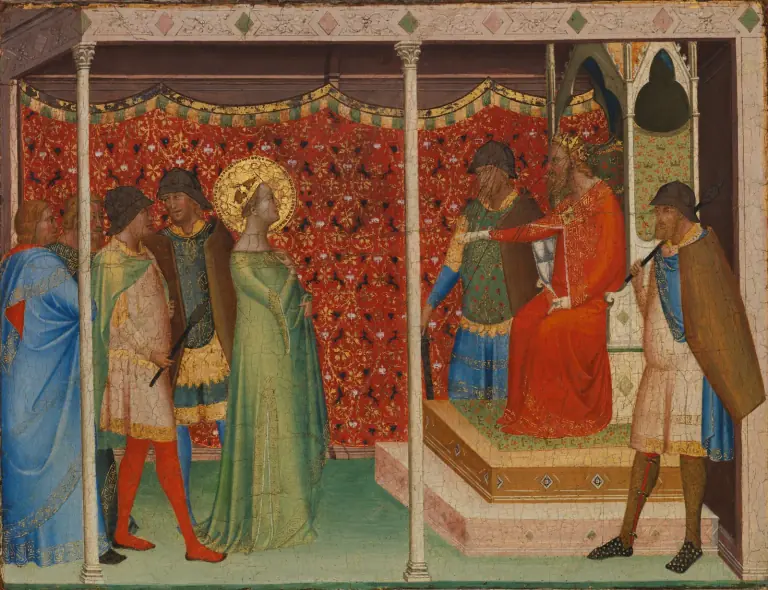
- Died
- At Caesarea in Palestine, according to her legend 134; under Decius, about 250, say katolsk.no and the 1897 Martyrology 13; probably later, says Aleteia 5
- Age
- Between eleven and twenty in the sources; fifteen at the cathedral of Nice 1
- Earliest record
- A ninth-century manuscript of the Martyrology of Bede 1
- Patroness of
- Nice and its diocese 145; co-patroness of Florence with Saint Zenobius 1; the diocese of Teano 1
- Churches
- The cathedral of Nice, dedicated to Mary and to her 4; the former cathedral of Santa Reparata at Florence 1
- Emblems
- A white banner with a red cross; a dove; a crown and palm 1
Saint Reparata is honored as a virgin martyr of Caesarea in Palestine, said to have been put to death as a girl under the emperor Decius, and as the patroness of Nice and one of the patrons of Florence. 134 Nothing about her life can be verified: her story is known only from a legend first attested centuries later, and the Norwegian bishops' saints database allows that she may never have existed. 1 The current Roman Martyrology no longer tells her story at all, and remembers her simply as venerated in various places as virgin and martyr. 2
What the legend tells
According to the legend, Reparata was a Christian girl of Caesarea Maritima, denounced during the persecution of Decius around 250. 1 katolsk.no gives the usual version: twelve years old, she was tortured, thrown into a furnace and walked out unharmed, and still refused to sacrifice to the Roman gods; forced to drink boiling pitch, she again survived, and was finally beheaded. 1 As her head fell, a white dove flew up toward heaven. 1
The 1897 English Roman Martyrology told the same story in brief: at Caesarea, under the emperor Decius, she refused to sacrifice to idols, "was subjected to various kinds of torments, and finally was struck with the sword. Her soul was seen to go out of her body in the shape of a dove, and ascend to heaven." 3 Later versions, katolsk.no says, grew more elaborate and more cruel. 1
At Nice the legend has a sequel. Her body, katolsk.no says, was laid in a boat and carried by the breath of angels, guided by a dove, to the bay now called the Baie des Anges, where it was found covered with roses, lilies and palms. 1 Anne Bernet, telling the story for Aleteia in 2021, describes fishermen who saw a boat with sails coming in on a windless sea, and found that the sails were the wings of angels. 5
What can be known
Very little. katolsk.no says she is known only from an unreliable legend of the ninth century, and that the earliest evidence of her cult is the middle of that century, when her name appears in a manuscript of the Venerable Bede's martyrology from the monastery of Lorsch. 1 Eusebius of Caesarea, who wrote a whole book on the martyrs of Palestine, never mentions her, and katolsk.no points out that he would have known if a girl had been martyred in his own episcopal city. 1
Aleteia takes a gentler view. Bernet thinks the traditional date of 250 or 251 is probably wrong, since the persecution of Decius produced more apostates than martyrs, but she finds it entirely plausible that a Christian virgin named Reparata died in one of the savage persecutions that struck Palestine at the end of the third century and the beginning of the fourth. 5 The name itself, she suggests, may have been a baptismal name, alluding to innocence restored. 5 The sources disagree even on her age: katolsk.no says they range from eleven to twenty, and the cathedral at Nice gives fifteen. 1
The legend also resembles others. katolsk.no compares the boat guided by angels to the stories of Restituta of Carthage, of Devota, patroness of Monaco and Corsica, and of Torpes of Pisa, and Aleteia adds the Provençal tradition of the companions of Christ who came ashore in the Camargue. 15
Florence and Nice
Her cult spread widely in medieval Europe, especially in Italy, where katolsk.no names Florence, Atri, Naples and Chieti. 1 At Florence she was the principal patron of the city until about 1298, when it was placed under the protection of the Virgin Mary and John the Baptist. 1 The old cathedral of Florence was dedicated to her, and she remains the city's co-patroness with its first bishop, Saint Zenobius. 1 Painters and sculptors from Arnolfo di Cambio and Andrea Pisano to Bernardo Daddi and Fra Bartolomeo portrayed her. 1
At Nice her cult is documented from the eleventh century, in a chapel belonging to the abbey of Saint-Pons, where she was invoked against plague and cholera; by the seventeenth century, katolsk.no says, she had been chosen patroness of the city and the diocese. 1 Relics brought from Florence by a man of Nice, Rostaing Raimbald, were kept in a chapel in the old town and moved into the cathedral in 1690. 1 That cathedral was consecrated on May 2, 1699. 4
John Paul II wrote to the bishop of Nice for the three hundredth anniversary. 4 The cathedral, he said, is dedicated to the Virgin Mary, Mother of the Church, and to Saint Reparata, whom the Roman Martyrology presents as a virgin from Caesarea in Palestine and a martyr who refused to sacrifice to idols. 4 He closed by invoking the Virgin and Saint Reparata for the people of the diocese. 4 katolsk.no adds that she is also patroness of the diocese of Teano in Italy, which claims to have received her relics in the ninth century, by a route nobody can trace. 1
What is Saint Reparata the patron saint of?
Saint Reparata is the patroness of the city and diocese of Nice, co-patroness of Florence with Saint Zenobius, and patroness of the diocese of Teano, according to katolsk.no. 1 She was invoked at Nice against plague and cholera, and katolsk.no adds that many Catholics today ask her intercession for the young. 1 In art she carries a white banner with a red cross, or appears with a dove, crowned and holding a martyr's palm, or seated in a furnace. 1
Saint Reparata's feast day
Saint Reparata's feast day is October 8. 12 The current Roman Martyrology, as the Italian bishops print it, keeps a commemoration of her that day as one venerated in various places as virgin and martyr; katolsk.no prints the Latin: "Commemorátio sanctæ Reparátæ, quæ divérsis in locis virgo et martyr cólitur." 12 Aleteia gives the same day for her feast at Nice. 5
The older Martyrology said much more. The 1897 English edition placed her on October 8 "at Caesarea, in Palestine," under Decius, with her torments, the sword and the dove. 3 Between that edition and the present one the legend has dropped out of the Martyrology, and only the commemoration remains. 23
Praying with Saint Reparata
There is almost nothing to know about her, and the Church's own calendar now says only that she is honored in many places. 2 What can be seen is the honor itself: a city that named its cathedral for her, another that put itself in her care, people who prayed to her in times of plague. 14
The legend that carried her to those places is about a girl who would not offer incense to the gods of the empire, however many times they tried. 13 Aleteia, which doubts the details, still holds that she died for Christ in the flower of her youth. 5
John Paul II, writing to the people of Nice, did not try to settle any of the questions. He commended them to the Virgin and to Saint Reparata, and asked that the anniversary strengthen their faith and their love for the Church. 4
Saint Reparata, pray for us.
Sources
- 1."Den hellige Reparata av Caesarea (~250)," Den katolske kirke (katolsk.no), Catholic Diocese of Oslo (in Norwegian).
- 2.Roman Martyrology, entry for October 8, "Santa Reparata, vergine e martire," as printed in "Santo del giorno," Conferenza Episcopale Italiana (in Italian).
- 3.The Roman Martyrology, October 8 (Baltimore: John Murphy Company, 1897).
- 4.John Paul II, Letter to Bishop Jean Bonfils of Nice for the 300th anniversary of the consecration of the cathedral, April 20, 1999, Libreria Editrice Vaticana (in French).
- 5.Anne Bernet, "Sainte Réparate et la légende de la Baie des Anges," Aleteia, October 7, 2021 (in French).
Saints to turn to next
Others in this collection who are turned to for some of the same things.