Saint Rabanus Maurus
c. 780 - February 4, 856
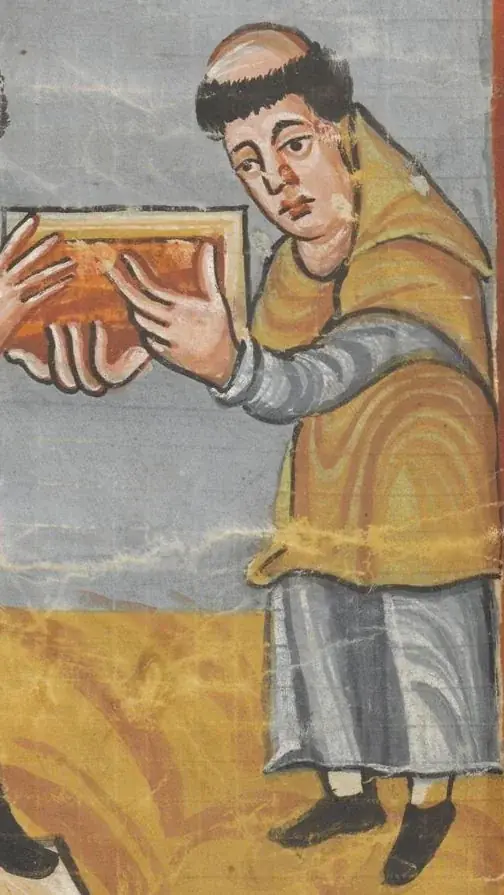
- Also called
- Hrabanus, Rhabanus, Maurus Magnentius Rabanus; "praeceptor Germaniae," the teacher of Germany 123
Saint Rabanus Maurus was a monk of Fulda who became its abbot and later Archbishop of Mainz, and the most learned churchman of the Carolingian age, remembered as the "praeceptor Germaniae," the teacher of Germany. 12 Benedict XVI called him "a truly extraordinary figure of the Latin West" and thought it likely that the Church owes him the hymn "Veni Creator Spiritus." 1 He died on February 4, 856, and his feast is February 4. 24
An oblate of Fulda
He was born at Mainz, about 780 according to Benedict XVI and santiebeati, about 776 or perhaps 784 according to the Catholic Encyclopedia. 123 As a small child he was given to the Benedictine monastery of Fulda, the house founded by Saint Boniface, as a "puer oblatus." 13 Benedict XVI quotes a line that may describe his own childhood: "There are some who have had the good fortune to be introduced to the knowledge of Scripture from a tender age." 1
He was ordained deacon in 801, and the next year was sent to Tours to study theology and the liberal arts under Alcuin, the great teacher of Charlemagne's court. 23 Alcuin grew fond of him and named him Maurus, after the young disciple whom Saint Benedict loved best. 123 After a year he was called home to teach. 2
He became head of the monastery school, and under him, the encyclopedia says, "Fulda became the most celebrated seat of learning in the Frankish Empire." 2 He was ordained priest in 814. 23 The encyclopedia records that the building mania of Abbot Ratgar held the school back for a time, and that under Abbot Eigil he could give himself again to teaching and writing. 2
Abbot, exile and archbishop
In 822 the monks elected him abbot. 23 The encyclopedia lists what followed: the new buildings finished, more than thirty churches and oratories raised, mosaics and reliquaries for the abbey church, more priests for the country towns, and many books for the library. 2 santiebeati says he brought Fulda to its greatest splendor. 3
He could not stay out of politics. Benedict XVI says he became the adviser of princes and strove to keep the Empire united. 1 In the quarrels among the sons of Louis the Pious he took the emperor's side, and after Louis died in 840 he supported the eldest son, Lothair. 2 When Louis the German defeated Lothair, Rabanus left Fulda, probably, the encyclopedia thinks, to avoid swearing allegiance to the victor. 2 He came back in 841 and resigned the abbacy early in 842, compelled by the king, it is believed. 2
He retired to the Petersberg near Fulda and gave himself to prayer and writing. 23 In 845 he was reconciled with Louis the German, and in 847 he was made Archbishop of Mainz, his native city, and consecrated on June 26. 23 santiebeati counts him the fifth successor of Saint Boniface in that see. 3 As archbishop he held three provincial synods; the second, in 848, condemned the monk Gottschalk of Orbais and his teaching on predestination. 2
The encyclopedia singles out his charity. In the famine of 850, according to the annals of Fulda, he fed more than three hundred people every day. 2 He died on February 4, 856, at Winkel near Mainz according to the encyclopedia, at Mainz according to santiebeati, and was buried in the monastery of Saint Alban at Mainz. 23 His relics were later moved by Archbishop Albrecht of Brandenburg, to Halle according to the encyclopedia, and santiebeati says they have been lost since the Reformation. 23
The Cross in pictures and verse
His first theological work, Benedict XVI says, was a poem: "De laudibus Sanctae Crucis," in praise of the Holy Cross, built so that the image of the crucified Christ appears among the lines of the writing itself. 1 He quotes Rabanus on one of its figures: "every time we raise our eyes to the Cross, let us remember the one who died for us to save us from the powers of darkness." 1
Benedict XVI saw in this a lesson for any age. Rabanus wanted faith to engage not only the mind and the heart but the senses, "mind, soul and body," and so he gave his attention above all to the liturgy, in which every part of human perception is drawn in. 1 "Faith is not only thought," the pope said, "but also touches the whole of our being." 1
The encyclopedia is cooler about the verse: he was "a skillful versifier, but a mediocre poet." 2 On the hymn "Veni Creator Spiritus," Benedict XVI says only that it is likely the Church owes it to him, and santiebeati that some attribute it to him. 13
Teacher of Germany
His works fill at least six volumes of the Patrologia Latina, and the encyclopedia calls him "probably the most learned man of his age." 12 He wrote commentaries on nearly every book of the Bible, drawing, by his own account, on the Fathers so as to serve "the poor reader, who may not have many books at his disposal." 12 Benedict XVI notes that he named his sources honestly and used them freely. 1
For the clergy and people of his diocese he wrote short works that Benedict XVI likens to catechisms, among them "De institutione clericorum" and "De disciplina ecclesiastica," and penitentials listing sins and their penances. 1 His "De universo," an encyclopedia in twenty-two books built on Isidore of Seville, gathered the knowledge of his time; he also wrote on grammar and the reckoning of the calendar, and compiled a martyrology. 23
The encyclopedia does not call him an original thinker: he "followed in the beaten track of his learned predecessors." 2 That was in a sense the point. santiebeati says he passed on to his own age the whole theological learning of the Fathers, and Benedict XVI that he kept alive the culture on which the following centuries drew. 13 Dante places him among the wise spirits in the heaven of the Sun. 3
What is Saint Rabanus Maurus the patron saint of?
Saint Rabanus Maurus's feast day
Saint Rabanus Maurus's feast day is February 4, the day of his death. 23 The current Roman Martyrology, as the Italian bishops publish it, remembers him at Mainz on that day as a monk of Fulda raised to the see of Mainz, a prelate of proven learning and rich eloquence who neglected nothing he could do for the glory of God. 4
Older usage called him Blessed. The Catholic Encyclopedia gives him that title, following Mabillon and the Bollandists, and says his feast was kept on February 4 in the dioceses of Fulda, Mainz and Limburg. 2 Benedict XVI says those dioceses and Breslau venerate him "as a saint or blessed," and santiebeati notes that the recent edition of the Roman Martyrology lists him as a saint. 13
Praying with Saint Rabanus Maurus
He spent his life on books and still ran an abbey and a diocese, and fed hundreds of people a day through a famine. 2 Benedict XVI drew from him the lesson that one can be available to others without giving up the time owed to reflection, study and meditation. 1
Benedict XVI also quoted his warning that those who neglect to make time for God deprive themselves of the vision of his light. 1 For Rabanus, that time was found above all in the liturgy, where words, music and images all serve the one act of worship. 1
He was not a pioneer, the encyclopedia says, and he did not try to be one. 2 He handed on what he had received, and made it easier for the reader with few books to find it. 1
Saint Rabanus Maurus, pray for us.
Sources
- 1.Benedict XVI, "Rabanus Maurus," General Audience, June 3, 2009 (Vatican City: Libreria Editrice Vaticana).
- 2.Michael Ott, "Blessed Maurus Magnentius Rabanus," in The Catholic Encyclopedia, Vol. 12 (New York: Robert Appleton Company, 1911).
- 3.Antonio Borrelli, "San Rabano Mauro," Santi, beati e testimoni (santiebeati.it), with the Roman Martyrology entry (in Italian).
- 4.Roman Martyrology, entries for February 4, Santo del giorno, Conferenza Episcopale Italiana (in Italian).
Saints to turn to next
Others in this collection who are turned to for some of the same things.
- Saint Aelred of Rievaulx1109 - January 12, 1166 (or 1167)PrayerWork and vocationStudy and teaching
- Saint Bertinc. 615 - c. 698 or 709Work and vocationStudy and teachingPrayer
- Saint Dunstanc. 909 or earlier - May 19, 988Work and vocationPrayerStudy and teaching
- Saint Ephremc. 306 - June 9, 373Study and teachingPrayerWork and vocation