Saint Pulcheria
January 19, 399 - July 453
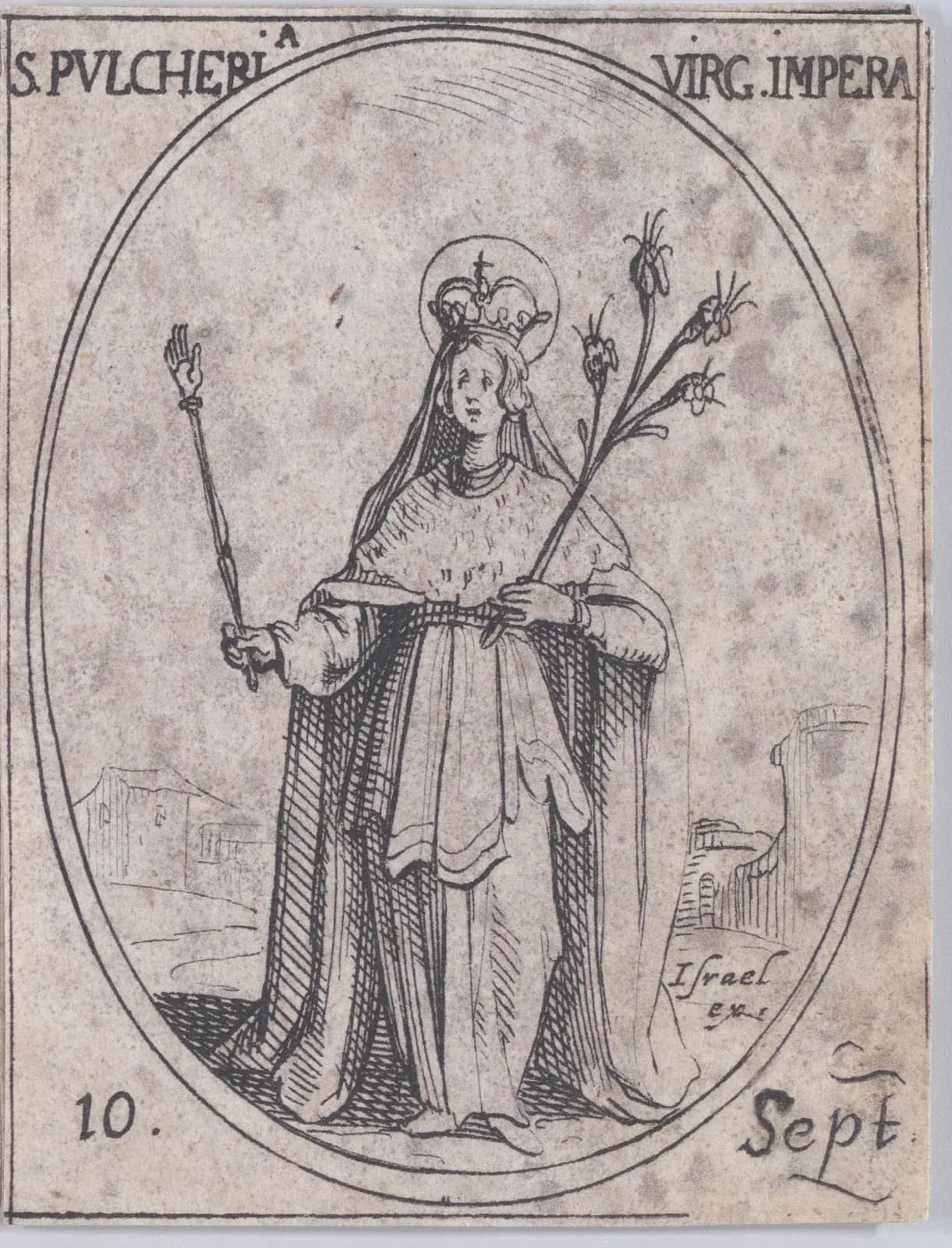
- Emblems
- A lily and a scepter 5
Saint Pulcheria was proclaimed empress at fifteen and governed the Eastern Roman Empire for her younger brother, Theodosius II, having vowed her virginity to God. 12 She used her place at court against the teachings of Nestorius and of Eutyches, and with her husband Marcian, who agreed to respect her vow, she called the Council of Chalcedon. 14 Pope Leo the Great wrote to her that the faith "cannot be disturbed" while she was present to defend it. 4
Regent at fifteen
Pulcheria was born on January 19, 399, a daughter of the emperor Arcadius. 15 J. P. Kirsch, in the 1911 Catholic Encyclopedia, calls her the eldest daughter; the Norwegian bishops' saints database (katolsk.no) says she was the second, after a sister, Flaccilla, who died young. 15 When Arcadius died in 408 he left a son, Theodosius, seven years old, and three daughters, Pulcheria, Arcadia and Marina. 12 katolsk.no adds that she had been baptized by John Chrysostom. 5
Sozomen, who wrote his church history under her brother, says that the princess "was not yet fifteen years of age, but had received a mind most wise and divine above her years." 2 On July 4, 414, the Senate proclaimed her Augusta and regent. 15 Kirsch says she had matured early, had great administrative ability, and soon exerted a healthy influence over a young emperor he calls "not very capable." 1 Sozomen says she could write and speak Greek and Latin "with perfect accuracy," transacted everything in her brother's name, and had him trained in riding, arms and letters. 2 She herself taught him manners: "she showed him how to gather up his robes, and how to take a seat, and how to walk." 2
The same historian is plain about her aims. She "strove chiefly, to lead him into piety, and to pray continuously," and guarded against "the innovation of spurious dogmas." 2 katolsk.no reports two further measures, made in her brother's name: pagans were removed from the administration in 414, and she persuaded him to expel the Jews of Constantinople and destroy their synagogues. 5
A vow and a palace at prayer
Sozomen writes that "She first devoted her virginity to God, and instructed her sisters in the same course of life." 2 To avoid jealousy and intrigue "she permitted no man to enter her palace," and she took God, the clergy and the people of the empire as witnesses of her vow, inscribing it on a gold and jeweled altar she gave to the church of Constantinople. 2 katolsk.no dates the public vow to 414, in Hagia Sophia, and suggests it also secured her position and her brother's, since no ambitious nobleman could marry her. 5
Kirsch says the palace became "almost a monastery." 1 Socrates, the source he cites, says it of Theodosius: "He rendered his palace little different from a monastery: for he, together with his sisters, rose early in the morning, and recited responsive hymns in praise of the Deity." 3 Sozomen describes the sisters eating and walking together, singing God's praises day and night, weaving, and giving to strangers and the poor. 2
He also tells the story he thought best showed her love of God. The relics of the Forty Martyrs of Sebaste had been hidden in a tomb outside the city and forgotten; Sozomen says the martyr Thyrsus and the Forty themselves appeared to her, and after a long search the relics were found and placed beside Thyrsus in a public festival, "at which I was present." 2 Kirsch records only that she had the relics transferred to a church. 1
Against Nestorius
In 421 Pulcheria arranged her brother's marriage. 15 Kirsch calls the new empress Eudoxia; katolsk.no calls her Athenais, the daughter of a pagan scholar of Athens, baptized with the name Eudocia. 15 The two Augustae were soon rivals, and Kirsch says the younger, with the help of courtiers, weakened Pulcheria's influence for a time. 1
When Nestorius became bishop of Constantinople, Pulcheria opposed him, while her sister-in-law supported him. 15 Cyril of Alexandria sent her his treatise on the faith and wrote to her, and the emperor blamed Cyril for appealing to the two empresses. 1 Kirsch concludes: "There is no doubt that the final acknowledgement by the emperor of the condemnation of Nestorius was largely due to Pulcheria." 1 The Nestorians answered with what he calls "gross calumnies" about her. 1
Kirsch credits her with the return of John Chrysostom's body from exile to the church of the Apostles on January 27, 438, which reconciled his followers with the Church. 15 Socrates, whom Kirsch cites for it, gives the initiative to Bishop Proclus, with the emperor's permission. 3 Court intrigue later drove her from the palace. Kirsch says she withdrew in 446 to a suburb and lived a monastic life, returning about 449. 1 katolsk.no gives a longer sequence: she withdrew to the Hebdomon palace in 441, was recalled after Eudocia's exile, left again about 447, and returned in 449. 5
Chalcedon
In 449 the monk Eutyches' teaching on the one nature of Christ was upheld by the council later called the Robber Synod, and the emperor confirmed it. 15 Pope Leo wrote to Pulcheria and her brother asking them to end the heresy, and wrote again and again. 15 Then on July 28, 450, Theodosius died. 15 Pulcheria was proclaimed empress and married the general Marcian, on condition that her vow be respected, and at her order he was proclaimed Augustus. 1 katolsk.no notes that several historians think the choice of Marcian was really the work of the general Aspar. 5
The new rulers wrote to Leo at once, and Pulcheria told him that the bishop of Constantinople had signed the pope's letter on the two natures of Christ. 1 She had Flavian, the bishop who had died after the Robber Synod, buried with honor, and recalled the bishops it had exiled. 145 Kirsch says she was influential at the Council of Chalcedon in 451 and attended its sixth session with Marcian on October 25. 1 katolsk.no says the bishops hailed Marcian as a new Constantine and Pulcheria as a new Helena. 5
Leo wrote to her on April 13, 451, that the faith "cannot be disturbed" when she is "present and prepared by the Lord for its defense." 4 He called her "the handmaid and pupil of the Truth" and spoke of the "double palm and crown" of her two victories, over Nestorius and over Eutyches. 4
Kirsch says she built three churches in Constantinople in honor of Mary the Mother of God, and churches, hospitals and houses for pilgrims elsewhere. 1 She died in 453; katolsk.no says in July, though the day is unknown, that she left everything she owned to the poor, and that she was buried in the church of the Apostles. 15
What is Saint Pulcheria the patron saint of?
Saint Pulcheria's feast day
Saint Pulcheria's feast day is September 10. 156 The current Roman Martyrology enters her on that day at Constantinople. 6 Kirsch notes that the Greek Menaia also keep September 10, while other Eastern calendars have August 7. 1 katolsk.no adds that the Orthodox also keep her on February 17 with Marcian, Flavian and Leo, that her name entered the Martyrology in its revision under Cardinal Baronius, and that Benedict XIV extended her feast in 1752. 5
Praying with Saint Pulcheria
Pulcheria held power for most of her life, and the sources do not pretend it was simple. She schooled an emperor, fought for doctrine at court, was pushed out more than once, and came back. 125 Some of what was done in her name, as katolsk.no records, was harsh. 5
Against that stands a vow made at fifteen and kept through a marriage of state. 12 Her historians describe a household that rose early to sing, and a woman who gave churches, hospitals and hostels, and in the end everything she had. 235
Leo's letter thanks her for victories over two heresies, and then for practical things: helping his envoys, bringing back exiled bishops, burying a dead one with honor. 4 Much of her service to the faith was done in that kind of work.
Saint Pulcheria, pray for us.
Sources
- 1.J. P. Kirsch, "St. Pulcheria," The Catholic Encyclopedia, Vol. 12 (New York: Robert Appleton Company, 1911).
- 2.Sozomen, Ecclesiastical History, Book IX, chapters 1-3, trans. Chester D. Hartranft, Nicene and Post-Nicene Fathers, Second Series, Vol. 2 (1890), via New Advent.
- 3.Socrates Scholasticus, Ecclesiastical History, Book VII, chapters 22 and 45, trans. A. C. Zenos, Nicene and Post-Nicene Fathers, Second Series, Vol. 2 (1890), via New Advent.
- 4.Leo the Great, Letter 79, to Pulcheria Augusta (April 13, 451), trans. Charles Lett Feltoe, Nicene and Post-Nicene Fathers, Second Series, Vol. 12 (1895), via New Advent.
- 5."Den hellige keiserinne Pulcheria Aelia (399-453)," Den katolske kirke (katolsk.no), Catholic Diocese of Oslo (in Norwegian).
- 6.Roman Martyrology, entry for September 10, "Santa Pulcheria," as printed in "Santo del giorno," Conferenza Episcopale Italiana (in Italian).
Saints to turn to next
Others in this collection who are turned to for some of the same things.