Saint Prisca
Dates unknown
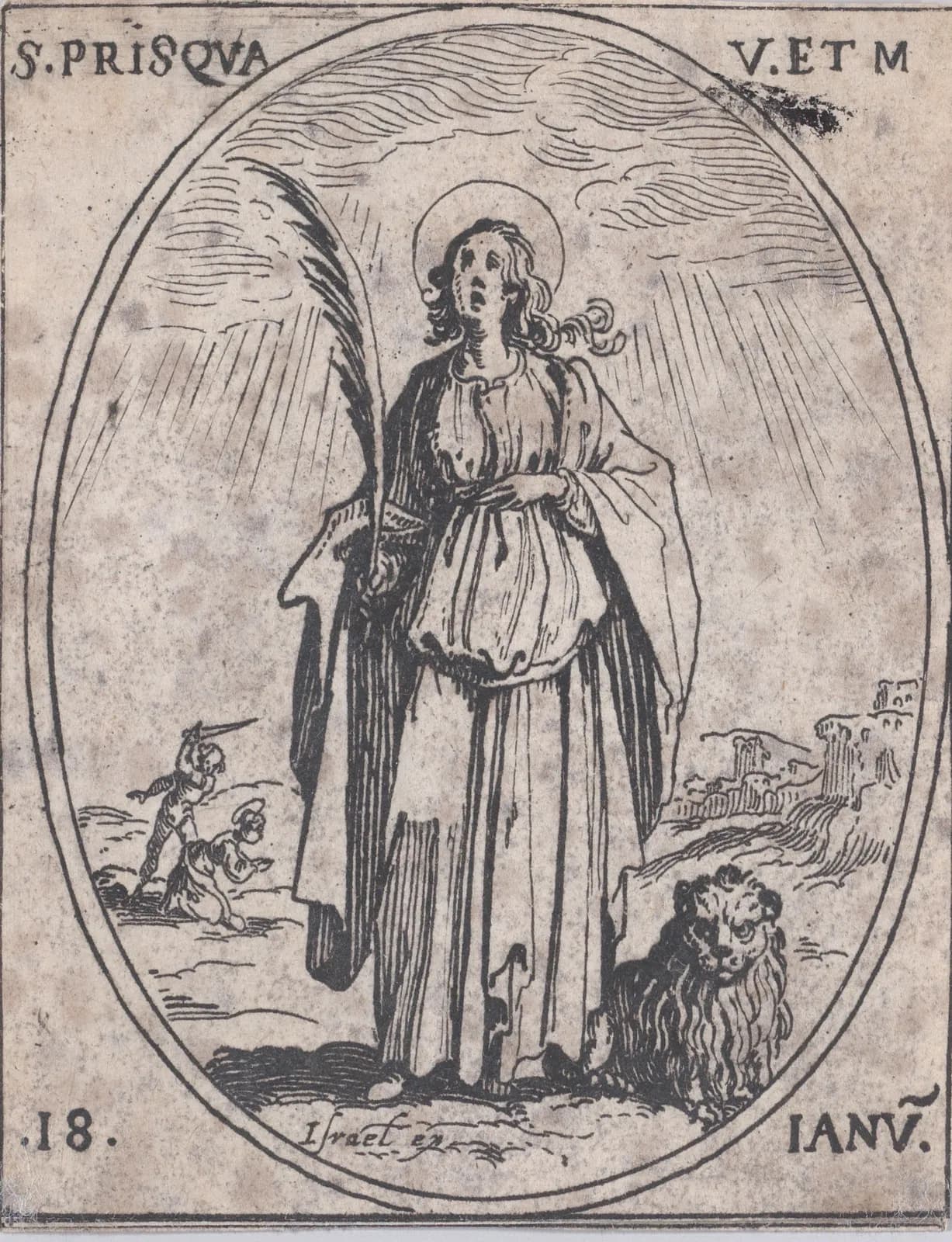
- Died
- At Rome; dates unknown 1; under the emperor Claudius, says the older Martyrology 5; about 275, says Butler 4
- Buried
- In the Catacomb of Priscilla on the Via Salaria 1
Saint Prisca was a martyr of the Church of Rome, buried in the Catacomb of Priscilla on the Via Salaria, whose grave pilgrims were visiting in the seventh century and whose dates nobody knows. 1 Her name is kept in Rome by a very old church on the Aventine Hill, and for centuries she was confused with the Priscilla, or Prisca, whom Saint Paul greets in his letters. 16 The story of her trial and death is a later legend, and the Catholic sources that tell it say plainly that it is not history. 124
A grave on the Via Salaria
J.P. Kirsch, writing in the 1911 Catholic Encyclopedia, begins with what can be shown. A martyr named Prisca was venerated at her grave in the Catacomb of Priscilla on the Via Salaria, and "all the seventh-century itineraries to the graves of the Roman martyrs" mention the place. 1 The Martyrologium Hieronymianum lists under January 18 a martyr Priscilla on the Via Salaria, and Kirsch takes her to be "evidently identical" with the Prisca of the itineraries. 1 He states that her dates are unknown. 1
The Norwegian bishops' saints database (katolsk.no) is shorter still. It says she has been honored in Rome since time out of mind and is named in the Roman Martyrology, and that nevertheless we know nothing about her. 2 Alban Butler, in the eighteenth century, could add that she is named in the sacramentary of Saint Gregory and in almost all the martyrologies of the West. 4
The title church on the Aventine
The church of Santa Prisca on the Aventine stands, Kirsch says, on the site of a very early title church, the Titulus Priscae, which is mentioned in the fifth century and was probably built in the fourth. 1 Catholic.net cites a fifth-century epitaph of "Adeodatus presb. Tit. Priscae," a priest of the title of Prisca, and says the Roman synods of 499 and 595 call her its founder. 7
In the eighteenth century a bronze tablet was found near the church, dated 224, granting a senator named Caius Marius Pudens Cornelianus citizenship of a Spanish city. 1 Since such tablets were usually set up in the recipient's house, Kirsch thinks the senator's palace may have stood there, and that the Prisca who founded the title church, or who lent part of the house for Christian worship perhaps as early as the third century, probably belonged to his family. 1 Catholic.net adds that a Roman house was found beneath the church. 7
Whether the founder of the church and the martyr in the catacomb were the same woman, Kirsch says, "cannot be proved." 1 He thinks some family connection likely, because the name Priscilla also belonged to the senatorial family of the Acilii Glabriones, whose burial place was the Catacomb of Priscilla. 1
The legend
The story most people know comes from a Passio. Catholic.net, summarizing it, says it was written in the tenth century at the earliest and has no real historical value. 7 In it Prisca is a girl of thirteen, arrested with other Christians under the emperor Claudius II in 269 and taken to the temple of Apollo to offer incense. 7 She refuses, is struck until her mouth bleeds, and goes through a long series of tortures; lions are loosed on her and do not touch her, and at last she is beheaded outside Rome on the road to Ostia. 7
Kirsch knew the same legend in brief: a Prisca "beheaded at the tenth milestone on the Via Ostiensis," whose body Pope Eutychianus was said to have moved to the church on the Aventine. 1 His judgment is short: "The whole narrative is unhistorical and its details impossible." 1 Since the legend gives January 18 as the day of her execution, he concludes that she is probably the martyr buried in the Catacomb of Priscilla. 1
Older books kept a plainer version. The 1897 English edition of the Roman Martyrology placed "the passion of St. Prisca, virgin and martyr" under the emperor Claudius, "after undergoing many torments." 5 Butler made her "a noble Roman lady" who "finished her triumph by the sword, about the year 275," and in the same breath wrote that "the acts of her martyrdom deserve no regard." 4 katolsk.no observes that her legend is very like those of Saints Tatiana and Martina, and that it has been suggested all three are one person. 2
Prisca or Priscilla?
Prisca and Priscilla are two forms of one name, and the name belongs also to the wife of Aquila, the tentmaker who worked beside Saint Paul. 14 Butler notes that the woman called Priscilla in Acts, Romans and First Corinthians is called Prisca in Second Timothy. 4 Kirsch says that later legend identified the founder of the Aventine title church with Paul's friend, and placed the couple's house on the spot where the church was built. 1 Catholic.net dates that confusion to the eighth century. 7
Butler records what the church on the Aventine made of it in his day. There was an "immemorial tradition at Rome" that Saint Peter consecrated an altar there and baptized in a stone urn still kept in the church, and Aquila and Priscilla "are still honored in this church, as titular patrons with our saint," with a considerable part of their relics under the altar. 4 Catholic.net mentions the old font and a painting of Peter baptizing Prisca, and calls the tradition without historical foundation. 7
Benedict XVI, speaking about Aquila and Priscilla in 2007, chose his words with care: "Later hagiographic tradition has given a very singular importance to Priscilla, even if the problem of identifying her with the martyr Priscilla remains." 6 He went on, "In any case, here in Rome we have a Church dedicated to St Prisca on the Aventine Hill." 6 The Martyrology keeps the two on different days: the martyr on January 18, and Aquila and Priscilla, "of whom mention is made in the Acts of the Apostles," on July 8. 45
What is Saint Prisca the patron saint of?
Saint Prisca's feast day
Saint Prisca's feast day is January 18. 123 The day goes back to the Martyrologium Hieronymianum, which lists the martyr Priscilla of the Via Salaria under it, and the 1897 Martyrology kept her there beside the feast of the Chair of Peter at Rome. 15 The current Roman Martyrology, as the Italian bishops print it, keeps a commemoration of Saint Prisca on January 18, in whose name a basilica on the Aventine is dedicated to God. 3 katolsk.no adds that since the calendar revision of 1969 her cult has been confined to that basilica. 2
Praying with Saint Prisca
There is very little to hold on to here, and the sources do not pretend otherwise. 12 A woman died for Christ in Rome and was buried among other Christians on the Via Salaria. 1 The oldest Roman calendar of martyrs kept her name under January 18, and in the seventh century pilgrims still came looking for her grave. 1
Everything else grew up around that. A church carried her name, a legend supplied the girl, the lions and the sword, and devotion joined her to the friend of Saint Paul who had kept a church in her own house. 167 Butler, who repeated the legend, still warned his readers that its acts deserved no regard. 4
Her memory has outlasted the facts. Benedict XVI left the question of her identity open and pointed instead to the church that still stands on the Aventine. 6 The current Martyrology does much the same, remembering her by the basilica that bears her name. 3
Saint Prisca, pray for us.
Sources
- 1.J.P. Kirsch, "St. Prisca," The Catholic Encyclopedia, Vol. 12 (New York: Robert Appleton Company, 1911).
- 2."Den hellige Prisca (200-t?)," Den katolske kirke (katolsk.no), Catholic Diocese of Oslo (in Norwegian).
- 3.Roman Martyrology, entry for January 18, "Santa Prisca, martire," as printed in "Santo del giorno," Conferenza Episcopale Italiana (in Italian).
- 4.Alban Butler, "St. Prisca, V.M.," The Lives of the Fathers, Martyrs, and Other Principal Saints, January (New York, imprimatur 1895), Project Gutenberg.
- 5.The Roman Martyrology, January 18 and July 8 (Baltimore: John Murphy Company, 1897).
- 6.Benedict XVI, General Audience on Priscilla and Aquila, February 7, 2007, Libreria Editrice Vaticana.
- 7.Ramón Rabre Jordá, "Prisca de Roma, Santa," with the Roman Martyrology entry for January 18, Catholic.net (in Spanish).
Saints to turn to next
Others in this collection who are turned to for some of the same things.