Saint Poemen
c. 340 - c. 450
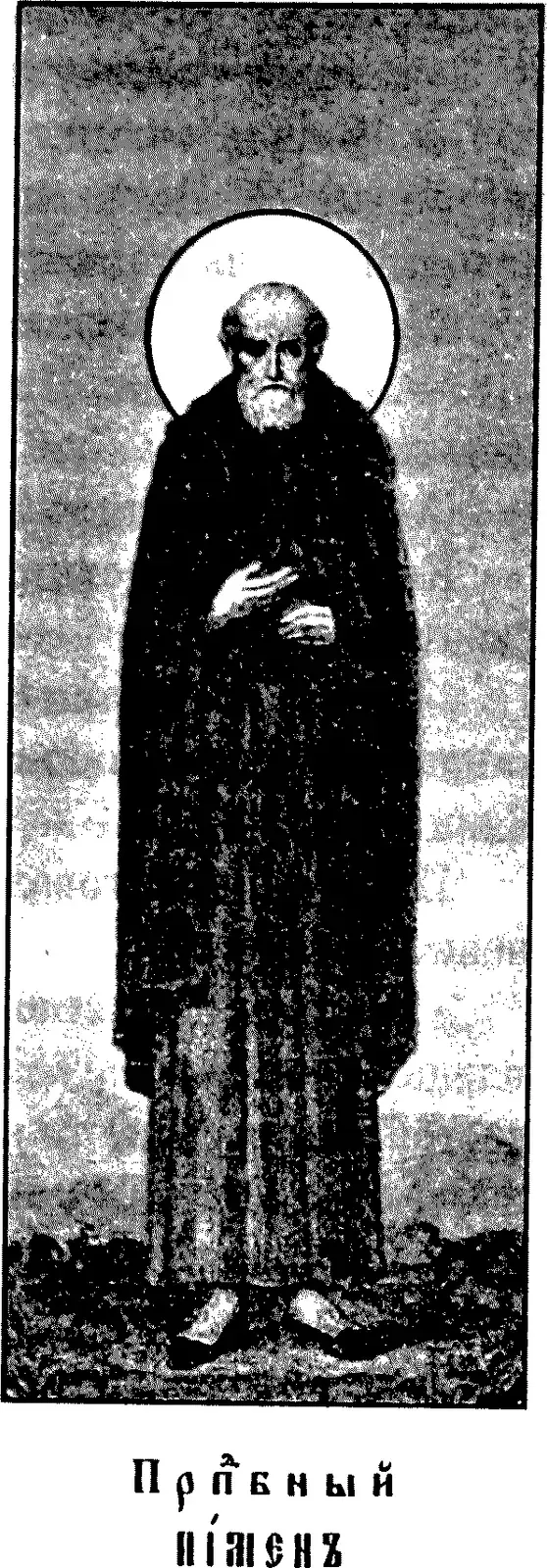
- Known for
- His sayings, which make up about a quarter of the Sayings of the Fathers 3
Saint Poemen was a monk of Scetis, in the Egyptian desert, whose short and practical answers to the brothers who came to him make up, by one count, nearly a quarter of the Sayings of the Desert Fathers. 13 He went into the desert with his brothers in the fourth century and lived there, by the reckoning of the Bollandists, to an age of about 110, dying around 450. 13 The Greek service books call him "The Lamp of the universe, and the Pattern of monks." 23 His feast is August 27. 4
Poemen, or Pastor
His name is the Greek word for shepherd, and the Latin translators of the desert sayings often turned it into Pastor; the Bollandist Joannes Pinius, who edited his dossier in the Acta Sanctorum, took pains to show that Poemen and Pastor are one man. 1 katolsk.no notes the same meaning and the same Latin form. 3 The 1897 English Martyrology spells him Poemon. 5
Almost everything known about him comes from the sayings. 1 A Greek life by a monk named Laurentius, from the monastery of Rutium in Calabria, survives, and Pinius printed it, but he observes that it is short and that nearly all of it recurs in the sayings themselves. 1
The French historian Tillemont thought there had been two monks of the name, one who heard Saint Antony and one who outlived Saint Arsenius. 1 Pinius preferred one: born about 340, a solitary at fifteen in time to hear Antony, who died in 356, and dead about 450 at around 110, no strange age among the desert fathers. 1 Butler, who writes of one man throughout, has him leave the world about 385. 2
Seven brothers in the desert
He was an Egyptian, and he did not go into the desert alone. 13 The sayings speak of seven brothers born of one mother, all monks at Scetis; the eldest was Anub, and another was called Paesius. 1 katolsk.no describes him going with one older and several younger brothers. 3 Laurentius says they followed him because his words drew them, and that he left homeland, family, wealth and reputation behind. 1
Barbarian raids broke up the first settlement. Butler dates the raid to 395 and katolsk.no to 408; both say the brothers took refuge near an old pagan temple at Terenuthis. 23 There Anub and Poemen governed the little community by turns, Butler says, "with a constant mutual deference to each other." 2 Of the twelve hours of the night they gave four to work, four to singing the psalms together and four to sleep; by day they worked until noon, read until three, and then went out for what they needed. 23 Butler says Poemen later returned to Scetis and was driven out again, with Saint Arsenius, by a fresh raid in 430. 2
The mother at the door
After many years their mother came into the desert to see her sons. 12 In Butler's telling Poemen did not open his door, and asked her through it whether she would rather see him for a moment now or have his company forever in the world to come. 2 She went away with joy, saying, "To make the happiness of seeing you in heaven the more sure, I willingly forego the pleasure of seeing you on earth." 2
Laurentius tells it more painfully. The old woman crossed mountains and rivers to reach them, he says, and the brothers withdrew as soon as they heard she had come. 1 She stood at the door weeping and calling out until the ground was wet, and they sent word that if she wished to see them she would see them on the great day, and that for now she should go. She went home, he says, glorifying God that her sons had come so far in virtue. 1 katolsk.no gives a shorter version: he refused to meet her so that they might enjoy the meeting more in the life to come. 3
The governor of the province fared no better. 12 Laurentius says the governor wanted to see Poemen and hear him, and when Poemen would not come, arrested the son of Poemen's sister. 1 The sister stood at his door and called him cruel and heartless, and he sent a brother out to tell her that Poemen had fathered no children. 1 When the governor offered to free the young man at a single word from him, Poemen sent back that the boy should be examined according to the laws, and put to death if he deserved death; if not, the governor might do as he wished. 1 The governor, astonished, let him go. 1
An elder the brothers came to
Pinius calls him the common oracle of the desert, the place the monks ran to in doubt. 1 One saying tells of a famous anchorite from another country who came a long way to meet him and began talking about Scripture and heavenly things. 1 Poemen turned his face away and said nothing. Afterward he explained that the visitor spoke of heaven, and he himself of earth; had the man asked about the passions of his soul, he would have answered. 1 The visitor came back and asked exactly that, and Poemen, pleased, told him to open his mouth on such matters and he would fill it with good things. 1
He was gentle with sinners. A brother who had committed a great sin asked whether three years of penance would be enough. Poemen said it was a long time, and he said the same of a year and of forty days; if a man repents with his whole heart and does not sin again, he said, God will receive him after three days. 12 Asked whether brothers who dozed during the Office should be shaken awake, he answered that when he saw a brother nodding off he laid the brother's head on his knees and let him rest. 1
One brother came to him again and again, tormented by blasphemous thoughts and too ashamed to say so, until Poemen drew him aside and asked him what was wrong. 12 Once he had spoken, Butler says, "he found himself at ease"; Poemen told him that whenever the thought came he should tell the devil, "May thy blasphemy fall on thee; it is not mine, for my heart detests it." 2 The Latin adds that what the soul does not want does not last long. 1
Butler collects a handful of his other sayings. To a man from Syria asking how to overcome a dry and hardened heart: "Water is soft, and stone hard; yet, drops of water often falling upon it, wear it hollow; so by the divine word often falling upon our heart, though it were of adamant, it must at length yield to the impression." 2 And: "He that is quarrelsome, or is apt to murmur and complain, can be no monk; he that renders evil for evil can be no monk; he that is passionate can be no monk." 12 In the Latin collection he also says that a man may seem silent while his heart condemns others, and so be talking all the time, while another talks from morning to evening and keeps silence. 1 katolsk.no cites one more: silence is no virtue when charity requires speech. 3
Fasting, wine and the Eucharist
Abba Joseph once asked him how to fast, and he answered that a monk should eat every day, but little. 1 Had he not gone two days without food when he was young, Joseph asked; three and four, Poemen said, and a whole week. 12 But the fathers had tried all that, and found it better to eat a little every day, and so handed down the royal way, because it is the light one. 1 Butler sums up his advice: fasts "should be moderate, but constant." 2 He held that wine had nothing to do with monks. 123
He urged frequent Communion. 23 In a saying both Butler and the Latin preserve, he compared monks in the desert to stags that eat serpents and burn with thirst from the poison: the monks, burned by the venom of the demons, long for Saturday and Sunday, when they go to the springs of water, which are the body and blood of the Lord. 12
Arsenius, and the end
He outlived Arsenius. When he heard that Arsenius had died, the Latin sayings record, he said that Arsenius was blessed, because he had wept for himself in this world. 1 katolsk.no says Poemen was present at the death and died himself soon after, about 450. 3 Butler gives about 451. 2 Laurentius says only that he fell a little sick, stretched out his feet and gave back his spirit to the one who had given it. 1 Pinius says no one knows where he died. 1
What is Saint Poemen the patron saint of?
None of the sources consulted for this page names a patronage for Saint Poemen. 123 The Greek service books quoted by Butler and the Bollandists praise him instead as a lamp and a pattern for monks, and the Sirletian menology, Pinius reports, says the old men of Egypt and the Thebaid all called him father. 12
Saint Poemen's feast day
Saint Poemen's feast day is August 27. 34 The current Roman Martyrology, as the Italian bishops print it, commemorates on that day, in the Thebaid in Egypt, Saint Poemen, abbot, an admired anchorite of whom many sayings full of wisdom have been handed down. 4 The 1897 English Martyrology entered him on the same day: "In Thebais, of St. Poemon, anchoret." 5 Butler and katolsk.no give August 27, and the Bollandists found him on that day in the Greek Synaxarion and Menaia. 123
Pinius questioned only the place the Martyrology gives him. He did not exclude the Thebaid, but thought Scetis and Egypt suited Poemen better, and headed his own commentary accordingly. 1
Praying with Saint Poemen
Most of what remains of him is answers to other people's questions. 1 The visitor who wanted to discuss heaven got silence; the brother who admitted what was troubling him got help at once. 12 He kept to what the person in front of him actually needed.
His severity was real, and other people felt it. He shut the door on his own mother and on his sister's pleading, and the sources do not soften either scene. 12 Yet the same man cut a penance of three years to three days and let a sleeping brother rest his head on his knees. 12
He kept coming back to judgment of others as the thing a monk must give up: the brother whose silence is full of condemnation, the man who renders evil for evil. 12 When Arsenius died, what Poemen praised in him was that he had wept for himself. 1
Saint Poemen, pray for us.
Sources
- 1.Joannes Pinius, "De S. Poemene anachoreta in monte Scethi et in Aegypto," commentary, with the Greek life by Laurentius, monk of Rutium, and the Apophthegmata of Poemen from Cotelier, in Latin translation, August 27, Acta Sanctorum, Augusti tomus VI (Antwerp, 1743; reprinted Paris: Victor Palmé), pp. 25-44, Internet Archive (in Latin and Greek).
- 2.Alban Butler, "St. Poemen or Pastor, Abbot," August 27, in The Lives of the Fathers, Martyrs, and Other Principal Saints, Vol. VIII (London: J. Murphy, 1812), pp. 398-400, Internet Archive.
- 3."Den hellige Poemen," Den katolske kirke, the saints database of the Catholic Church in Norway, katolsk.no (in Norwegian).
- 4.Roman Martyrology, entry for August 27, "San Pemeno, abate," Santo del giorno, Conferenza Episcopale Italiana (in Italian).
- 5.The Roman Martyrology, August 27 (Baltimore: John Murphy Company, 1897), Internet Archive.
Saints to turn to next
Others in this collection who are turned to for some of the same things.