Saint Plato of Sakkoudion
c. 734 - 813 or 814
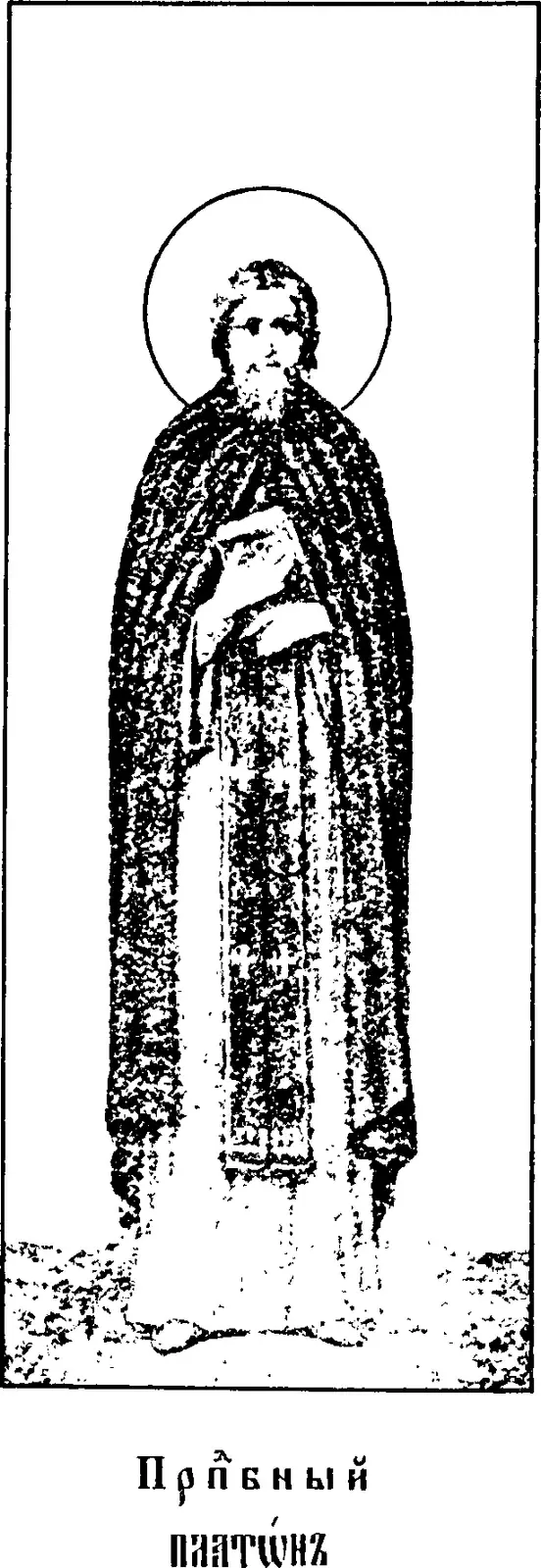
- Also called
- Plato the Studite; Plato of Symboleon 2
- Monastic life
- Monk of Symboleon on the Bithynian Olympus; abbot there from 770, and of Sakkoudion from 782 12
Saint Plato was a rising official in the imperial treasury at Constantinople who, in his twenties, freed his slaves, sold his estates and walked to a monastery in Bithynia in a single coarse black suit. 12 He became an abbot, the teacher of his nephew Saint Theodore the Studite, and an old man who would not accept what an emperor had done with his marriage, and was jailed and exiled for it. 23 His feast is April 4. 14
A career in the treasury
He was born about 734 into a wealthy family of Constantinople. 12 When he was thirteen, plague took both his parents; katolsk.no names them as Sergius and Euphemia. 12 He was raised by an uncle who was high treasurer to the emperor and who trained him in the work of the office. 12 Butler notes, among his "inferior accomplishments," a remarkable skill at shorthand. 1
Families with daughters noticed him. Butler says that "persons in the highest stations at court wished to make him their son-in-law." 1 He preferred churches and monasteries to visits, and he persuaded his three brothers to live unmarried and give themselves to God. 12 Then he set his slaves free, sold his lands, provided dowries for his two sisters, "who marrying, became the mothers of saints," and gave the rest to the poor. 1
Butler puts his departure at twenty-four. 1 katolsk.no says he gave up his career in his early twenties and left about 763. 2 Either way he took one servant as far as Bithynia, sent him back with all his clothes except "one coarse black suit," and walked alone to the monastery of Symboleon on Mount Olympus. 12
Symboleon
The abbot was Theoctistus, and he did not make it easy. To give the new monk occasions for virtue, Butler writes, he "often reproved and punished him for faults of which he was not guilty," and Plato took it in silence. 1 He baked bread, watered the ground and carried manure, though most of his time went to copying books. 12
When Theoctistus died in 770 the community chose Plato, then thirty-six, as abbot, against his resistance. 12 He answered the promotion with more austerity: water only, and sometimes only once in two days; bread, beans or herbs without oil; nothing to eat or wear that his own hands had not earned, and from the same work he fed several poor people. 1 The monastery was remote enough to escape the worst of the iconoclast emperor Constantine V. 12
After that emperor died in 775, Plato went to Constantinople on business and was received with great honor. 12 A patriarch tried to make him bishop of Nicomedia. Butler names him as Paul, and goes out of his way to say it was not Tarasius; katolsk.no names Nicetas I. 12 Plato refused and went back to Symboleon. He was never ordained a priest. 12
Sakkoudion and the nephews
His sister Theoctista and her whole household entered religious life and founded the monastery of Sakkoudion near Constantinople. 12 In 782 the family persuaded Plato to leave Symboleon and govern it. 12 Two of her sons were monks there: Theodore, later called the Studite, and Joseph, later archbishop of Thessalonica. 23
Plato saw what Theodore could be. He sent him to Constantinople to be ordained, and after twelve years as abbot of Sakkoudion he resigned, with the community's consent, in his nephew's favor. 12 The Catholic Encyclopedia dates the succession to 794. 3 In those same years, katolsk.no adds, Plato spoke against the iconoclasts at the synod of Constantinople in 786 and at the Second Council of Nicaea in 787. 2
The emperor's marriage
In 795 the young emperor Constantine VI put away his wife Mary and married Theodota, a lady of his mother's court who happened to be a relative of Plato's. 12 The patriarch Tarasius disapproved but took no canonical action against the emperor, and the wedding was performed by a priest named Joseph, the treasurer of the church. 12 Plato and Theodore broke communion with the patriarch over it, and Plato published among the monks a sentence of excommunication against the emperor. 12
Joseph and others tried to bring him round. He refused them, and refused the emperor "to his face," Butler says. 1 Sakkoudion was closed. 2 In Butler's account Plato suffered imprisonment and other hardships until Constantine VI fell in 797; katolsk.no has him in solitary house arrest in Constantinople while Theodore and his monks were exiled to Thessalonica in 796. 12 The Catholic Encyclopedia gives the nephew's side: banished to Thessalonica by Constantine VI, he "returned in triumph after the emperor's overthrow." 3
A chain under the cloak
Arab raids reached the walls of the capital, and in 799 the community left Sakkoudion for the half-ruined monastery of the Studium in Constantinople, which Theodore made the model for Byzantine monastic life. 13 There the old abbot took a vow of obedience to his nephew and lived as a recluse in a narrow cell, in prayer and manual work, "having one foot fastened to the ground with a heavy iron chain, which he carefully hid with his cloak when anyone came to see him." 12
He was not left in peace. In 806 the emperor Nicephorus had a layman, also named Nicephorus, made patriarch. Plato judged the elevation irregular and opposed it; katolsk.no says he and Theodore were jailed for twenty-four days. 12 Then the priest Joseph was restored to his office. Plato condemned it aloud as a scandal against the Church's discipline. 12 The emperor had him guarded for a whole year "by a troop of insolent soldiers and false monks," brought him before a council of court bishops, and had him condemned on charges Butler calls fictitious. 1
He was banished and moved from place to place among the islands for four years, ill as he was. 12 katolsk.no places the exile on Prinkipo, the largest of the Princes' Islands, from 809, with the Studite monks dispersed. 2 The Catholic Encyclopedia confirms that the quarrel broke out again in 809 and that Theodore was exiled a second time, and recalled in 811. 3 It was the new emperor, Michael I, who freed them. 12
His death
Back in Constantinople he was received with every mark of respect and went straight back to his cell. 12 Feeling his end coming, he had his grave dug and asked to be carried to it and laid down beside it. 12 The chief men of the city came to see him there, among them the patriarch Nicephorus, now reconciled with him. 12 katolsk.no adds that Joseph, the priest he had opposed for twenty years, came too, to ask for his prayers. 2
He died singing "I am the resurrection and the life," katolsk.no says, on April 4, 814; it notes that other sources give March 19, 813 or April 8, 814. 2 Butler gives March 19, 813, near the end of his seventy-ninth year, and says the patriarch performed his funeral. 1 His nephew Theodore wrote his life. 12
What is Saint Plato the patron saint of?
Saint Plato's feast day
Saint Plato's feast day is April 4. The current Roman Martyrology, as the Italian bishops publish it, enters him on that day at Constantinople, as an abbot who fought long against the enemies of the holy images and who, with his nephew, reordered the monastery of the Studium. 4 Butler says that his memory is honored on April 4 "both by the Latins and Greeks." 1 katolsk.no gives April 4 as the day he died, and says the Orthodox keep him on April 5. 2
Praying with Saint Plato
Plato gave things away in order: his career, his property, his slaves, his clothes, and at last the abbacy itself, to a nephew he had trained. 12 Then he vowed obedience to that nephew and lived under him. 1
The quarrel that defined his old age was over a marriage. The patriarch, a holy man, let it pass; Plato would not. 2 He paid for it with years under guard and in exile, as a sick man in his seventies. 12 The sources do not present it as a fight he enjoyed. He hid the chain on his foot from visitors. 1
At the end the patriarch he had resisted came to his bedside reconciled, and so, in the Norwegian account, did the priest whose restoration he had denounced. 12 He had asked to be laid beside his own open grave. 12
Saint Plato of Sakkoudion, pray for us.
Sources
- 1.Alban Butler, "St. Plato, Abbot," April 4, in The Lives of the Fathers, Martyrs, and Other Principal Saints, Vol. IV (Dublin: James Duffy, 1866).
- 2."Den hellige Platon av Sakkoudion (~734-814)," Den katolske kirke, the saints database of the Catholic Church in Norway, katolsk.no (in Norwegian).
- 3.Klemens Löffler, "St. Theodore of Studium," The Catholic Encyclopedia, vol. 14 (New York: Robert Appleton Company, 1912).
- 4.Roman Martyrology, entries for April 4, Santo del giorno, Conferenza Episcopale Italiana (in Italian).
Saints to turn to next
Others in this collection who are turned to for some of the same things.