Saint Perpetuus of Tours
d. 490, 491 or c. 494
- Born
- In the Auvergne, of a senatorial family 2
- Bishop of Tours
- From about 460, for thirty years, says the 1911 Catholic Encyclopedia 1; 461-91, says the same encyclopedia on Tours 5; from about 464, says katolsk.no 2
- Introduced
- Regular fasts in the diocese, including the fast before Christmas from Saint Martin's day 23
Saint Perpetuus was bishop of Tours for about thirty years in the second half of the fifth century. 12 He tore down the small chapel over the tomb of Saint Martin and built in its place a basilica that Gregory of Tours, a century later, measured window by window. 14 He also set the fasts of his church, among them a fast from Martin's day to Christmas that was an early form of Advent. 23
A bishop from a bishop's family
The Norwegian bishops' saints database (katolsk.no) says Perpetuus was born in the Auvergne into one of its great senatorial families. 2 Léon Clugnet, in the 1911 Catholic Encyclopedia, says he belonged to the family that produced Eustochius, his predecessor at Tours, and Volusianus, his successor. 1 katolsk.no adds that Eustochius was probably his uncle, that Perpetuus was wealthy and read theology, and that he was a friend of the poets Sidonius Apollinaris and Paulinus of Périgueux. 2
Gregory of Tours, who held the same see a century later, records the succession plainly: after Eustochius died in the seventeenth year of his episcopate, "Perpetuus was ordained fifth bishop after the blessed Martin." 4 Counted from the first bishop, Clugnet makes him the eighth. 1 katolsk.no calls him the sixth, noting that other lists make him the eighth. 2
The dates are just as unsettled. Clugnet says he was appointed about 460. 1 Georges Goyau, writing on the archdiocese of Tours in the same encyclopedia, follows Duchesne and gives 461-91. 5 katolsk.no gives about 464, and lists both 460-90 and 464-94. 2 All agree he governed about thirty years. 12 Clugnet admits how little is known, but says "it is apparent, from what little information we have, that during his administration Christianity was considerably developed and consolidated in Touraine." 1
Councils and fasts
Soon after his election he presided at a council at Tours, where eight bishops gathered on the feast of Saint Martin and, Clugnet says, "an important rule was promulgated relative to ecclesiastical discipline." 1 katolsk.no says the council was called to curb the worldliness of the Gallic clergy. 2 A few years later, in 467, he presided over a meeting of bishops at Vannes in Brittany and consecrated Paternus as its first bishop. 2 Clugnet adds that he kept a close watch on his own clergy, and that priests were removed from office for proving unworthy. 1
His most lasting decision concerned fasting. katolsk.no says that Gregory of Tours, writing some 120 years later, recorded that Perpetuus ordered the whole diocese to fast on Wednesdays and Fridays, apart from a few feasts, and added fasts on several Mondays of the year. 2 Among them was a fast that began on Saint Martin's day, November 11, and ran to Christmas. 2 It came to be known as Saint Martin's Lent, and katolsk.no calls it the earliest reference to a season of Advent; the council of Mâcon in 581 extended the custom to other Frankish churches. 2 The current Roman Martyrology remembers him for having restored in his church the practice of fasts and vigils. 3
The basilica of Saint Martin
Martin had been buried outside the city, and his successor Brice had built a small chapel over the grave. 14 Gregory says Perpetuus, seeing "that miracles were being worked continually at Saint Martin's tomb, and that the chapel which had been built over it was a tiny one," judged it unworthy of them, and built "great church which remains to the present day, situated 550 paces from the city." 4
Gregory gives its measurements as he knew it: "It is 160 feet long and 60 wide and 45 high to the vault." 4 He counts 52 windows, 120 columns and eight doors in the whole building. 4 The ceiling of the old chapel was too fine to lose, so Perpetuus built a church of the apostles Peter and Paul to hold it, and Gregory says "He built many other churches which remain to the present time in Christ's name." 4 Bishop Eufronius of Autun sent the block of marble that covered the tomb. 24
Clugnet dates the basilica to 470. 1 Goyau says it was dedicated in 472, and that it was there that Clovis was later invested with the purple robe sent by the emperor Anastasius. 5 katolsk.no says Martin's relics were translated into it on July 4, 473. 2 It adds a story told of that day: the coffin would not move until an unknown old man came forward to help, and those present took him for an angel or for Martin himself. 2 Gregory ties the church's feast to the same date, "four days before the Nones of July," and Martin's burial to November 11. 4
katolsk.no follows the building through the centuries: rebuilt larger in 1014 and again after a fire in 1230, sacked by the Huguenots in 1562, and destroyed in 1793 except for two towers. 2 The tomb was found again by excavation in 1860, and a smaller basilica was finished in 1924. 2
The will and the end
A document survives that claims to be Perpetuus's will. Clugnet says it was first published in 1661 by Dom Luc d'Achery, and calls it a "curious historical monument belonging to the end of the fifth century" that "gives us an excellent idea of the sanctity of its author." 1 katolsk.no describes the same text, dated March 1, 475, in which he makes the poor his heirs and leaves them pastures, woods, vineyards, houses, mills, gold, silver and clothing, and says it has since been exposed as a forgery. 2
His last years, katolsk.no says, were darkened by the Goths, who overran Touraine and brought Arianism with them. 2 Clugnet gives his death as January 1 or December 8, 490, or April 8, 491. 1 katolsk.no gives April 8, about 494, and notes the other dates. 2 He was buried in the basilica he had built, at the feet of Saint Martin. 2
What is Saint Perpetuus the patron saint of?
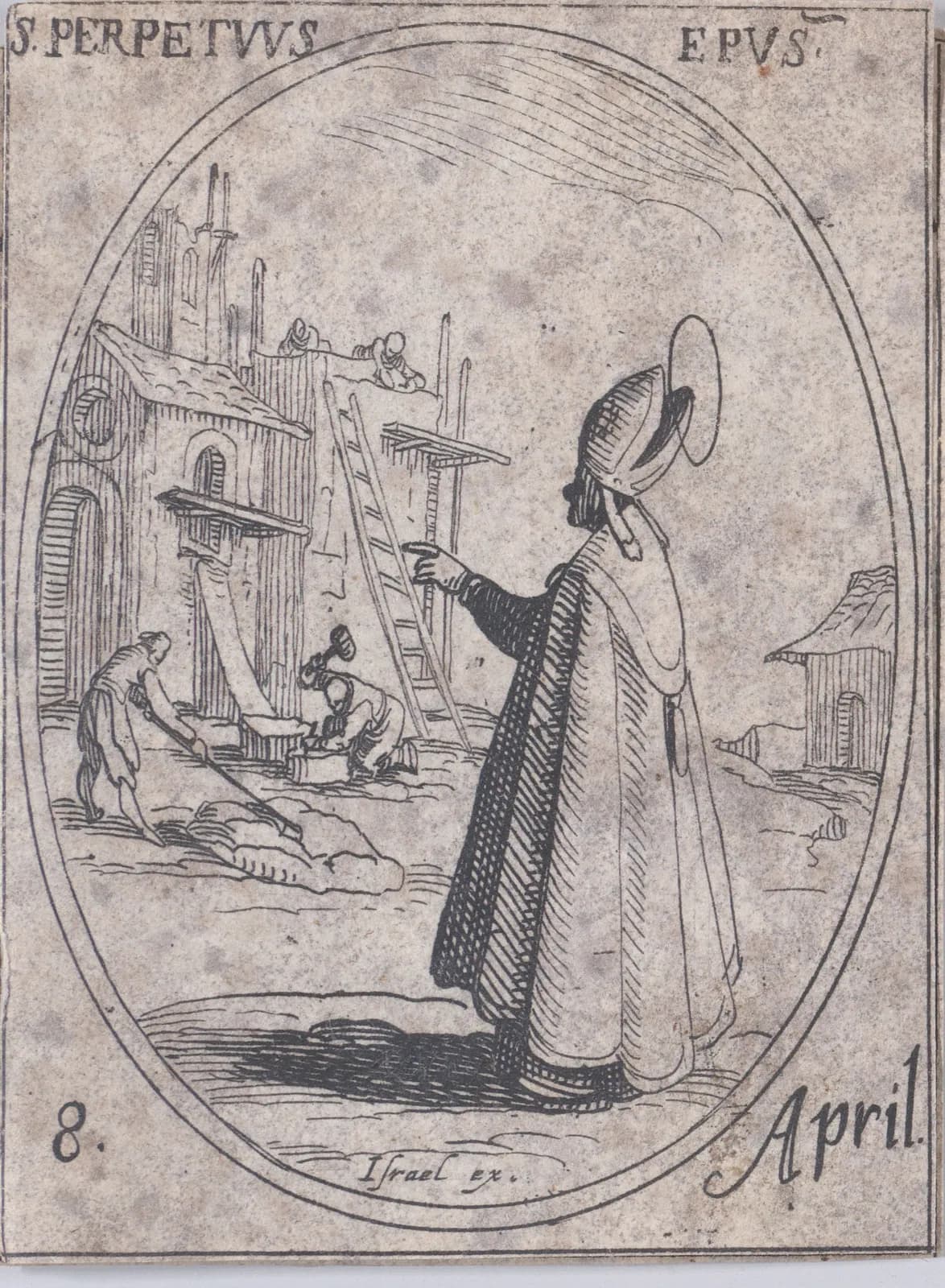
None of the sources consulted names a patronage for Saint Perpetuus. katolsk.no says he is shown in art as a bishop directing the building of a church, sometimes with a sick person healed at his tomb. 2 He is remembered at Tours with the basilica of Saint Martin, which Goyau calls the chief source of that church's prestige through the Middle Ages. 5
Saint Perpetuus's feast day
Saint Perpetuus's feast day is December 30 in the current Roman Martyrology, which enters him at Tours as the bishop who built the basilica of Saint Martin and many others in honor of the saints. 3 katolsk.no gives his memorial as April 8, the date it prefers for his death, and notes that December 30 is also found. 2 This page follows the Martyrology. 3
Praying with Saint Perpetuus
Perpetuus spent his episcopate looking after another man's grave. He came into a church already shaped by Martin, and the work he is remembered for was making room for the pilgrims who came to Martin. 14
He did it on a large scale. Gregory, who worshiped in that basilica, still counted its windows and columns a century later, and Goyau traces the church's prestige to it. 45 Perpetuus also kept the old chapel's ceiling, and built another church to put it in. 4
The other half of his legacy asked something of every household in the diocese. katolsk.no says the fasts he set were still kept at Tours a century after his death. 2 The weeks of fasting from Martin's day to Christmas are one of the roots of Advent. 2
He was buried at the feet of the saint he had served. 2 The Martyrology remembers both things he did: the churches, and the fasts and vigils. 3
Saint Perpetuus of Tours, pray for us.
Sources
- 1.Léon Clugnet, "St. Perpetuus," The Catholic Encyclopedia, Vol. 11 (New York: Robert Appleton Company, 1911).
- 2."Den hellige Perpetuus av Tours (d. ~494)," Den katolske kirke (katolsk.no), Catholic Diocese of Oslo (in Norwegian).
- 3.Roman Martyrology, entry for December 30, "San Perpetuo, vescovo," as printed in "Santo del giorno," Conferenza Episcopale Italiana (in Italian).
- 4.Gregory of Tours, History of the Franks, Book II, chapters 14-15, trans. Ernest Brehaut (New York: Columbia University Press, 1916), Internet Medieval Sourcebook, Fordham University.
- 5.Georges Goyau, "Archdiocese of Tours," The Catholic Encyclopedia, Vol. 15 (New York: Robert Appleton Company, 1912).
Saints to turn to next
Others in this collection who are turned to for some of the same things.