Saint Paul VI
September 26, 1897 - August 6, 1978
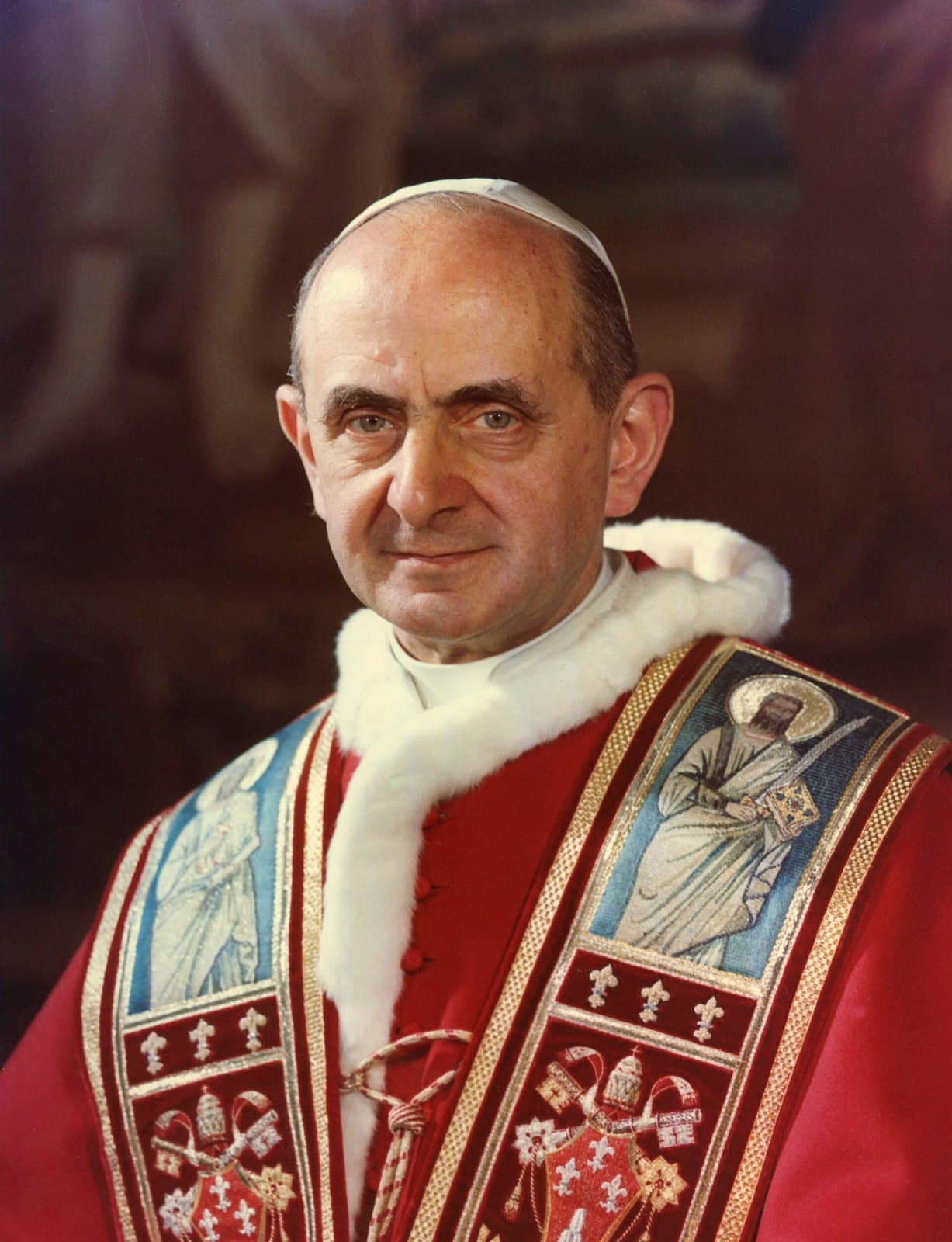
- Thirty years
- In the Vatican Secretariat of State, from 1924 1
- Archbishop of Milan
- He called himself "archbishop of the workers" and visited factories regularly 1
- Vatican II
- Elected in June 1963, he continued the Council at once and saw it through three more sessions 1
- The excommunications of 1054
- Revoked jointly with Patriarch Athenagoras the day before the Council closed 1
- Bishops at 75
- He decreed in 1966 that they must offer their resignations; in 1970 that cardinals over 80 would not vote in conclaves 1
Saint Paul VI inherited a council three months after it lost the pope who called it, and finished it. 1 He was the first pope to leave Italy in a century and a half, flying to Jerusalem in 1964 to meet the Ecumenical Patriarch in person, and the two of them revoked the excommunications of 1054. 1 He also buried his friend Aldo Moro, murdered by the Red Brigades four months before his own death. 1
Thirty years at a desk
Giovanni Battista Montini was born near Brescia, the second of three sons of a lawyer, editor and member of the Italian Chamber of Deputies; his mother "was very involved in Catholic Action." 1 He was ordained in 1920, studied literature, philosophy and canon law, and in 1924 joined the Vatican Secretariat of State, "where he worked for 30 years." 1
As chaplain to the Federation of Italian Catholic University Students "he met and became a very good friend of Aldo Moro, who eventually became prime minister." 1 That friendship reappears at the end of his life and it is not a happy detail: "Moro was kidnapped by the Red Brigade in March 1978, and murdered two months later. A devastated Pope Paul VI presided at his funeral." 1 Paul VI died ten weeks after that.
In 1954 he was named archbishop of Milan, "where he sought to win disaffected workers back to the Catholic Church. He called himself the 'archbishop of the workers' and visited factories regularly while overseeing the rebuilding of a local Church tremendously disrupted by World War II." 1
John XXIII made him a cardinal in 1958 - "the first of 23 cardinals named," two months after his own election. 1 Montini helped prepare Vatican II "and participated enthusiastically in its first sessions." 1
Finishing somebody else's council
He was elected in June 1963, with the Council interrupted by John XXIII's death. "When he was elected pope in June 1963, he immediately decided to continue that Council, which had another three sessions before its conclusion on December 8, 1965." 1
Franciscan Media records what he put into getting it right: "The pope worked very hard to ensure that bishops would approve the Council's 16 documents by overwhelming majorities." 1 Not merely passed - passed by margins that would hold.
The day before it closed, "Paul VI and Patriarch Athenagoras revoked the excommunications that their predecessors had made in 1054." 1 Nine hundred and eleven years, undone by two men in one gesture on the second-to-last day of a council.
He had already "stunned the world by visiting the Holy Land in January 1964, and meeting Athenagoras, the Ecumenical Patriarch of Constantinople in person." 1 Eight more international trips followed - New York in 1965, to speak for peace at the United Nations General Assembly; India in 1964; Colombia in 1968; Uganda in 1969; seven Asian countries in a ten-day tour in 1970. 1
What he changed about the office
In 1965 he instituted the World Synod of Bishops. 1 In 1966 he "decreed that bishops must offer their resignations on reaching age 75." 1 In 1970 "he decided that cardinals over 80 would no longer vote in papal conclaves or head the Holy See's major offices." 1
Those three decisions were about limiting the tenure of men like himself, and he made them while holding the one office they did not touch.
He increased the number of cardinals significantly, "giving many countries their first cardinal", established diplomatic relations between the Holy See and forty countries, and instituted a permanent observer mission at the United Nations in 1964. 1
He wrote seven encyclicals. "His last one in 1968 on human life - Humanae Vitae - prohibited artificial birth control." 1
He died at Castel Gandolfo on August 6, 1978, and was buried in St. Peter's. 1 He was beatified on October 19, 2014, and canonized on October 14, 2018. 1
What is Saint Paul VI the patron saint of
He belongs to workers, by his own choice of title in Milan, and to anyone who travels for their work - he ended the papacy's confinement to Italy. 1 Vatican News lists him as "St. Paul VI, Pope". 2
Franciscan Media's verdict is that "Saint Paul VI's greatest accomplishment was the completion and implementation of Vatican II. It was a monumental task that he completed with grace and integrity." 1
Saint Paul VI's feast day
The feast of Saint Paul VI is May 29. 12 Franciscan Media states it directly: "Since 2019 his liturgical feast has been celebrated on May 29." 1 Vatican News keeps his day page there. 2
Note that it is neither his birthday nor the day he died. Franciscan Media runs its column on September 26, which is his birthday; he died on August 6, 1978. Both dates appear in the sources and neither is the feast.
Praying with Saint Paul VI
He is the saint for finishing what somebody else started and getting none of the credit for it. Vatican II is John XXIII's council in everyone's memory, and John XXIII presided over one of its four sessions. Paul VI ran the other three, shepherded sixteen documents to overwhelming majorities, and spent the following thirteen years implementing them. 1
The three rules about age are the most self-effacing thing a pope has done in modern times. 1 Bishops resign at seventy-five; cardinals stop voting at eighty; the man who decided both was sixty-eight and in an office with no retirement. He built the doors he would not have to walk through.
The embrace with Athenagoras is worth imagining concretely. 1 Two men, in Jerusalem, undoing a mutual excommunication that had outlived every person who had anything to do with it. Nobody was owed an apology any more. They did it anyway, because the wall was still standing.
And Aldo Moro. 1 A friendship that began among university students ended with the pope presiding at the funeral of a man the Red Brigades had murdered. He was eighty, devastated, and had ten weeks to live. Nothing about a life of service protects you from that, and the record does not pretend it did.
Saint Paul VI, pray for us.
Sources
Saints to turn to next
Others in this collection who are turned to for some of the same things.
- Saint Alphonsus Rodriguez1532 or 1533 - October 1617Work and vocationSuffering and illness
- Saint John Ic. 470 - May 18, 526Suffering and illnessDiscernment
- Saint John Paul IIMay 18, 1920 - April 2, 2005Suffering and illnessDiscernment
- Saint Aloysius GonzagaMarch 9, 1568 - June 21, 1591DiscernmentSuffering and illness