Saint Paul the Hermit
Third and fourth centuries; said to have died in 341
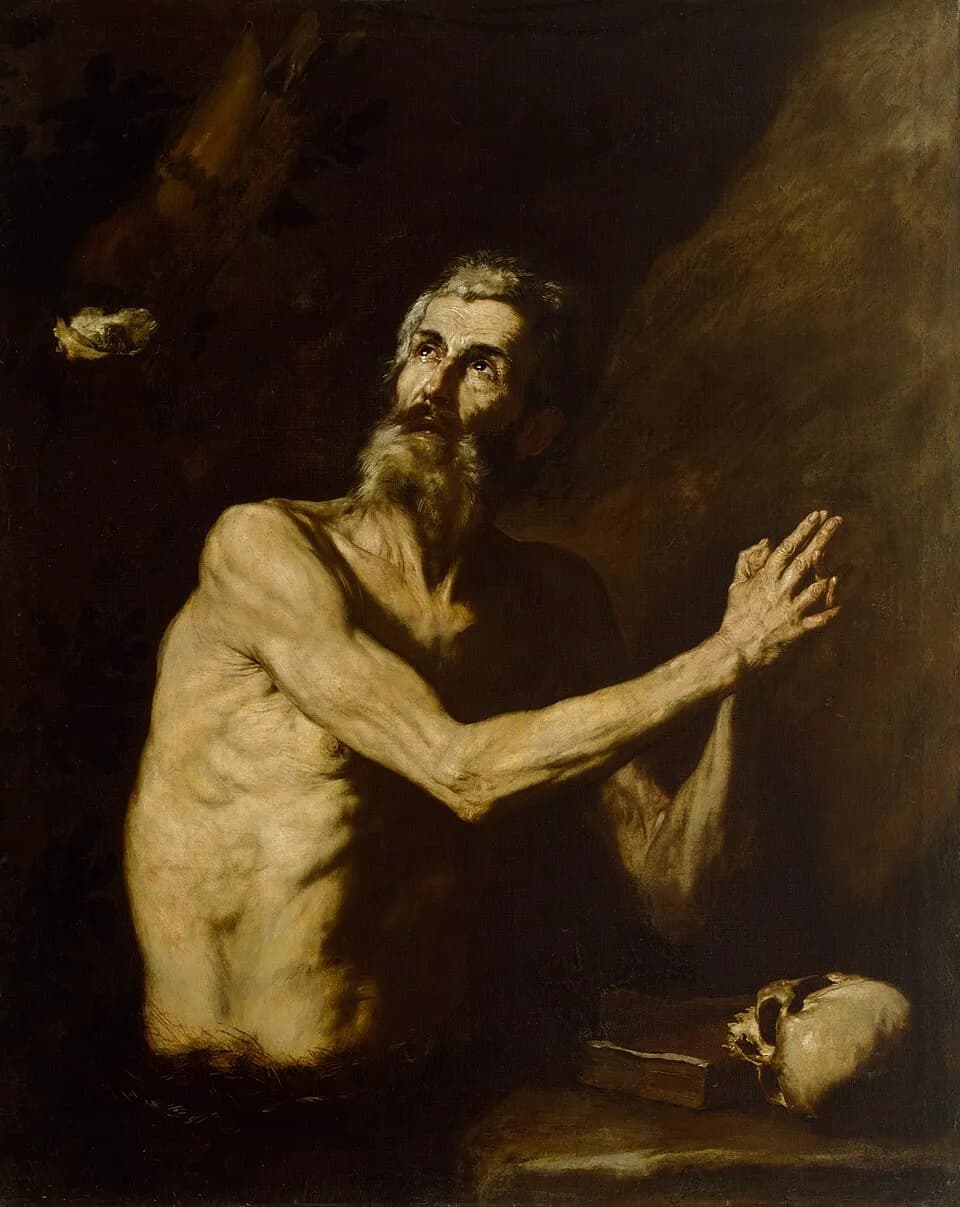
Saint Paul the Hermit, also called Paul of Thebes, is the man Saint Jerome named as the first Christian hermit: an Egyptian who went into the desert of the Thebaid as a teenager to escape a persecution and stayed there, alone, for the rest of a very long life. 12 Almost all of what is told about him comes from Jerome's short Life, and Vatican News opens its entry with the admission, "Very little is known about St Paul." 23 The Roman Martyrology lists him on January 10. 5
A life known from one short book
Jerome wrote the Life of Paulus to settle an argument about who had been the first monk to live as a hermit. Most people said Anthony of Egypt. Jerome answers that two of Anthony's own disciples, Amathas and Macarius, said otherwise: "a certain Paul of Thebes was the leader in the movement, though not the first to bear the name." 2 He admits how little he has. He will tell the beginning and the end, and of the long middle he writes, "What his middle life was like, and what snares of Satan he experienced, no man, it is thought, has yet discovered." 2
The 1911 Catholic Encyclopedia spends most of its article on the manuscripts. There is Jerome's Latin Life, and there are two Greek versions, one much shorter than the Latin, and scholars of the day disagreed about which came first. 1 It also makes a point that matters for anyone wondering whether Paul was invented: "belief in the existence of St. Paul seems to have existed quite independently of the Life." 1 The current Martyrology keeps its entry to a single line, placing him in the Thebaid in Egypt and calling him a hermit who cultivated the monastic life from its very beginnings. 5
Into the desert at sixteen
Jerome sets the story in the persecutions of Decius and Valerian, when the churches of Egypt and the Thebaid were being laid waste. 2 Paul was about sixteen. He and his newly married sister had just lost both parents, and he had come into a large inheritance. Jerome describes him as "highly skilled in both Greek and Egyptian learning," gentle, and devout. 2 He withdrew to a house in a remote spot to wait the persecution out, and there his own brother-in-law decided to hand him over for the sake of the money. 2
So he fled farther, into the mountains. Jerome says he went by easy stages until he found a rocky mountain with a cave at its foot, closed by a stone. Inside was a wide chamber open to the sky, shaded by an old palm tree, with a clear spring. 2 The mountain was full of hollows, and in them lay rusted anvils and hammers; the place, Jerome reports from Egyptian writers, had been "a secret mint at the time of Antony's union with Cleopatra." 2 Paul took the cave as a gift from God and never left. "The palm afforded him food and clothing." 2 The encyclopedia gives the same outline: flight at sixteen during the Decian persecution, and a cave in the mountainside until he was a hundred and thirteen. 1
Vatican News adds two details that do not come from Jerome. It calls Paul a nobleman, and it says that by tradition "his cell is found on Mt Sinai," which is a different place from the Egyptian Thebaid of Jerome and the Martyrology. 235 It also reckons his solitude at "more than 90 years." 3
Anthony comes to find him
The rest of the Life is one visit. Anthony, ninety years old, had begun to think that no monk more perfect than himself lived in the desert, and was told in the night that there was a better man farther in, whom he should go and see. 2 The encyclopedia puts it more bluntly: he "was tempted to vain-glory, thinking he was the first to dwell in the desert." 1 He set out at dawn with a staff and no idea of the road.
On the way Jerome has him meet a centaur, who points out the direction, and then a small horned creature with goat's feet, who offers him dates and asks for his prayers. 2 The encyclopedia notes that in the shorter Greek version both are plainly demons, and suggests that tales of fabulous beasts would naturally attach to such a journey among people who still half believed in them. 1 Jerome himself is unsure about the centaur, and says he cannot decide whether it was the devil or one of the strange animals of the desert. 2
After two days and two nights Anthony followed a thirsty she-wolf to a cave, went in, and made a noise in the dark. Paul barred the door. Anthony lay at the threshold for hours, pleading: "You welcome beasts: why not a man?" 2 At last Paul opened, smiling, and the two old men embraced and greeted each other by name. Paul's first questions were about the world he had left: "how fares the human race? Are new homes springing up in the ancient cities? What government directs the world?" 2
While they talked, a raven settled on a branch and set a whole loaf in front of them. Paul explained: "For the last sixty years I have always received half a loaf: but at your coming Christ has doubled his soldier's rations." 2 They then argued until evening over who should break it, each deferring to the other, and settled it by each pulling from his own side. 2
The cloak and the lions
The next morning Paul told Anthony that he was about to die and that Anthony had been sent to bury him. He asked him to go back and fetch the cloak that Bishop Athanasius had given him, to wrap the body in. Jerome says he asked this to soften his friend's grief at his death. 2 Anthony went home, told his disciples only, "I have seen Elias, I have seen John in the desert, and I have really seen Paul in Paradise," took the cloak, and hurried back. 2
He was too late. Still three hours away, he saw Paul rising among angels, and in the cave he found the body "in a kneeling attitude, with head erect and hands uplifted," so lifelike that he knelt and prayed beside it before he understood. 2 He had nothing to dig with. Two lions came out of the desert, lay down at the dead man's feet, and scraped out a grave with their paws; Anthony blessed them, buried Paul, and took home the tunic Paul had woven from palm leaves, which he wore afterward at Easter and Pentecost. 2
The encyclopedia names all of this, the meeting, the raven, the cloak, the death before Anthony's return and "the grave dug by lions," as "among the familiar legends of the Life." 1 Catholic Culture, summarizing the same book, notes that it "charmed and instructed generations of the faithful and formed the inspiration of many artists," and gives the only date any of these sources offers: Paul "is said to have died in 341." 4
What is Saint Paul the Hermit the patron saint of?
Saint Paul the Hermit's feast day
Praying with Saint Paul the Hermit
There is very little to hold on to here, and Jerome knew it. He had a beginning, an ending, and about ninety years of silence in between, and he did not fill the silence with invented episodes. 2 Whatever Paul's prayer was like, nobody wrote it down. What is left is the outline of a man who ran from danger, found a spring and a palm tree, and stayed.
He did not go into the desert out of heroism. By Jerome's account he went because a relative was about to sell him to the persecutors, and he meant to wait until it was over. 2 The waiting turned into a life. That is an odd and rather consoling origin for the whole tradition of Christian hermits.
The meeting with Anthony is the warmest thing in the book: two very old men arguing all afternoon about which of them is too unimportant to break the bread. 2 Anthony had set out because he thought he was the first and best of the hermits, and he came home saying he did not deserve the name of monk. 12
Jerome ends with a question for his wealthy readers, "what did this old man in his nakedness ever lack?", and with a wish of his own: that he "would much sooner take Paul's tunic with his merits, than the purple of kings with their punishment." 2 The tunic was palm leaves.
Saint Paul the Hermit, pray for us.
Sources
- 1.Francis Joseph Bacchus, "St. Paul the Hermit," The Catholic Encyclopedia, vol. 11 (New York: Robert Appleton Company, 1911).
- 2.Saint Jerome, "The Life of Paulus the First Hermit," trans. W. H. Fremantle, G. Lewis and W. G. Martley, Nicene and Post-Nicene Fathers, Second Series, vol. 6 (1893); New Advent.
- 3."St Paul, the First Hermit," Saint of the Day, 15 January, Vatican News.
- 4.Liturgical Year calendar, January 15 (1962 Missal: St. Paul the First Hermit), Catholic Culture.
- 5."San Paolo, eremita," Santo del giorno, 10 gennaio, from the Roman Martyrology, Conferenza Episcopale Italiana (in Italian).
Saints to turn to next
Others in this collection who are turned to for some of the same things.
- Saint Agnes of Bohemiac. 1200-1205 - March 1281 or 1282Poverty and simplicityPrayer
- Saint Aidan of Lindisfarnec. 590 - August 31, 651Poverty and simplicityPrayer
- Saint Alexius of RomeFifth century, by traditionPoverty and simplicityPrayer
- Saint André BessetteAugust 9, 1845 - January 6, 1937PrayerPoverty and simplicity