Saint Paschasius Radbertus
c. 786-790 - April 26, c. 860-865
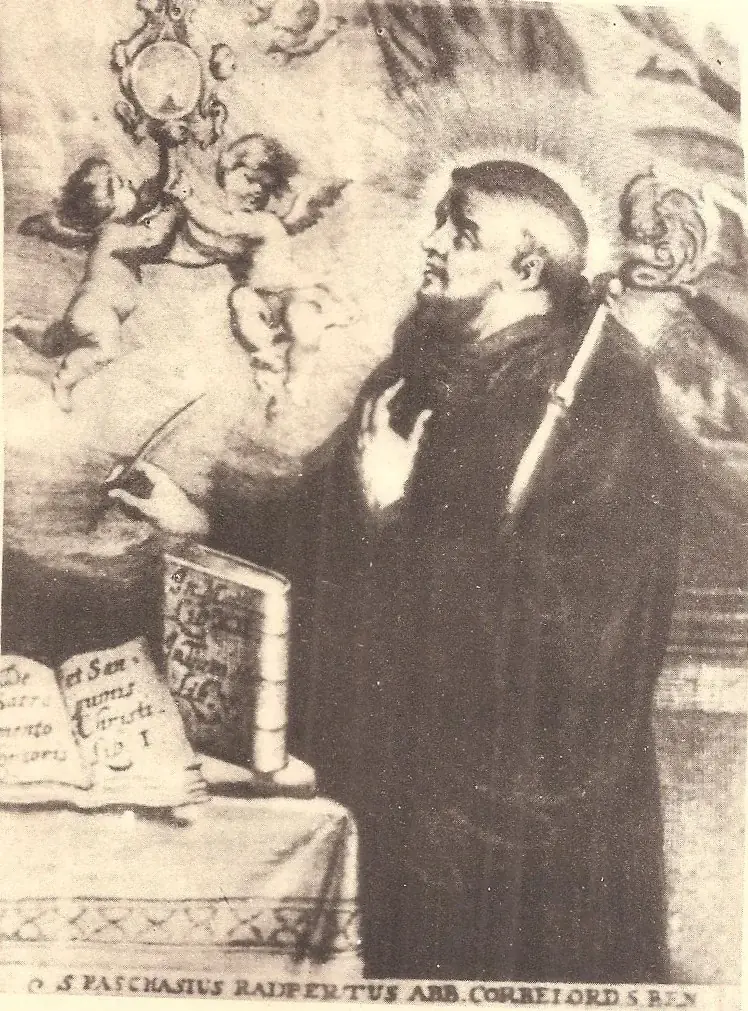
- Born
- At or near Soissons, in 786 according to the Catholic Encyclopedia, about 790 according to katolsk.no and santiebeati 134
Saint Paschasius Radbertus was a foundling brought up by Benedictine nuns at Soissons who became a monk, a famous teacher and for seven years abbot of Corbie in northern France. 134 His treatise on the Body and Blood of the Lord, written in 831 and revised in 844, set off the first controversy over the Eucharist in the West, and the current Roman Martyrology remembers him as the abbot who set out that doctrine with lucidity and clarity. 15 He died at Corbie on April 26, about 860, and April 26 is his feast. 15
A child of the nuns of Soissons
The Catholic Encyclopedia says he was born at Soissons in 786 and "as a child he was exposed, but was taken in and brought up by Benedictine Nuns." 1 katolsk.no, which gives about 790, says he was found one day on the steps of the convent of Notre-Dame; santiebeati calls him a "son of nobody." 34 Butler tells it differently: his mother's death "left him an orphan in his infancy," and the nuns of Our Lady's at Soissons took charge of his education. 2
The nuns sent him to the monks of Saint Peter's in the same town to be taught. 23 He read Terence and Cicero, received the tonsure, and then, Butler says, "returned into the world, and led some years a secular life." 2 Santiebeati says he was known in Soissons for a time as a man about town among a crowd of pleasure-seekers; katolsk.no cautions that nothing shows his life was dissolute, though he himself seems to have thought it blameworthy. 34
At about twenty-two he entered the strict Benedictine monastery of Corbie, near Amiens, under its abbot, Saint Adalard. 134 He was ordained a deacon there, and out of humility he never allowed himself to be ordained a priest. 134
Teacher at Corbie
For many years he taught the young monks. 1 In 822 he went with Adalard and his brother Wala into Saxony to found a daughter house, New Corbie, or Corvey, in Westphalia. 123 At home he preached to the community on Sundays and feasts and lectured every day on the sacred sciences, and Butler says that under him "the schools of Corbie became very famous." 2 Among his pupils Butler names Saint Anscharius, the future apostle of the North. 2
He signed the acts of a council at Paris in 846 simply as Radbert. In the works he wrote afterward he always put Paschasius before it, following, Butler explains, the custom among Frankish men of letters of taking a Roman or scriptural name. 23 He gave others such names too: in his life of Abbot Wala, written as a funeral dialogue, Wala is "Arsenius." 23
He lived under four abbots, Adalard, Wala, Heddo and Isaac, and when Isaac died he was chosen abbot himself, "though only a deacon." 1 Butler and katolsk.no date the election to 844. 23
Abbot, and not for long
The office did not suit him, and every source says he left it, though they give different reasons. 1234 The encyclopedia says only that he resigned "on the occasion of a disagreement" after about seven years. 1 Butler says the distractions of the post made him try hard to lay it down, which he could not do until 851. 2 Santiebeati says Charles the Bald wanted him to take back into the monastery a cousin of the king who had been expelled for unworthiness, and that Radbert refused and left. 4 katolsk.no describes open revolt among some of the monks when he tried to restore the old discipline, and suggests the politics around Charles of Aquitaine, a royal prisoner kept at Corbie, may explain his going. 3
He spent some years at the nearby abbey of Saint-Riquier, finishing his books. 23 Then the monks of Corbie asked him back, and he came on the condition that he would hold no office. 34 Santiebeati sums up the rest: prayer and study, to the last day. 4
On the Body and Blood of the Lord
He wrote a long commentary on Matthew in twelve books, expositions of Psalm 44 and of Lamentations, a defense of Mary's perpetual virginity, a treatise on faith, hope and charity, and lives of Adalard and Wala. 12 The Second Vatican Council cites his commentary on Matthew in a note to Lumen gentium, where it says the Church was built upon blessed Peter, "Christ Jesus Himself being the supreme cornerstone." 6
His most important work, the encyclopedia says, is De corpore et sanguine Domini, written in 831 for the monks of New Corbie and sent in revised form in 844 to Charles the Bald. 12 Its aim was "the clearest and most comprehensible explanation of the Real Presence," in accordance with Ambrose, Augustine and Chrysostom. 1 He insisted that the Eucharistic Body of Christ is "non alia plane caro, quam quae nata est de Maria et passa in cruce et resurrexit de sepulchro": no other flesh than that born of Mary, which suffered on the cross and rose from the tomb. 1
The king had another monk of Corbie, Ratramnus, answer "certain questionable assertions," and Rabanus Maurus joined in. 1 The encyclopedia judges that Paschasius stated the identity of the Eucharistic and the historical Body "in such exaggerated terms that the difference between the two modes of existence was not sufficiently brought out," and still concludes: "At bottom his doctrine was as orthodox as that of his opponents." 1 He defended himself in a letter to the monk Frudegard, and Gerbert, later Pope Sylvester II, wrote that his teaching was correct in every particular. 12
"Forget me"
Butler says he often styled himself in his writings "The Outcast of the Monastic Order." 2 In his last illness he forbade anyone to write his life, so that, Butler writes, "his humility has robbed us of the edification which such a history would have afforded us." 2 Santiebeati gives his words as "I do not deserve to be remembered; forget me," and says he asked to be buried in the section kept for the poor and the monastery's servants. 4
He died at Corbie on April 26. The encyclopedia puts it about 860 and calls 865 "improbable"; Butler says about 865, katolsk.no 865, and santiebeati 860. 1234 He was buried in the church of Saint John at Corbie. 12 The encyclopedia and Butler say that after miracles at his grave his body was solemnly moved into the abbey church of Saint Peter in 1073 by authority of the pope, whom Butler names as Gregory VII. 12 Santiebeati gives 1058 as the year he was received into the abbey church with the honors of a saint; katolsk.no has both, an enshrinement in 1058 and the move of 1073. 34 His remains, saved from the Revolution, are in the parish church of Corbie. 34
What is Saint Paschasius Radbertus the patron saint of?
Saint Paschasius Radbertus's feast day
Saint Paschasius Radbertus's feast day is April 26, the day of his death. The current Roman Martyrology, as the Italian bishops print it, enters him that day as abbot of Corbie who set out with lucidity and clarity the doctrine of the true Body and Blood of the Lord in the mystery of the Eucharist. 5 The Catholic Encyclopedia, Butler, katolsk.no and santiebeati give the same day. 1234
katolsk.no notes that he was not in the Roman Martyrology before the Second Vatican Council; Butler, writing in the eighteenth century, says he was honored at Corbie and in the Gallican and Benedictine martyrologies. 23
Praying with Saint Paschasius Radbertus
He began with nothing, not even parents anyone could name, and was raised by women who owed him nothing. 13 He spent a few years trying the world before he went to Corbie, and the sources do not agree on how badly. 234
He wrote at length about the Eucharist, and he was criticized for it in his lifetime by men who believed what he believed. 1 The encyclopedia does not pretend he got everything right, and still finds him orthodox at bottom. 1
At the end he asked to be forgotten. 24 The Church remembered him anyway, and of all that he wrote the line it keeps on his day is the one about the Body and Blood of the Lord. 5
Saint Paschasius Radbertus, pray for us.
Sources
- 1.Joseph Pohle, "St. Paschasius Radbertus," The Catholic Encyclopedia, Vol. 11 (New York: Robert Appleton Company, 1911).
- 2.Alban Butler, "St. Paschasius Radbert, Abbot, Confessor," April 26, in The Lives of the Fathers, Martyrs, and Other Principal Saints, Vol. IV, April (Derby: Richardson and Son, 1843), Internet Archive.
- 3."Den hellige Paschasius Radbertus," Den katolske kirke, the saints database of the Catholic Church in Norway, katolsk.no (in Norwegian).
- 4.Domenico Agasso, "San Pascasio Radberto, Abate," with the Roman Martyrology entry, Santi e Beati, santiebeati.it (in Italian).
- 5.Roman Martyrology, entry for April 26, "San Pascasio Radberto, abate," Santo del giorno, Conferenza Episcopale Italiana (in Italian).
- 6.Second Vatican Council, Dogmatic Constitution on the Church, Lumen gentium (November 21, 1964), no. 19 and note, vatican.va.
Saints to turn to next
Others in this collection who are turned to for some of the same things.
- Saint Abercius of HieropolisSecond century; died at seventy-two or laterPrayerStudy and teaching
- Saint Aelred of Rievaulx1109 - January 12, 1166 (or 1167)PrayerStudy and teaching
- Saint Ambrosec. 340 - April 4, 397PrayerStudy and teaching
- Saint Anselm of Canterbury1033 or 1034 - April 21, 1109Study and teachingPrayer