Saint Paschal I
Died 824
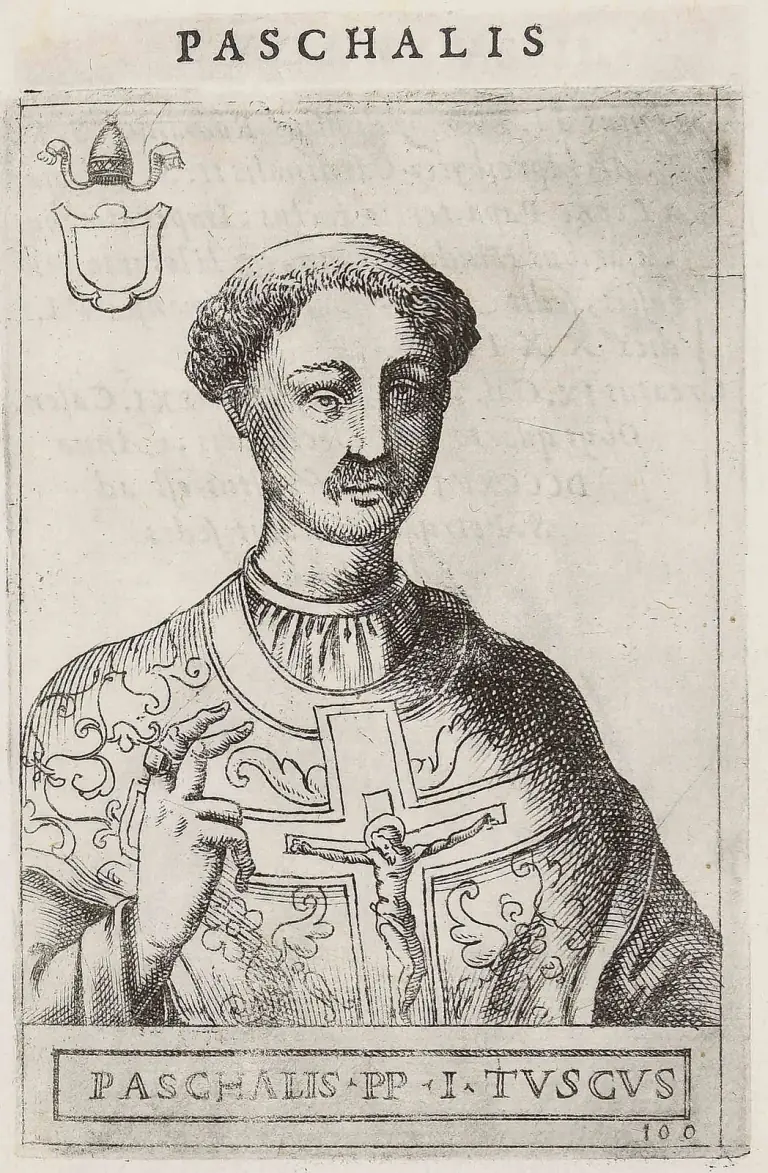
- Before his election
- Superior of the monastery of Saint Stephen near Saint Peter's, caring for pilgrims 126
Saint Paschal I was pope from 817 to 824, and his face is still in the apses of three Roman churches he rebuilt, a tall, beardless man wearing the square halo given to the living. 16 Into one of them, Santa Prassede, he brought the bones of about 2,300 martyrs from the crumbling catacombs, and into another he carried the body of Saint Cecilia. 26 The Roman Martyrology keeps him on February 11. 3
The abbot of the pilgrims
Paschal was a Roman, the son of Bonosus; Horace Mann's history of the popes, following the Liber Pontificalis, names his mother Theodora. 16 katolsk.no, the Norwegian bishops' saints database, says the family was the Massimi. 2 He joined the Roman clergy young and was taught the liturgy and the Scriptures in the Lateran. 1 The Liber Pontificalis credits him with piety, cheerfulness, hospitality and a love of the poor, and Mann warns that the portrait is partly borrowed from earlier lives in the same book. 6
Pope Leo III made him superior of the monastery of Saint Stephen beside Saint Peter's, whose work was to look after the pilgrims who came to the apostle's tomb. 12 Mann quotes the biographer on the pilgrims who came "for love of Blessed Peter, the apostle," from distant lands. 6
When Stephen IV died on January 24, 817, Paschal was chosen unanimously and consecrated the next day. 1 katolsk.no reads the haste as a sign of Roman anxiety about interference from the emperor. 2 Paschal wrote to the Emperor Louis the Pious at once. Einhard, the Frankish annalist, summarized the letter in words Mann translates: "the honour had been, as it were, thrust upon him, though he did not want it, and often refused it." 6
Pope and emperor
In 817 Louis issued the Pactum Ludovicianum, confirming the rights and possessions of the Holy See. 12 katolsk.no adds that the emperor undertook not to interfere in the papal lands unless asked, and gave up any claim to approve a pope before his consecration. 2 At Easter in 823 Paschal crowned Louis's son Lothair emperor in Rome, and katolsk.no says he gave him a sword as well, the first time such a ceremony took place. 12
Paschal also backed the mission to the North. He named Archbishop Ebo of Reims papal legate to the pagan peoples of northern Europe, with Bishop Halitgar of Cambrai beside him. 12
The deaths of Theodore and Leo
The worst event of the pontificate came after Lothair left Rome in 823. Two high officials of the papal household, the primicerius Theodore and his son-in-law Leo, the nomenclator, led the party that favored the Franks. 1 Both were seized in the Lateran and blinded; Kirsch says they were then killed by the pope's servants, katolsk.no that they were beheaded. 12
Paschal was accused of ordering it. He swore his innocence, katolsk.no says before a synod of thirty-four bishops, but at the same time declared that the dead men had been guilty of treason, and so the emperor's envoys could punish no one. 126 Mann, who defends him, admits the affair "set the lovers of law and order both in the Church and the State earnestly thinking." 6
A refuge for the image-venerators
In the East the quarrel over images had broken out again under the Emperor Leo V, and the Church's great defender there, Saint Theodore the Studite, appealed to Rome. 15 Paschal encouraged him, and when the iconoclast patriarch at Constantinople sent legates to Rome, the pope would not receive them. 15
In 818 Paschal sent legates to the emperor with a letter defending the icons. Adrian Fortescue, in the Catholic Encyclopedia's article on Iconoclasm, says it argued that people need outward signs for invisible things, the sacraments, words and the sign of the cross among them, and asked how those who accept such signs can reject images. 5 It changed nothing in Constantinople. 15 Monks driven out of the East came to Rome, and Paschal gave them places in his new monasteries, among them the one at Santa Prassede. 15
The churches and the martyrs
Paschal rebuilt Santa Prassede, Santa Cecilia in Trastevere and Santa Maria in Domnica from the ground up and filled their apses with mosaics. 12 Kirsch was unimpressed and wrote that they "demonstrate today the deterioration of this art." 1 They are also portraits. Mann describes all three: Paschal kneels at the Virgin's feet at Santa Maria in Domnica, offers a model of the church at Santa Prassede, and is presented to Christ by Saint Cecilia, her hand on his shoulder, in Trastevere. 6 He wears the square nimbus that marked a living person. 6 In the chapel of Saint Zeno at Santa Prassede, built in his mother's memory, a mosaic of her bears the name "Theodora Episcopa." 6
The catacombs outside the walls were falling into ruin, and Paschal brought their martyrs inside. 36 A marble inscription at Santa Prassede, dated July 20, 817, lists the relics he laid there, about 2,300 bodies in all, most of them under the high altar by his own hands. 26 Mann adds that this wholesale removal put an end to the old custom of pilgrimage to the catacombs. 6
The search for Saint Cecilia's body had failed, and Paschal had been told the Lombards had carried it off. Then, by the Liber Pontificalis as Mann retells it, he fell asleep at matins in Saint Peter's, and a young woman appeared to him, told him her name was Cecilia, and reproached him for giving up when he had been close enough to speak with her. 6 He searched again and found her, clothed in gold, and moved her with Valerian and other martyrs to her rebuilt church in Trastevere. 16 katolsk.no dates the finding to 822. 2
His biographer also records that he spent large sums ransoming Christians taken by Saracen pirates and bringing them home. 26
An uncertain death
The sources do not agree on when Paschal died. Kirsch says April, May or June of 824. 1 katolsk.no gives February 11, 824. 2 Mann says apparently February 11, or May or early June by the historian Jaffé, and notes that the feast long kept in May is a reason to favor May. 6
Where he was buried is disputed too. Kirsch says simply that he was laid in Santa Prassede. 1 katolsk.no says a popular uprising kept him out of Saint Peter's, and that his body waited until his successor, safely installed, buried it at Santa Prassede. 2 Mann notes that the Liber Pontificalis says Saint Peter's, and he warns against reading too much into the chronicler Thegan's report that the Romans would not have him there. 6
What is Saint Paschal I the patron saint of?
Saint Paschal I's feast day
Saint Paschal I's feast day is February 11 in the current Roman Martyrology, which enters his burial at Rome on that day and remembers him as the pope who took many bodies of martyrs from the catacombs and placed them with honor in the churches of Rome, so that they would be venerated. 3 Vatican News lists him on February 11. 4
For centuries the date was May 14. Kirsch, in 1911, says he "is honoured as a saint on 14 May." 1 katolsk.no says his name was entered in the calendar of saints by Cardinal Cesare Baronius late in the sixteenth century, and that the May 14 commemoration was dropped in 1963. 2
Praying with Saint Paschal I
The first thing the sources say about Paschal is that he looked after pilgrims, and the last thing he is known for is giving the martyrs a roof. 13 Between the two he spent his money on mosaics and on ransoming captives. 26
The story of Cecilia is told of him as a sign of persistence. He had given up the search on the strength of a rumor, and the biographer has the saint herself tell him to keep looking. 6 Twelve centuries later visitors to Trastevere can still see the pope she is presenting to Christ. 6
Servants of the same pope put out the eyes of two men in the Lateran and killed them. 12 Paschal swore he had not ordered it and then defended those who had. 16 The sources leave that standing beside the churches and the relics, and so does this page.
In the mosaics he holds out a church in both hands, with the square halo of a living man, as though asking that it be accepted. 6 The inscription at Santa Prassede says he laid the saints there hoping by their prayers to reach heaven. 6
Saint Paschal I, pray for us.
Sources
- 1.Johann Peter Kirsch, "Pope Paschal I," The Catholic Encyclopedia, vol. 11 (New York: Robert Appleton Company, 1911).
- 2."Den hellige pave Paschalis I," compiled by Per Einar Odden, Helgener, salige og andre, katolsk.no, the Catholic Church in Norway (in Norwegian).
- 3.Roman Martyrology, entry for February 11, "San Pasquale I, papa," Santo del giorno, Conferenza Episcopale Italiana (in Italian).
- 4."St. Paschal I, Pope," Saints of the day, February 11, Vatican News.
- 5.Adrian Fortescue, "Iconoclasm," The Catholic Encyclopedia, vol. 7 (New York: Robert Appleton Company, 1910).
- 6.Horace K. Mann, The Lives of the Popes in the Early Middle Ages, vol. 2 (London: Kegan Paul, Trench, Trübner, 1902), "Paschal I," as digitized on the Internet Archive.
Saints to turn to next
Others in this collection who are turned to for some of the same things.
- Saint Agnes of Bohemiac. 1200-1205 - March 1281 or 1282Poverty and simplicityPrayer
- Saint Aidan of Lindisfarnec. 590 - August 31, 651Poverty and simplicityPrayer
- Saint Alexius of RomeFifth century, by traditionPoverty and simplicityPrayer
- Saint André BessetteAugust 9, 1845 - January 6, 1937PrayerPoverty and simplicity