Saint Paschal Baylon
1540 - 1592
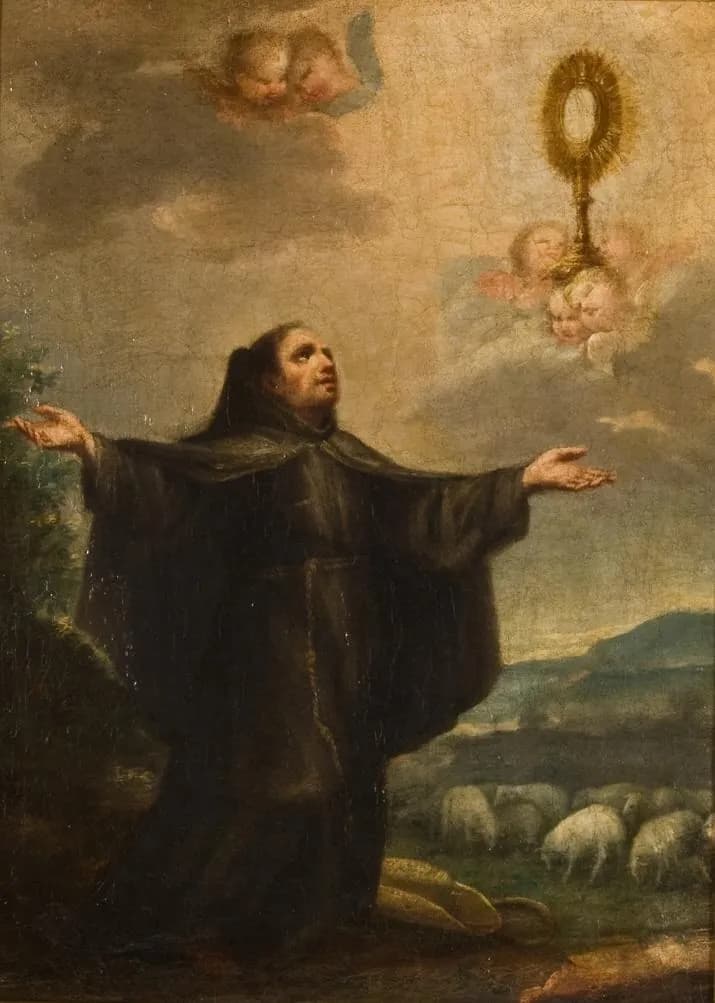
- Patron saint of
- Eucharistic congresses and associations 12345; shepherds, according to Franciscan Media 2
- Born
- Torre-Hermosa, in the Kingdom of Aragon, Spain 13; May 24, 1540 according to the Catholic Encyclopedia and Franciscan Media 12, May 16, 1540 according to the Friars Minor 3
Saint Paschal Baylon was a Spanish shepherd who became a Franciscan lay brother, spent his religious life as a porter, cook and beggar, and is the Church's patron of Eucharistic congresses and associations. 12 He never studied for the priesthood and could barely read, yet people of every station came to him for advice, and the 1911 Catholic Encyclopedia names devotion to the Eucharist as "the salient feature of his character." 13 He died in 1592 at a friary in Villa Real, near Valencia, and his feast is kept on May 17. 134
A shepherd from Aragon
He was born in 1540 at Torre-Hermosa, in the Kingdom of Aragon, on the feast of Pentecost. 13 In Spain that feast was called "the Pasch of the Holy Ghost," according to the encyclopedia, and that is where his name came from. 1 The sources disagree on the day: the encyclopedia and Franciscan Media give May 24, and the Friars Minor, his own order, give May 16. 123
His parents, Martin Baylon and Elizabeth Jubera, are described by the encyclopedia as "virtuous peasants" and by Franciscan Media as "poor and pious." 12 The Friars Minor add that it was a large family, and that the piety of the house came above all from his mother, who was very devoted to the Blessed Sacrament. 3
From the age of seven until he was twenty-four he kept sheep. 12 His father put him in charge of the flocks, and the Friars Minor say he spent whole hours of that work praying, meditating and singing to God and to the Virgin Mary. 3 Franciscan Media notes that he listened in the fields for the church bell rung at the Elevation during Mass. 2 It also records that he once offered to pay the owners of crops for any damage his animals had done. 2 He had no schooling to speak of; the Friars Minor say he taught himself to read while he was grazing the flock, and later learned to write a little. 3
According to the Friars Minor, he first came to know the reformed Franciscans at eighteen, at their friary in Monforte del Cid, and hoped to join them, but was turned away, perhaps because he was too young. He took work as a shepherd for a wealthy flock owner, Martino Garcia, who allowed him to stay at the friary and attend its Marian shrine. 3
Porter, cook and beggar
In 1564 he was received as a lay brother among the Friars Minor of the Alcantarine Reform, the branch of the order that took its name from Saint Peter of Alcantara. 123 The Friars Minor date his clothing in the habit to February 2, 1564, and his profession to the following year, at the friary of Orito. 3 Franciscan Media says he was urged to study for the priesthood and chose to remain a brother. 2
The work he was given was the work of a lay brother. Franciscan Media lists porter, cook, gardener and official beggar for the community. 2 Porter was the office he held longest: the Friars Minor say he kept the door at Orito until 1573, moved among the friaries of the province of Alicante until 1589, and spent his last three years at Villa Real, near Valencia, still acting as porter and beggar. 3
The door was where the poor came, and the sources agree on how he treated them. The encyclopedia calls his charity to the poor and afflicted "remarkable," and adds his "unfailing courtesy." 1 Franciscan Media says he gained a reputation for great generosity at the door, and that "the friars sometimes tried to moderate his liberality!" 2 It also says he kept the vow of poverty strictly and would waste nothing given for the friars' use. 2 The Friars Minor describe hard bodily penances, which he carried to the limit of what his body could stand. 3
Without education, he was still sought out for counsel. The encyclopedia says people "of every station in life" asked his advice, and that he was close friends with people of eminent holiness. 1 The Friars Minor say even "illustrious and erudite personalities" came to him. 3
The journey to France
The one episode in which he left Spain is recorded in all the detailed sources. The encyclopedia says that on a journey through France he defended the Real Presence of Christ in the Eucharist against a Calvinist preacher, and as a result "narrowly escaped death at the hands of a Huguenot mob." 1
The Friars Minor give the circumstances. In 1576 the minister provincial of Spain needed to send an urgent message to the minister general of the order in Paris, and sent Paschal at a time when much of France was held by Calvinists. On the road he was mocked, insulted and beaten, and at Orleans he was nearly stoned to death after an argument over the Eucharist in which he answered his opponents. 3 After he came home, the same source says, he wrote a small book of sentences on the Eucharist, which together with his answers in France earned him the name "theologian of the Eucharist." 3
Before the Blessed Sacrament
All the sources put the Eucharist at the center of his life. The encyclopedia says the devotion showed itself in him very early. 1 Franciscan Media says he spent his spare moments praying before the Blessed Sacrament. 2 The Friars Minor call it "the most evident mark of his life." 3 In art he is usually shown, as the encyclopedia puts it, "in adoration before a vision of the Host," and the Friars Minor name the monstrance as his main attribute. 13
The Friars Minor quote a passage from his own writings on prayer: "this is what you ask supremely: that God be sought above all else." 3
Death and canonization
According to the Friars Minor, he collapsed one day while begging in the town of Villa Real and did not recover, and he died at the friary of the Rosary there on Pentecost, the feast on which he had been born. 3 The encyclopedia also places his death on Whitsunday, at Villa Reale. 1 The date is again disputed: May 15, 1592 in the encyclopedia and Franciscan Media, May 17, 1592 in the Friars Minor. 123
Franciscan Media says people came to his tomb as soon as he was buried and that miracles were reported promptly. 2 He was beatified in 1618 and canonized in 1690. 12 The Friars Minor name the popes, Paul V and Alexander VIII. 3 The encyclopedia says his cult spread especially in Spain and southern Italy, and through the Spanish conquests into South and Central America. 1 The Friars Minor add that his remains at Villa Real were desecrated and scattered during the Spanish Civil War, and that some were recovered and returned to the city in 1952. 3
What is Saint Paschal Baylon the patron saint of?
He is patron of Eucharistic congresses and associations, a patronage given by Pope Leo XIII. 123 The sources describe it a little differently. The encyclopedia says Leo XIII, in an apostolic letter it names as Providentissimus Deus, declared him "the especial heavenly protector of all Eucharistic Congresses and Associations." 1 Franciscan Media says he was named patron of Eucharistic congresses and societies in 1897. 2 The Friars Minor say Leo XIII proclaimed him patron of "Eucharistic Works" on November 26, 1897, and shortly afterward patron of the International Eucharistic Congresses. 3 Vatican News and Pope Francis call him patron of the Eucharistic Associations. 45
Franciscan Media also lists him as patron of shepherds, the trade he followed until he was twenty-four. 2
Saint Paschal Baylon's feast day
His feast is kept on May 17. 125 Vatican News lists him under that date as "Franciscan lay, Patron of the Eucharistic Associations." 5 At the general audience of May 17, 2017, Pope Francis told the pilgrims, "Today, we celebrate the liturgical memorial of Saint Paschal Baylon, Patron of Eucharistic Associations." 4
May 17 is also the date the Friars Minor give for his death, while the encyclopedia and Franciscan Media put his death two days earlier, on May 15. 123
Praying with Saint Paschal Baylon
Most of his life was spent doing the jobs no one else in a friary is asked to do. He kept sheep until he was twenty-four, and afterward kept the door, cooked, gardened and went out begging for his community. 123 Franciscan Media says he was urged toward the priesthood and chose to stay a brother. 2 The record that survives is mostly a record of that work, and of the time he spent before the Blessed Sacrament when the work allowed. 23
Franciscan Media notes that Saint Francis wrote most of his letters to promote devotion to the Eucharist, and that Paschal shared the concern. Its reflection suggests that "an hour in prayer before our Lord in the Eucharist could teach all of us a great deal." 2 Pope Francis, on his feast, asked that his love for the Eucharist show young people "the importance of faith in the real presence of Jesus," and that the Eucharist support the sick and nourish newly married couples. 4
The life was not a sheltered one. The one time he was sent abroad, he was beaten and nearly stoned for what he said about the Eucharist, and came home and wrote about it. 13 The doorway where he spent his days was the place the poor came to, and the friars, according to Franciscan Media, sometimes had to rein in what he gave away. 2
His patronage came three centuries after his death, from Leo XIII, and attaches him to congresses and associations devoted to the Eucharist. 13 The sources tie it to the same thing they describe in his life: a brother who taught himself to read in the fields, whose counsel was sought by learned people, and who is shown in art kneeling before the Host. 13
Saint Paschal Baylon, pray for us.
Sources
- 1.Oswald Staniforth, "St. Pascal Baylon," The Catholic Encyclopedia, Vol. 11 (New York: Robert Appleton Company, 1911).
- 2."Saint Paschal Baylon," Saint of the Day, Franciscan Media.
- 3."St Paschal Baylón," Order of Friars Minor, May 17, 2024.
- 4.Pope Francis, General Audience, May 17, 2017, greetings to young people, the sick and newlyweds.
- 5."17 May," Saint of the Day, Vatican News.
Saints to turn to next
Others in this collection who are turned to for some of the same things.
- Saint André BessetteAugust 9, 1845 - January 6, 1937PrayerWork and vocationPoverty and simplicity
- Saint Benedict the Moor1524 or 1526 - April 4, 1589Work and vocationPoverty and simplicityPrayer
- Saint Isidore the Farmerc. 1070 - May 15, 1130Work and vocationPrayerPoverty and simplicity
- Saint Katharine DrexelNovember 26, 1858 - March 3, 1955Poverty and simplicityWork and vocationPrayer