Saint Onuphrius
d. c. 400
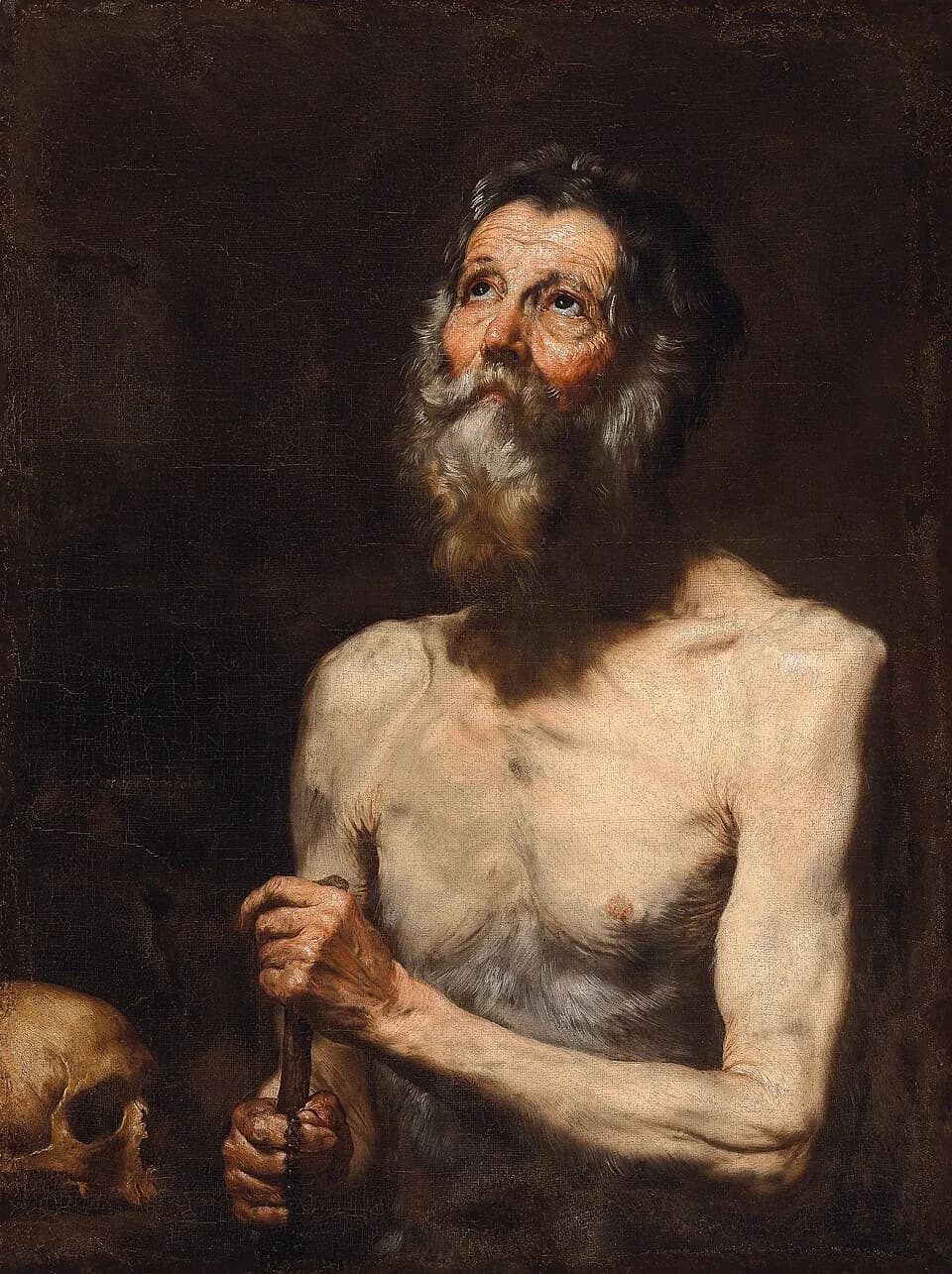
Saint Onuphrius was a monk of Egypt who left his monastery for the desert and lived there alone for sixty or seventy years, until a monk named Paphnutius came across him in his last days, heard his story, and buried him. 134 Nearly everything known about him comes from that one visitor. 3 His feast is June 12, and English has also called him Humphrey. 147
One witness
Vatican News puts the state of the evidence in a sentence: little is known of his life beyond what the monk Paphnutius reported. 3 Katolsk.no, the website of the Catholic Church in Norway, sets the scene. In the first Christian centuries the Theban desert of Upper Egypt held many hermits, living more severely than is easy to imagine, and Paphnutius, a pupil of Saint Macarius the Great, was the last of them. 1
Around the year 400, katolsk.no says, Paphnutius went out to visit the hermits because he wanted to find out whether their life was meant for him. 1 The Archdiocese of Gaeta, whose weekly page retold the story in 2025 for a town that keeps Onuphrius as its patron, describes what he met: an old man without clothes, a belt of leaves around his hips, his hair and beard as white as snow and reaching to his feet. 2 Paphnutius remembered him as radiant and majestic. 2
What the hermit told him
The old man told his story. He had been a monk at Hermopolis, which katolsk.no describes as a strict house of a hundred monks near Thebes. 13 He left it, Vatican News says, on the example of John the Baptist and Elijah, to take up what it calls the most perfect state of life, the solitude of the desert. 3 Katolsk.no adds one detail about his origins, that he was the son of an Egyptian tribal chief. 1
How he had stayed alive is told in more than one way. In the Gaeta article he says that his guardian angel led him to the place, that at first he ate only the scarce plants of the desert, and that later the angel began to bring him bread. Then a palm grew up beside his shelter and gave good dates, and a spring rose nearby. 2 Katolsk.no reports a tidier version from other sources, in which sixty years divide into three: twenty on bread and water, twenty on fruit and herbs, and twenty in which an angel brought him food from heaven. 1
Onuphrius himself, in the Gaeta telling, did not make much of the dates or the bread. He insisted that he was fed and given drink above all by the sweet words of God. 2 Paphnutius then asked him how, living as he did, he could receive communion. The answer was that an angel of God brought it to him every Saturday. 2
The last night
Food appeared for the two of them by a miracle, katolsk.no says, and they spent the whole night praising God. 1 In the morning Onuphrius told his guest that the Lord had let him know he was about to die, and that Paphnutius had been sent to bury him. 1 The Gaeta article has the same turn: the next day the old hermit said that this would be the day of his departure from the world. He knelt, prayed, and died. 2
Paphnutius saw a light on the body and heard angels singing. 2 Katolsk.no says he buried Onuphrius in a cave in the mountainside, and that the place at once disappeared, as though to tell him that he was not to stay there. 1 So he went back to his monastery and told everyone that the holy anchorite was dead. 2 Katolsk.no gives the day as June 12, about the year 400, and prints its own question mark after the date. 1
How much is certain
The sources do not agree on the numbers. Katolsk.no says he was alone for seventy years and Vatican News says more than seventy. 13 The Roman Martyrology, in its single line on him, says he lived devoutly for sixty years in the vastness of the desert, and katolsk.no notes that other sources say sixty too. 14 The Gaeta article places his desert life between 320 and 400. 2
Paphnutius is not easy to pin down either. Vatican News calls him a monk of the fifth century. 3 Katolsk.no explains that Paphnutius the Great is recorded as dying about 356, too early for a meeting around 400, so the author is now thought to be Paphnutius of Wadi Natrun, the desert of Scetis. 1 The 1911 Catholic Encyclopedia does know a Paphnutius in the Scetic desert at the right time, a priest and anchorite nicknamed the Buffalo for his love of solitude, whom John Cassian visited in 395 when he was in his ninetieth year. 8 It does not connect him with Onuphrius, and it would be guessing to do so here.
What can be said is that the story is old and traveled early. Katolsk.no says it was written down by one of Paphnutius's monks and was already popular in the sixth century. 1 Eugene Hyvernat, cataloging Coptic manuscripts for the encyclopedia, found a life of Onuphrius among the readings for the feasts of anchorites, and in another collection a life together with a eulogy of him by Pisenthios of Coptos. 5
From the Thebaid to the Janiculum
His veneration in the Coptic Church began as early as the seventh century, according to katolsk.no, and the crusaders carried it west, where he was greatly honored in the centuries that followed. 1 The same page calls him the only one of the desert fathers credited with a cult of his own in the West, and says that relics are kept in Munich and Brunswick, brought back from the Holy Land in 1171 by Duke Henry the Lion. 1
In Rome his name is on the Janiculum. The encyclopedia says the church of Sant'Onofrio was built there in 1439 by the de Cupis family and Nicolò da Forca Palena, and was served by the Hieronymites. 6 The Order of the Holy Sepulchre, whose headquarters Pius XII transferred to the church in 1948, adds that "there was a hermitage in this spot even before that," and that building went on into the sixteenth century. 7 The poet Torquato Tasso died in the convent and is buried in the church. 67 One of its five side chapels is dedicated, in the Order's English, to "Saint Humphrey." 7
A smaller place keeps him more loudly. The Benedictines of Montecassino built a little monastery near Campodimele, in the Aurunci hills of southern Lazio, and from then on, the Gaeta article says, the hermit has been the chief intercessor of the people there. 2 In 2025 the town marked nine hundred years since that first monastery was restored, and the archbishop of Gaeta came on June 12 to say Mass and walk in the procession. 2
Artists nearly always show him as Paphnutius saw him, covered by his own hair and a girdle of leaves. 1 Katolsk.no lists what else may appear with him: a chain, a cross, a host, a crown or a scepter, sometimes an angel bringing him bread or the Eucharist. 1 Now and then two lions dig his grave, which katolsk.no calls a confusion with the story of Saint Paul the Hermit. 1
What is Saint Onuphrius the patron saint of?
Saint Onuphrius is the patron saint of weavers. Katolsk.no states it and offers a probable reason with a straight face: he wore nothing but a loincloth of leaves and his own hair, which grew the length of his body. 1 No other source used here names a trade or a cause.
He is also the patron of Campodimele, the hill town in the Archdiocese of Gaeta, whose people call on him constantly and celebrate him every June. 2
Saint Onuphrius's feast day
Saint Onuphrius's feast day is June 12. Katolsk.no gives that as his memorial day and says his name stands in the Roman Martyrology, which does enter him on it, in Egypt, as an anchorite. 14 Vatican News lists him among the saints of June 12, and the Gaeta article says the Catholic and Orthodox churches both remember him then. 23 The Coptic manuscripts that Hyvernat cataloged put his feast on Payni 16, which he reckons as June 10. 5
Praying with Saint Onuphrius
There is very little here to imitate in any literal way. Nobody reading this is going to walk into the Egyptian desert and stay for seventy years, and the sources do not suggest that anyone should. Vatican News calls the solitude he chose the most perfect state of life, and leaves it at that. 3
What the story does preserve is the order of his attention. Asked about food, he talked about the words of God. 2 Asked about the Eucharist, he had an answer ready, because even alone he had not gone without it. 2 The palm tree and the spring are in the account, but he mentions them almost in passing.
It is also worth seeing how close the whole life came to leaving no trace. He spent sixty or seventy years unseen. 14 One man arrived at the very end, stayed a night, and buried him. 12 Everything the Church knows of Onuphrius rests on that visit. 3
Paphnutius had gone out to learn whether the hermit life was for him. 1 The grave was hidden as soon as he closed it, which the story reads as his answer, and he went home to tell the others. 12 His part was to carry the story back, and that is the only reason there is a feast on June 12.
Saint Onuphrius, pray for us.
Sources
- 1.Per Einar Odden, "Den hellige Onofrios ( -~400?)," Den katolske kirke (the Catholic Church in Norway), last updated February 16, 2001 (in Norwegian).
- 2.Paolo Andrea Natta, "Campodimele festeggia il Patrono," Lazio Sette, page of the Archdiocese of Gaeta, June 8, 2025 (in Italian).
- 3."Sant'Onofrio, anacoreta," Santo del giorno, June 12, Vatican News (in Italian).
- 4.Roman Martyrology, entry for June 12, "Sant'Onofrio, anacoreta," as printed in "Santo del giorno," Conferenza Episcopale Italiana (in Italian).
- 5.Eugene Hyvernat, "Coptic Literature," The Catholic Encyclopedia, Vol. 16 (New York: The Encyclopedia Press, 1914).
- 6.Umberto Benigni, "Rome," The Catholic Encyclopedia, Vol. 13 (New York: Robert Appleton Company, 1912).
- 7."The Grand Magisterium of the Order," Equestrian Order of the Holy Sepulchre of Jerusalem, vatican.va.
- 8.Maurice Hassett, "Paphnutius," The Catholic Encyclopedia, Vol. 11 (New York: Robert Appleton Company, 1911).
Saints to turn to next
Others in this collection who are turned to for some of the same things.
- Saint Agnes of Bohemiac. 1200-1205 - March 1281 or 1282Poverty and simplicityPrayer
- Saint Aidan of Lindisfarnec. 590 - August 31, 651Poverty and simplicityPrayer
- Saint Alexius of RomeFifth century, by traditionPoverty and simplicityPrayer
- Saint André BessetteAugust 9, 1845 - January 6, 1937PrayerPoverty and simplicity