Saint Olaf
995 - July 29, 1030
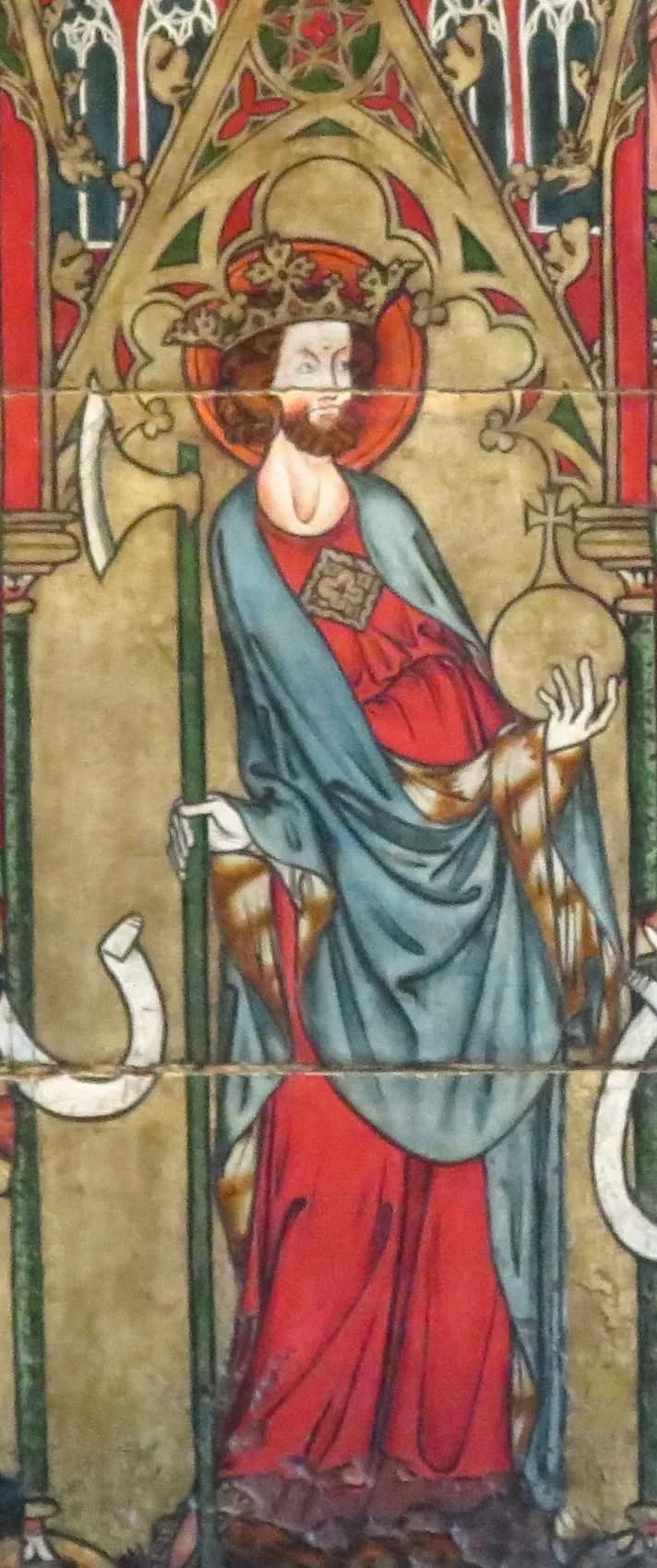
- Patron saint of
- Norway, in the words of John Paul II: "Saint Olav, Patron of Norway" 6
- Feast day
- July 29, the day of his death 715; in the General Roman Calendar, July 29 is the Memorial of Saints Martha, Mary and Lazarus 16
- Also called
- King Olaf II of Norway; Olav in Norway 7
- King of Norway
- 1015-1030, as the 1911 encyclopedia dates his reign 1
Saint Olaf spent his teens as a Viking raider, was baptized in Normandy, and came home to make Norway a Christian kingdom, by preaching and law where that worked and by the sword where it did not. 191011 He was killed fighting his own rebellious subjects at Stiklestad on July 29, 1030, and that winter many of the people who had turned against him began to call him a holy man. 17 John Paul II called him "Patron of Norway," and his feast is July 29. 6715
A difficult man to describe
Most written sources for Olaf Haraldsson's life are two centuries later than he is, and Father Olav Müller, a Norwegian priest whose life of the king was printed in 1993, adds: "Nor can we always trust them fully." 8 The portraits vary accordingly: "For some he is a brutal psychopath - for others, a bloodless saint like an angel - for still others, a genius as a military leader and a capable king who makes use of Christianity to further his political goals." 8
The 1911 Catholic Encyclopedia is plainer: he was the son of King Harald Grenske and was born in 995. 1 The Catholic News Agency adds that his father was a local king in Vestfold whom Olaf never met, and that Norwegians spell his name Olav. 7
The Viking years
According to Müller, Olaf first went to sea on a warship at twelve. 9 He raided in the Baltic and then spent three years harrying southeast England, in the campaign in which Vikings took Canterbury in 1011 and killed its archbishop, Alphege. 9 The encyclopedia says only that he "went as a viking to England, where he partook in many battles and became earnestly interested in Christianity." 1
Müller does not soften what that life involved. "When he stole property from poor people, when he killed those who offered resistance, when he captured people and sold them as slaves, when he dishonoured women and burnt villages, it never occurred to him that he was acting badly," he writes. 9 The Catholic News Agency tells of a dream, as he prepared to sail into the Mediterranean, in which a man told him to "go back to Norway," where he "shall be king forever"; historical or not, Olaf came to treat his return as "a matter of conscience." 7
Baptism in Normandy
For his baptism, the encyclopedia sets aside the saga writer Snorri's date of 998, in Norway, and says it was "more probably about 1010 in Rouen, France, by Archbishop Robert." 1 Müller and the Catholic News Agency place it in the winter of 1013-1014, which Olaf spent at Rouen as the guest of Duke Richard II of Normandy. 107 Müller is careful to say that this was no sudden conversion. 10
King, lawgiver, and the sword
After many battles he was accepted as king. 17 The encyclopedia says he "made it his object to extirpate heathenism and make the Christian religion the basis of his kingdom," and brought bishops and priests from England, among them Grimkel. 1 It calls him "the great Norwegian legislator for the Church." 1 At Moster in the 1020s, Müller writes, Bishop Grimkel and the king established the Christian law: newborn children were not to be exposed to die, slaves were to be ransomed each year, a man was to have one wife, and rape and the abduction of women were severely punished. 11 For centuries afterward, the whole law of the land was called "St Olav's law." 11
The encyclopedia also says that, like his ancestor Olaf Tryggvason, he "made frequent severe attacks on the old faith and customs, demolishing the temples and building Christian churches in their place." 1 Müller is more specific. The coast was largely Christian already, paganism held on inland, and Snorri "tells us repeatedly that those who were not willing to accept baptism were threatened with the loss of their lives, their limbs and their property." 11 Müller writes that Olaf "burnt pagan sanctuaries, burned farms, killed or mutilated pagans who resisted him," and adds that his English clergy held to "the Catholic Church's teaching that no pagan may be compelled to become a Christian." 11
His defense of Olaf is that a king of that age took for granted his right to decide his subjects' religion, and that Olaf, whose model was Charlemagne, acted "in subjective good faith." 11 Müller does not use that to excuse him. Olaf must have believed he was doing God's will, he writes, "but his mind - i.e., the feelings that filled him when he acted violently like this - must have been anything but Christian." 11
Rebellion and exile
Olaf punished the great chieftains as severely as small men, and Müller quotes Snorri on the result: people "could not endure his righteousness." 11 The encyclopedia says the clans rose and appealed to Cnut, king of Denmark and England, who was elected king of Norway in his place, and that the resentment "was due not alone to his Christianity, but also in a high degree to his unflinching struggle against the old constitution of shires and for the unity of Norway." 1 Müller writes that Cnut bought many of the chieftains with gold, and that Olaf fled through Sweden to Novgorod. 12 The encyclopedia gives the exile as two years. 1
Stiklestad
He came back with an army and met his rebellious subjects at Stiklestad on July 29, 1030. 1 In Müller's account he knew his chances were slim; he refused to let his men burn the farmers' farms on the way, saying it was better not to go into battle "with stolen goods," and gave money for Requiem Masses for the enemy soldiers who would die. 13
He was mortally wounded, and the encyclopedia says he fell "praying 'God help me'." 1 Müller quotes the saga's version, that he leaned against a stone and "threw away his sword, asking God to help him," and then says he doubts it: no Norse warrior would willingly throw down his sword, and "the pious tradition likes to paint its heroes in «details of martyrdom»." 13 He adds: "Saint Olav does not need these, for he is a martyr." 13
A saint within a year
The Church in Norway's account, as the Catholic News Agency quotes it, says: "That winter, there were many in Trondheimen who began to say that king Olaf was truly a holy man and that many wonders took place because of his holiness." 7 The encyclopedia says that "many miraculous occurrences are related in connection with his death and his disinterment a year later." 1 Bishop Grimkel had the body dug up, and Müller reports Snorri's account of a wonderful fragrance and a face ruddy as if asleep. 14 Grimkel and Earl Einar placed the coffin on the high altar of St. Clement's church in Nidaros, now Trondheim. 1 At the time, Müller explains, it was the local bishop and not the pope who canonized a saint, and Grimkel did so. 14
Müller is direct about the question of martyrdom. The English Church of the period counted Christian kings who died fighting pagans as martyrs, and "naturally, Olav knew very well that he was not fighting against pagans at Stiklestad." 14 He argues that Olaf still gave his life for Christ, since without a united kingdom Christianity in Norway would have stayed a thin covering. 14 He also quotes Bonaventure: "Do you not know that many saints were sinful?" 14
His cult spread to Denmark, Sweden and London, and the arms of Norway show a lion holding his battle-axe. 1 Nidaros Cathedral, now Lutheran, was built over his grave, and John Paul II prayed there with Norwegian Lutherans in 1989, saying that "both Protestants and Catholics in Norway look to Saint Olav for their roots in the past." 5 At Mass in Oslo on the same visit he said that "the life and martyrdom of the great Saint Olav marked the 'Baptism' of the Norwegian peoples." 2
What is Saint Olaf the patron saint of?
Norway. John Paul II called him "Saint Olav, Patron of Norway" in 2002, and in 1989 described Nidaros Cathedral as "the hallowed national shrine where Saint Olav, King and Martyr, is buried." 63 At an ecumenical service in Oslo he spoke of "the great martyr Saint Olav, to whom both Catholics and Protestants now look as a source of inspiration." 4 None of the sources consulted names any other patronage.
Saint Olaf's feast day
His feast is July 29, the anniversary of his death at Stiklestad. The Catholic News Agency says he "is celebrated in the Church on July 29," and the Catholic Church in Norway lists the same date as his memorial day. 715 In the General Roman Calendar the date is given to other saints: in 2021 Pope Francis decreed that July 29 be designated "the Memorial of Saints Martha, Mary and Lazarus." 16
Praying with Saint Olaf
None of his Catholic biographers tries to tidy him up. The Church in Norway publishes a life of him that describes the farms he burned and the people he mutilated, and the 1911 encyclopedia calls his attacks on the old religion "severe." 111
Müller's account is of a conversion that took years and kept failing. Bishop Grimkel, he writes, had witnessed "how Olav's cooperation with God's grace had broken down," and had seen just as often how Olaf picked himself up and took up the struggle afresh. 14 He changed slowly, sometimes at other people's cost, and kept going.
The sources also keep returning to justice. The law that carried his name forbade the exposure of infants and required slaves to be ransomed, and Snorri says he would rather have lost his kingdom than judge anyone unjustly. 11 At Stiklestad, Müller says, he paid for Requiem Masses for the enemy soldiers who would fall. 13
He went into that battle sensing he would die. 13 Bishop Erik Varden of Trondheim, looking toward the thousandth anniversary of Stiklestad, said that a life lived in the service of the Gospel "brings freedom and flourishing but not necessarily success." 7
Saint Olaf, pray for us.
Sources
- 1.Niels Hansen, "St. Olaf Haraldson," The Catholic Encyclopedia, Vol. 11 (New York: Robert Appleton Company, 1911).
- 2.John Paul II, Homily at Holy Mass in the square adjacent to Akershus Castle, Oslo, June 1, 1989.
- 3.John Paul II, Address at the welcome ceremony at Fornebu International Airport, Oslo, June 1, 1989.
- 4.John Paul II, Address at the ecumenical meeting at Akershus Castle, Oslo, June 1, 1989.
- 5.John Paul II, Address at the ecumenical meeting in the Lutheran Cathedral of Nidaros, Trondheim, June 2, 1989.
- 6.John Paul II, Address to a Delegation from the Lutheran Diocese of Nidaros (Norway), November 16, 2002.
- 7.Emma Silvestri, "Norway begins preparations for Jubilee of St. Olaf in 2030," Catholic News Agency, February 18, 2024.
- 8.Olav Müller, SS.CC., Saint Olav - King of Norway, Foreword, translated by Brian McNeil, CRV (Maximilian, 1993). Published online by the Catholic Church in Norway (katolsk.no).
- 9.Olav Müller, SS.CC., Saint Olav - King of Norway, ch. II, "Olav the Viking," translated by Brian McNeil, CRV. Catholic Church in Norway (katolsk.no).
- 10.Olav Müller, SS.CC., Saint Olav - King of Norway, ch. III, "As a guest of duke Richard II in Normandy," translated by Brian McNeil, CRV. Catholic Church in Norway (katolsk.no).
- 11.Olav Müller, SS.CC., Saint Olav - King of Norway, ch. VII, "Olav and the work of Christianisation," translated by Brian McNeil, CRV. Catholic Church in Norway (katolsk.no).
- 12.Olav Müller, SS.CC., Saint Olav - King of Norway, ch. VIII, "Canute the mighty conquers Norway," translated by Brian McNeil, CRV. Catholic Church in Norway (katolsk.no).
- 13.Olav Müller, SS.CC., Saint Olav - King of Norway, ch. XI, "Martyrdom," translated by Brian McNeil, CRV. Catholic Church in Norway (katolsk.no).
- 14.Olav Müller, SS.CC., Saint Olav - King of Norway, ch. XII, "The Canonisation," translated by Brian McNeil, CRV. Catholic Church in Norway (katolsk.no).
- 15."Olav den hellige (995-1030)," Helgener, salige og andre, Den katolske kirke (Catholic Church in Norway), which gives his memorial day (minnedag) as July 29.
- 16."Memorial of Saints Martha, Mary and Lazarus - July 29," Liturgical Year calendar, Catholic Culture.
Saints to turn to next
Others in this collection who are turned to for some of the same things.