Saint Odilo of Cluny
c. 962 - December 31, 1048 or January 1, 1049
- Born
- About 962, of the nobility of Auvergne 1
- Called
- "Archangel of the Monks," by Fulbert of Chartres 1
- Wrote
- A life of the Empress Saint Adelaide, a life of his predecessor Mayeul, sermons and hymns 1
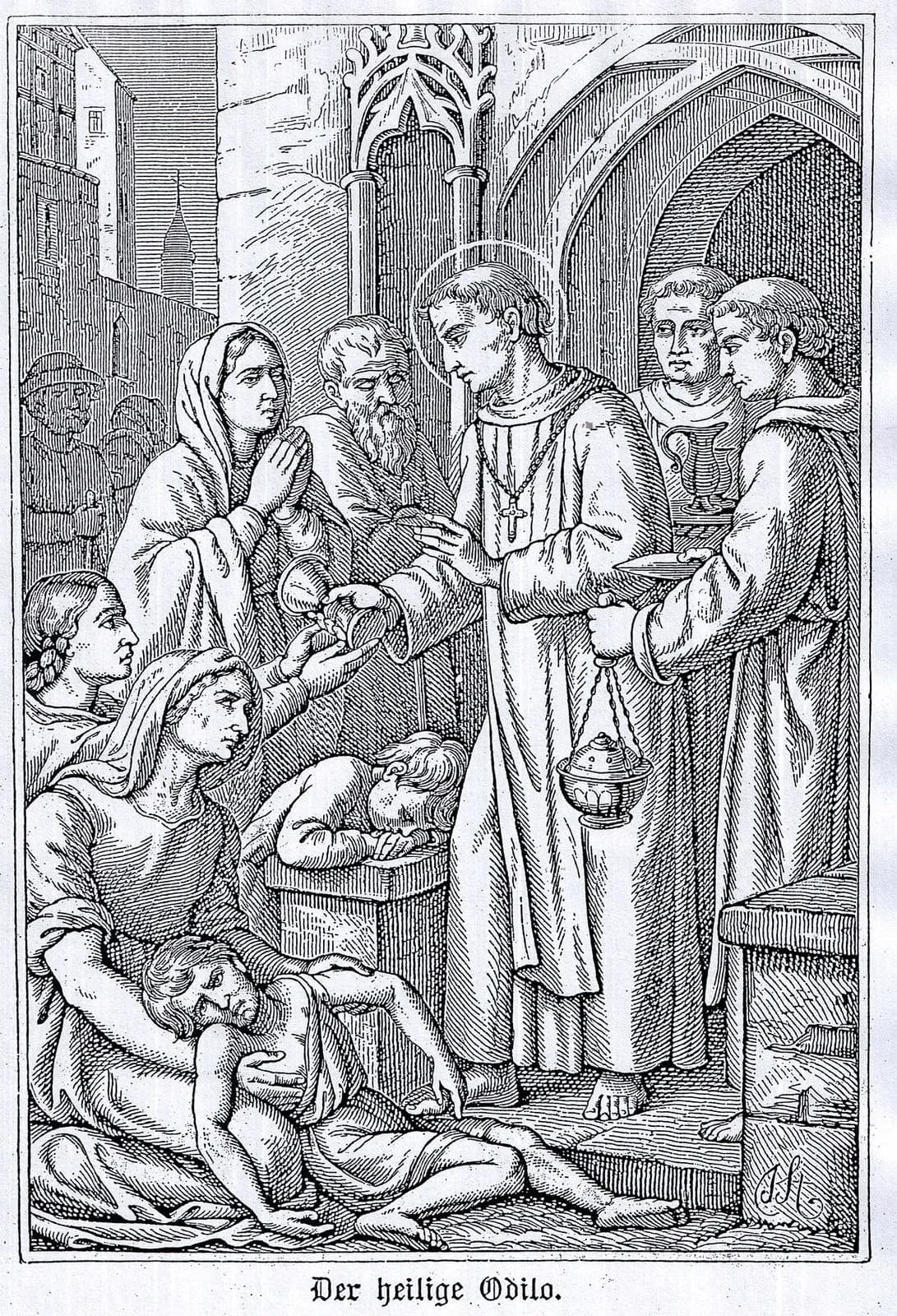
Saint Odilo of Cluny was the fifth abbot of the great Burgundian monastery, which he ruled for more than fifty years, and the man who first ordered his monks to pray for all the dead on the day after All Saints. 12 The custom spread from Cluny to the whole Church and is now All Souls' Day. 14 The Roman Martyrology remembers him as severe with himself and gentle and merciful with others, a peacemaker between warring peoples, and a refuge for the starving in time of famine. 2
From Auvergne to Cluny
Odilo was born about 962 into the nobility of Auvergne, and as a young man became a cleric at the seminary of Saint-Julien in Brioude. 1 In 991 he entered Cluny. Before his year of probation was out, Abbot Mayeul made him his coadjutor, and shortly before Mayeul died in 994 Odilo was made abbot and received holy orders. 1 He would hold the office until his death, a span his successor's biographer in the same encyclopedia calls "nigh on half a century." 5
Cluny had been founded in 910 by William the Pious, Duke of Aquitaine, and placed under Saint Berno. 6 Benedict XVI, in a 2009 audience on the Cluniac reform, named Odilo among the "truly worthy people" who governed it in turn, and noted that their long abbacies gave the reform stability. 3 The abbots of Cluny were chosen by their monks, free of any civil authority, and Cluny and its dependent houses answered directly to the pope rather than to the local bishops. 3
Abbot
Löffler, who wrote the 1911 Catholic Encyclopedia article, credits Cluny's rapid growth under Odilo "chiefly to his gentleness and charity, his activity and talent for organizing." 1 He calls him a man of prayer and penance, zealous for the Divine Office, who encouraged learning, had the monk Radolphus Glaber write a history of the times, and put up a magnificent new monastery building. 1 The number of monasteries attached to Cluny rose under him from thirty-seven to sixty-five. 1 By keeping the houses he reformed in permanent dependence on Cluny, Löffler says, Odilo prepared the way for the union of monasteries that his successor Hugh completed. 1
His contemporaries noticed. Fulbert of Chartres called him the "Archangel of the Monks." 1 Two popes, John XIX and Benedict IX, offered him the archbishopric of Lyons, and he refused it both times. 1 He traveled to Italy nine times and sat in several synods there. 1
Among emperors
From 998 Odilo had the confidence of the Emperor Otto III, and he was close to his successor Henry II, though Löffler notes that Henry, for political reasons, tried to limit the independence of the German monasteries. 1 Vatican News, writing about Henry, says Odilo was one of the emperor's counselors and that Henry supported the reform that went out from Cluny. 7 In Germany, Löffler admits, the Cluniac program never took lasting hold, because the monks there "were more inclined to individualism." In 1046 Odilo was in Rome for the imperial coronation of Henry III. 1
He was related, Löffler says, to the Empress Adelaide, and wrote her life; he also wrote a short life of his predecessor Mayeul, sermons for the feasts of the year, hymns and prayers. Most of his correspondence is lost. 1 Löffler adds that Odilo and his monks fought particular abuses, such as simony and the marriage of clergy, rather than following any political program, and that the popes, when they set about reforming the Church, could count above all on the religious of Cluny. 1
The Peace of God and the famine
Two things the Martyrology singles out in its brief entry are peace and hunger: it says he made peace between warring peoples in the name of God, and in time of famine helped the afflicted by every means he had. 2 Löffler supplies the details. From 1041 Odilo worked for the conclusion of what Löffler calls the Peace of God, the Treuga Dei, which he judges "of great economic importance." 1 Benedict XVI described the Truce and the Peace of God as two institutions promoted by Cluny that marked medieval civilization. 3 During the great famines of those years, especially 1028 to 1033, Odilo "exercised his active charity and saved thousands from death." 1
All Souls' Day
Prayer for the dead was very old by Odilo's time. The encyclopedia's article on All Souls' Day traces it from the names of the departed read out in the early Church, through a commemoration of deceased monks at Pentecost in sixth-century Benedictine houses, to a German custom of praying for the dead on October 1. 4 What Odilo did was to fix a day. He ordered the commemoration of all the faithful departed to be kept every year in the monasteries of his congregation, and from there it spread to other Benedictines and to the Carthusians. 4 The Martyrology says he was the first to institute it, on the day after the feast of All Saints. 2
When he did so is less clear. Löffler puts it "probably not in 998 but after 1030," and says the day "was soon adopted in the whole church." 1 Benedict XVI, speaking in November 2009, credited the monks of Cluny with enriching the calendar with "the Commemoration of All Souls, which we too have just celebrated," and explained why it fit them: the monks felt responsible "for interceding at the altar of God for the living and the dead." 3
Death at Souvigny
Odilo died while on a visitation to the monastery of Souvigny, and was buried there; he was soon venerated as a saint. 1 The date depends on whom one reads. Löffler gives December 31, 1048. 1 Kennedy, in the encyclopedia's article on Hugh, gives January 1, 1049, and the current Roman Martyrology keeps his passing on January 1. 25 In 1063 Saint Peter Damian took up the cause of his canonization and wrote a short life, drawn from the fuller biography by Jotsald, a monk who had traveled with him. 1 His relics, with those of Mayeul, were burned by revolutionaries in 1793 "on the altar of the fatherland." 1
What is Saint Odilo of Cluny the patron saint of?
Saint Odilo of Cluny's feast day
Praying with Saint Odilo of Cluny
The Martyrology's description of him is a good one to sit with: severe with himself, gentle and merciful with others. 2 Most people find the opposite easier, lenient inward and exacting outward. Löffler, for his part, puts Cluny's growth under Odilo down to his gentleness and charity before anything else. 1
His best-known act is a simple one. The dead were already prayed for; he gave them a day, and made the remembering regular. 4 Benedict XVI saw in it the conviction that the monks were responsible for interceding "for the living and the dead," because so many people had asked to be remembered. 3 The whole Church now keeps the day he set apart. 1
The famine years belong in the same picture. The abbot who arranged a day of prayer for the dead was also, in the same decades, keeping the living from becoming dead. 1 Löffler puts the number at thousands. 1
Saint Odilo of Cluny, pray for us.
Sources
- 1.Klemens Löffler, "St. Odilo," The Catholic Encyclopedia, Vol. 11 (New York: Robert Appleton Company, 1911).
- 2.Roman Martyrology, entry for January 1, "Transito di sant'Odilone, abate," as printed in "Santo del giorno," Conferenza Episcopale Italiana (in Italian).
- 3.Benedict XVI, General Audience on the Cluniac reform, November 11, 2009, Libreria Editrice Vaticana.
- 4.Francis Mershman, "All Souls' Day," The Catholic Encyclopedia, Vol. 1 (New York: Robert Appleton Company, 1907).
- 5.Thomas Kennedy, "St. Hugh the Great," The Catholic Encyclopedia, Vol. 7 (New York: Robert Appleton Company, 1910).
- 6.George Cyprian Alston, "Congregation of Cluny," The Catholic Encyclopedia, Vol. 4 (New York: Robert Appleton Company, 1908).
- 7."St Henry II, Emperor," Saint of the Day, July 13, Vatican News.
Saints to turn to next
Others in this collection who are turned to for some of the same things.
- Saint Agnes of Bohemiac. 1200-1205 - March 1281 or 1282Poverty and simplicityPrayer
- Saint Aidan of Lindisfarnec. 590 - August 31, 651Poverty and simplicityPrayer
- Saint Alexius of RomeFifth century, by traditionPoverty and simplicityPrayer
- Saint André BessetteAugust 9, 1845 - January 6, 1937PrayerPoverty and simplicity