Saint Nonna
Died August 5, 374
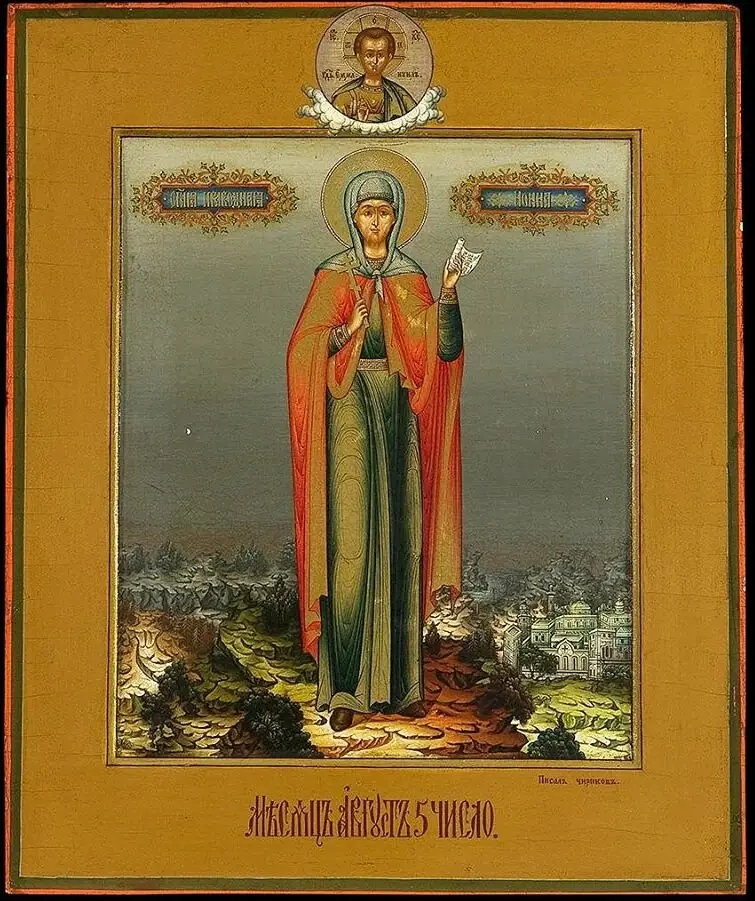
Saint Nonna was a Christian woman of Cappadocia who prayed her husband into the Church, saw him become bishop of Nazianzus, and raised three children who are all honored as saints: Gregory Nazianzen, the theologian, Caesarius the physician, and Gorgonia. 145 Nearly everything known about her comes from her son Gregory, who spoke about her in the funeral orations he gave for her husband and for two of her children, with her listening. 123 She died in 374, and her feast is August 5. 456
Born into the faith
Nonna was a Christian from birth. Her son Gregory says she was "consecrated to God by virtue of her descent from a saintly family," possessed of piety "as a necessary inheritance, not only for herself, but also for her children." 2 In his oration for his father he describes her as having "received virtue as her patrimony; not, as he had been, cut out of the wild olive and grafted into the good olive." 1 Fabio Arduino, on santiebeati, says she was born toward the end of the third century and raised as a Christian by her parents. 5
Her husband, Gregory, belonged to a sect his son calls the Hypsistarii, a mixture of "Greek error and legal imposture": they rejected idols and sacrifices but reverenced fire and lights, kept the Sabbath and food laws but despised circumcision, and said they worshiped the Almighty alone. 15 katolsk.no places the couple at Arianzus, a remote estate near Nazianzus in Cappadocia. 4
Praying her husband home
She could not bear, her son says, "the being but half united to God, because of the estrangement of him who was a part of herself." 1 So "she fell before God night and day, entreating for the salvation of her head with many fastings and tears," and worked on her husband "by means of reproaches, admonitions, attentions, estrangements, and above all by her own character." 1 "The drop of water constantly striking the rock was destined to hollow it." 1
The turning point was a dream. Her husband dreamed that he was singing a verse he did not know, from the psalms: "I was glad when they said to me, we will go into the house of the Lord." 1 When Nonna heard it, Gregory says, she "seized the opportunity," told him the vision would bring the greatest joy if it were fulfilled, and pressed him on before anything could get in the way. 1 Bishops were passing through on their way to the Council of Nicaea, and he asked them for baptism. 1 katolsk.no dates his conversion to 325. 4
He became a priest and then bishop of Nazianzus; katolsk.no says he was made bishop about 328 and held the see for forty-five years. 45 Gregory, looking back, says of his parents' marriage that "while they excelled all others, they could not excel each other, because in virtue they were quite equally matched." 1 In his oration for Gorgonia he calls them "the Abraham and Sarah of these our latter days, Gregory and Nonna his wife." 3
The woman her son described
Gregory's portrait of her is specific. She had no use for cosmetics, "worthy of women on the stage," and acknowledged "but one kind of beauty, that of the soul." 1 She ran her household as carefully as if she knew nothing of piety and gave herself to God as fully "as if absolutely released from household cares." 1 She was devoted to the poor, the orphan and the widow. 1
He asks, "What time or place for prayer ever escaped her?" and describes her fasting and keeping vigil and standing "like a pillar at the night long and daily psalmody." 1 In church her voice was heard only in the responses; she never turned her back to the altar; and however many her own griefs, she would not let a tear fall or a sound of mourning escape before the Eucharist or on a feast. 1
Her husband trusted her with the greater part of the family's giving. "Not even the Atlantic Ocean," Gregory says, "could meet her drafts upon it." She would, "as I have often heard her say, have gladly sold herself and her children into slavery, had there been any means of doing so, to expend the proceeds upon the poor." 1
A mother of saints
She promised Gregory to God before he was born and dedicated him as soon as he was born. 1 He calls himself her favorite. 1 When her two sons were away studying, one at Alexandria and one in Greece, she prayed that as she had sent them out together she might see them come home together; without any plan of their own they arrived at Byzantium at the same time, which Gregory attributes to her prayer. 2
Gregory tells two stories in which her prayers or her presence reached across a distance. Once, when she was gravely ill and could not eat, she dreamed that he came to her at night with a basket of white loaves, blessed them and fed her; the next morning she was better and told him, "My child, you most readily and kindly fed me, and then you ask how I am." 1 Another time he was caught in a storm at sea, unbaptized and afraid; his parents learned of his danger in a dream and prayed, and a boy on board dreamed he saw Nonna "walk upon the sea, and seize and drag the ship to land." 1
She outlived two of her children. Caesarius, the physician, died in his prime, and Gregory describes his mother at the funeral "substituting the festal garments of religion for the trappings of woe," overcoming her tears and lulling her laments "to sleep" with psalms. 2 She promised to give away his whole estate as a funeral offering for him, leaving nothing to those who had expected to inherit it. 2 Gorgonia died with "her aged mother" bending over her. 3 katolsk.no notes that Nonna heard the funeral orations Gregory gave for both. 4
Widowhood and death
Her husband died in 374, very old. 1 Gregory gave his funeral oration with Nonna present, the translators note, and with Saint Basil there too. 1 Near its end he turned and spoke to her directly: "You have borne, in a most brave, Christian spirit, the loss of children, who were still in their prime and qualified for life; bear also the laying aside of his aged body by one who was weary of life." 1 He reminded her that he was still there to care for her, "your Isaac," and asked only for "a mother's blessing and prayers." 1
She did not outlive her husband by long. katolsk.no and Arduino both say she died a few months after him, in 374; katolsk.no says she was over ninety, Arduino only that she was very old. 45
What is Saint Nonna the patron saint of?
Saint Nonna's feast day
Saint Nonna's feast day is August 5. 45 The current Roman Martyrology, as the Italian bishops publish it, remembers her on that day at Nazianzus in Cappadocia, "moglie del santo vescovo Gregorio il Vecchio e madre dei santi Gregorio il Teologo, Cesario e Gorgonia," wife of the holy bishop Gregory the Elder and mother of Saints Gregory the Theologian, Caesarius and Gorgonia. 6 Arduino gives August 5 as the anniversary of her death in 374. 5
Praying with Saint Nonna
She married a man who did not share her faith and did not pretend that it did not matter to her. Her son lists what she used: prayer, fasting, tears, argument, affection, distance, and above all the way she lived. 1 It took years. 1
Everything we know of her comes through a son who loved her, speaking in public, which is reason to read him as a son. 1 But the details he chose are not general praise. A woman who would not cry before the Eucharist however much she was grieving, and who said she would have sold herself to feed the poor, is somebody in particular. 1
She buried two of her children and her husband. At her son's funeral she put on festal clothes and sang psalms, and the grief was no less for that. 2 Gregory did not tell her not to grieve. He told her to bear it, and to keep blessing him. 1
Saint Nonna, pray for us.
Sources
- 1.Gregory Nazianzen, Oration 18, "On the Death of His Father," with the translators' introduction, trans. Charles Gordon Browne and James Edward Swallow, Nicene and Post-Nicene Fathers, Second Series, Vol. 7 (Buffalo, 1894), revised by Kevin Knight, New Advent.
- 2.Gregory Nazianzen, Oration 7, "Panegyric on His Brother S. Caesarius," trans. Charles Gordon Browne and James Edward Swallow, Nicene and Post-Nicene Fathers, Second Series, Vol. 7 (Buffalo, 1894), New Advent.
- 3.Gregory Nazianzen, Oration 8, "On His Sister Gorgonia," trans. Charles Gordon Browne and James Edward Swallow, Nicene and Post-Nicene Fathers, Second Series, Vol. 7 (Buffalo, 1894), New Advent.
- 4.Per Einar Odden, "Den hellige Nonna," Helgener, Den katolske kirke, katolsk.no (in Norwegian).
- 5.Fabio Arduino, "Santa Nonna," with the Roman Martyrology entry, Santi, beati e testimoni, santiebeati.it (in Italian).
- 6.Roman Martyrology, entries for August 5, Santo del giorno, Conferenza Episcopale Italiana (in Italian).
Saints to turn to next
Others in this collection who are turned to for some of the same things.