Saint Nicholas I
c. 800 or c. 820 - November 13, 867
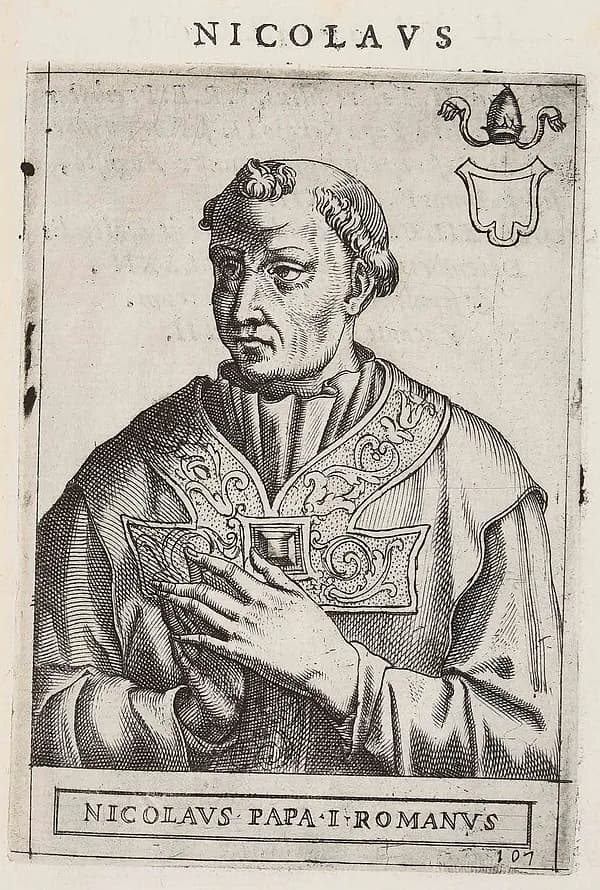
Saint Nicholas I was pope for nine years, from 858 to 867, and in that time he overruled a king who wanted a new wife, deposed archbishops who helped him, and refused to recognize a patriarch of Constantinople installed by the emperor. 12 Catholic writers count him, with Leo I and Gregory I, among the popes called "the Great." 34 His feast is November 13. 5
A Roman deacon
He was born in Rome, and the sources do not agree on when. Johann Peter Kirsch, in the Catholic Encyclopedia, says the date is unknown; Vatican News says "around the year 800"; Fr. William Saunders, writing for Catholic Answers, says "about 820." 135 His family was distinguished. The encyclopedia calls his father, Theodore, a defensor; Saunders says he was an official in the papal administration. 13
Nicholas entered the service of the Church young. Pope Sergius II made him a subdeacon and Leo IV made him a deacon, and according to Saunders he was a trusted adviser to Benedict III. 13 Kirsch describes him as already known for "piety, benevolence, ability, knowledge, and eloquence." 1
Benedict died on April 7, 858. The emperor Louis II, who was near Rome, came into the city to influence the election, and on April 24 Nicholas was chosen and, the same day, "consecrated and enthroned in St. Peter's in the presence of the emperor." 1 Saunders dates the election April 22; the Holy See's list of popes has April 24. 38 A few days later the new pope visited the emperor's camp outside the walls, and Louis came out to meet him and led his horse for some distance. 1
Archbishops called to account
Kirsch paints the Europe of 858 in dark colors. Charlemagne's empire "had fallen to pieces," Christian territory was threatened from north and east, and "many bishops were worldly and unworthy of their office." 1 Nicholas's first struggles were with churchmen.
Archbishop John of Ravenna oppressed the people of the papal territory, extorted money from his own suffragan bishops, imprisoned priests illegally and forged documents against the Roman See. 1 He ignored three summonses and was excommunicated. Nicholas then went to Ravenna in person, where he "investigated and equitably regulated everything," and John submitted at a Roman synod in November 861. 1 He later relapsed and had to submit a second time. 13
The other case was a question of law. A synod at Soissons in 861 deposed Bishop Rothad of that city, and Rothad appealed to the pope. 1 Hincmar, the powerful archbishop of Reims, opposed the appeal and lost. He "had to acknowledge the right of the papacy to take cognizance of important legal causes," in Kirsch's words, and Saunders adds that Nicholas ordered the bishop reinstated. 13
The king's marriage
The conflict that made his name was over a marriage. Lothair II, king of Lorraine, "had abandoned his lawful wife Theutberga to marry Waldrada." 1 In April 862 a synod of his bishops at Aachen approved the new union. In June 863, at a synod in Metz, the pope's own legates, "bribed by the king, assented." 1
Nicholas took the case to himself. Weidenkopf says Theutberga had appealed to Rome; Kirsch says simply that the pope "brought the matter before his own tribunal." 14 When the archbishops of Cologne and Trier arrived in Rome as delegates, a Lateran synod in October 863 condemned and deposed them. 1
The emperor Louis II took up the cause of the deposed archbishops, and Kirsch reports that King Lothair advanced on Rome with an army and laid siege to the city, "so that the pope was confined for two days in St. Peter's without food. Yet Nicholas did not waver in his determination." 1 The emperor was reconciled with him and withdrew. Nicholas never stopped trying to reconcile Lothair and Theutberga, "but without effect." 1
He applied the same law in both directions. When Ingiltrud, the wife of a Count Boso, left her husband for a lover, Nicholas had her excommunicated. 1 When Judith, daughter of King Charles, married Count Baldwin of Flanders without her father's consent and the Frankish bishops excommunicated her, the pope "urged leniency, in order to protect freedom of marriage." 1
Photius and Constantinople
In the East the patriarch Ignatius of Constantinople had been deposed and banished in November 857, and the learned layman Photius put in his place, "hurried through Holy Orders in six days," as Adrian Fortescue writes. 24 The emperor Michael III wrote asking Nicholas to recognize the change. Nicholas sent two legates with instructions to hear both sides and report back. At a synod in May 861, according to Fortescue, they "took heavy bribes" and agreed to everything. 2
When Ignatius's own messenger reached Rome in 862, Nicholas, "having heard both sides, decided for Ignatius." 2 He wrote to the Eastern patriarchs asking them to refuse Photius recognition, and at a Roman synod in 863 he condemned his own two legates and declared Photius excommunicated unless he withdrew. 12 The emperor answered with a threat to come to Rome with an army. 2 Weidenkopf sums up the pope's response: he "was not intimidated and stood his ground." 4
In 867 Photius retaliated by declaring the pope and the Latins excommunicated. 2 That September the emperor was murdered and Photius fell with him, and Ignatius was restored. 2 Nicholas died that November 13. 2
Bulgarians, Danes and Slavs
Nicholas also looked outward. He approved the union of the sees of Bremen and Hamburg and confirmed Saint Ansgar and his successors as papal legates to the Danes, Swedes and Slavs. 1 When Prince Boris of Bulgaria, newly converted by Greek missionaries, sent Rome a list of one hundred and six questions on Christian teaching and discipline, Nicholas answered them all in a long letter that Kirsch calls "celebrated," and sent legates as well. 1 Boris in the end joined the Eastern Church. 1
One of his last acts touched two other saints. John Paul II records that it was Nicholas who, in 867, invited the brothers Cyril and Methodius to Rome from their mission among the Slavs. 7 By the time they arrived, Hadrian II had succeeded him. 7
In Rome itself he rebuilt and endowed several churches, and Kirsch says his private life was marked by "earnest Christian asceticism and profound piety." 1 On the long-argued question of whether he relied on the forged decretals of Pseudo-Isidore, Kirsch reports the conclusion of the historian Schrörs that he did not base his view of the law on them. 1 He died on November 13, 867, and was buried in Saint Peter's. 15
What is Saint Nicholas I the patron saint of?
Saint Nicholas I's feast day
Saint Nicholas I's feast day is November 13. Vatican News lists "St. Nicholas I, Pope" on that date, and the Roman Martyrology, in the text published by the Italian bishops, has his entry there: at Rome, at Saint Peter's, Saint Nicholas I, pope, who worked with apostolic vigor to strengthen the authority of the Roman Pontiff throughout the Church. 56
November 13 is also the day he died in 867. 13 Kirsch does not mention a feast, and says only that the Romans esteemed him highly and that he "after death was regarded as a saint." 1
Praying with Saint Nicholas I
Most of what is recorded of Nicholas is conflict, and nearly all of it was conflict he could have avoided by agreeing with someone powerful. A king wanted a different wife and had bishops willing to approve it. An emperor wanted his own patriarch and had already installed him. 12 In each case the pope's own envoys came home having been bought, and he had to begin again. 12
Theutberga is easy to lose sight of in the story, a discarded queen whose case two synods had already decided against her. Kirsch notes that the synod of Metz "condemned the absent Theutberga." 1 Nicholas was shut up for two days without food in Saint Peter's while an army lay outside, and did not change the judgment. 1
Weidenkopf quotes the historian Warren Carroll on what the episode showed: that it "made it unmistakably clear to all Christendom that kings as well as Christians were under the law of Christ." 4 Saunders calls Nicholas "a champion of the poor" and "a reformer of clergy and laity alike." 3
He did not win everything. Lothair never took his wife back, and Bulgaria went to Constantinople. 1 Saunders thinks the decline of the papacy that followed in the ninth and tenth centuries is the reason he is so much less known than Leo and Gregory. 3
Saint Nicholas I, pray for us.
Sources
- 1.Johann Peter Kirsch, "Pope St. Nicholas I," The Catholic Encyclopedia, vol. 11 (New York: Robert Appleton Company, 1911).
- 2.Adrian Fortescue, "Photius of Constantinople," The Catholic Encyclopedia, vol. 12 (New York: Robert Appleton Company, 1911).
- 3.Fr. William P. Saunders, "Who Were the 'Great' Popes, and Why?", Catholic Answers Magazine, October 1, 2005.
- 4.Steve Weidenkopf, "What Makes a Pope 'Great?'", Catholic Answers Magazine, May 20, 2014.
- 5."St. Nicholas I, Pope," Saint of the Day, 13 November, Vatican News.
- 6.Roman Martyrology, entry for November 13, "San Nicola I, papa," Santo del giorno, Conferenza Episcopale Italiana (in Italian).
- 7.John Paul II, encyclical Slavorum Apostoli, June 2, 1985.
- 8."Nicholas I," The Supreme Pontiffs, The Holy See.
Saints to turn to next
Others in this collection who are turned to for some of the same things.
- Saint Adelaide931 - December 16, 999Marriage and familyCourage
- Saint EustaceMartyred at Rome, in 118 by tradition; other accounts give 140 or 188CourageMarriage and family
- Saint Gianna Beretta MollaOctober 4, 1922 - April 28, 1962Marriage and familyCourage
- Saint HermenegildDied April 13, 585CourageMarriage and family