Saint Nicetius of Trier
Late 5th century - c. 566
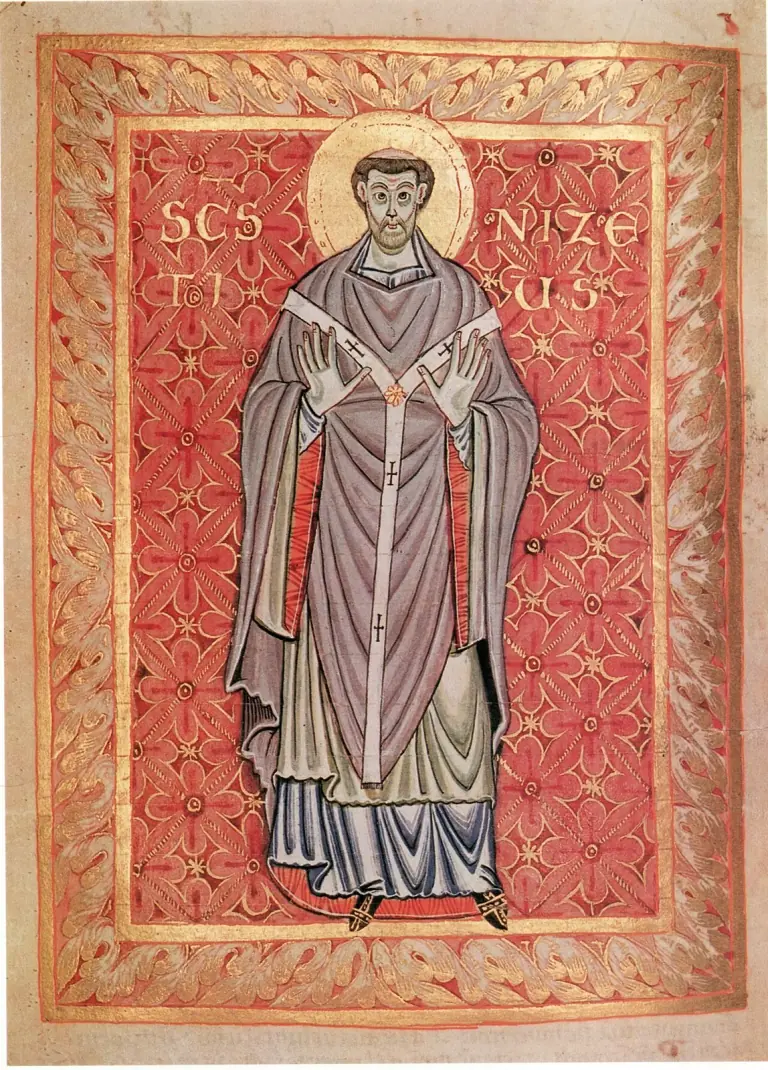
- Born
- Late in the fifth century, of a Gallo-Roman family, apparently in Auvergne 1
- Buried
- In the church of Saint Maximin at Trier 1
Saint Nicetius was bishop of Trier for nearly forty years in the sixth century, the most important bishop of that ancient see in the years after the migrations, when the Franks took over what had been Roman Gaul. 1 He rebuilt its ruined cathedral, preached every day, excommunicated a king and was exiled for it, and wrote to the emperor Justinian to tell him he was in error. 12 His feast is October 1. 3
An abbot the king respected
Nicetius came from a Gallo-Roman family, apparently from Auvergne, and was born late in the fifth century. 1 From his youth he gave himself to the religious life. 1 His parents, Butler says, placed him young in a monastery, where his progress in learning and piety was such that "his reputation reached the court." 2 He became abbot. 1
King Theodoric I (511-534) came to know him as abbot and to value him, even though, the Catholic Encyclopedia says, Nicetius "often remonstrated with him on account of his wrong-doing without, however, any loss of favour." 1
Much of what is known about him comes from one of his pupils. Aredius, later abbot of Limoges, told his memories of Nicetius to Gregory of Tours, who wrote them down; the rest comes from letters written by or to the bishop and from two poems of Venantius Fortunatus. 1
Bishop of Trier
When Bishop Aprunculus of Trier died, the clergy and people sent a delegation to the king to choose a successor. 1 They asked for Saint Gallus, and the king refused. They then chose Abbot Nicetius, and Theodoric confirmed him. 1 Butler says the king "obliged him to accept the bishopric of Triers" in 527. 2 Nicetius set out for Trier about that year with an escort sent by the king, and on the road, the Catholic Encyclopedia notes, he already showed his firmness. 1
Trier had suffered terribly in the upheavals of the migrations. 1 One of his first works was to rebuild the cathedral, which Venantius Fortunatus mentions; the Catholic Encyclopedia reports that archaeologists had found masonry of the Frankish period in the cathedral that may belong to his reconstruction. 1 Fortunatus also describes a fortified castle with a chapel that Nicetius built above the Moselle. 1
A bishop who did not spare the king
He preached daily and attacked the moral evils of the nobility and the common people alike, "and in so doing did not spare the king and his courtiers." 1 The current Roman Martyrology sums up Gregory of Tours' portrait of him in three phrases: vehement in preaching, terrible in rebuke, steadfast in teaching. 3 Butler adds that the hardest of his battles was against incestuous marriages. 2
For his misdeeds Nicetius excommunicated King Clotaire I, who for a time ruled all the Frankish lands, and in 560 the king sent him into exile. 13 Clotaire died the next year. 1 His son Sigebert, the new ruler of Austrasia, let the bishop return; Butler says Sigebert "would not take possession of his kingdom till Nicetius was restored." 12
He took part in the councils of the Frankish bishops, though the two sources date them differently. 12 The Catholic Encyclopedia lists Clermont in 535, Orleans in 549, Clermont again in 549, Toul in 550, where he presided, and Paris in 555. 1 Butler has the two councils of Clermont in 535 and 549, the council of Orleans, Paris in 551, and a council Nicetius assembled at Toul in 555. 2
Letters to a queen and an emperor
His correspondence reached far beyond Trier. Letters to him survive from Abbot Florianus of Romainmôtier, Bishop Rufus of Octodurum, now Martigny, and Archbishop Mappinius of Reims. 1 Two of his own letters are famous. 12
The first went to Clodosvinda, the Catholic wife of Alboin, the Arian king of the Lombards, urging her to do everything she could to bring her husband to the Catholic faith. 12 Butler, who calls her a daughter of Clotaire I, quotes his argument from the miracles at the shrines of Gaul: "Let the king," he wrote, "send messengers to the church of St. Martin; if they dare enter it, they will see the blind enlightened, the deaf recover their hearing, and the dumb their speech." 2 He reminded her too of her grandmother Clotilda, and how she had brought Clovis to the Catholic faith. 2
The second went to the emperor Justinian at Constantinople, about the emperor's position in the controversies that grew out of Monophysitism. 1 Butler identifies the error as that of the Incorrupticolae, who held that Christ's body in his mortal life could not suffer, and says Nicetius told the emperor "with an episcopal authority and zeal" that since his edict demanding the bishops' subscription, all Italy, Africa, Spain and Gaul had anathematized his name. 2
His own life, and his school
In private he was austere. He fasted often, and "while the priests and clerics who lived with him were at their evening meal he would go, concealed by a hooded cloak, to pray in the churches of the city." 1 He founded a school to train clergy, and Aredius was its best-known pupil. 1
Two short treatises have come down under his name, one on vigils and one on the good of psalmody. 12 Butler accepts them as his and summarizes them: the first praises watching in prayer, the second the singing of God's praises together. 2 The Catholic Encyclopedia calls their authenticity doubtful. 1
He died in 563, or more probably in 566, and was buried in the church of Saint Maximin at Trier. 12
What is Saint Nicetius the patron saint of?
Saint Nicetius's feast day
Saint Nicetius's feast day is October 1, the day on which the current Roman Martyrology, as the Italian bishops print it, remembers him. 3 The Catholic Encyclopedia notes that October 1 was already his feast at Trier. 1
The older Roman Martyrology placed him on December 5, and Butler gives his life under that day. 12
Praying with Saint Nicetius
Nicetius was made a bishop by a king and then spent his life telling kings what they did not want to hear. 12 He scolded Theodoric and kept his favor; he excommunicated Clotaire and lost his see. 1 The record does not show him adjusting what he said to the person in front of him.
His letters show the same plainness at a distance. He told a queen what to say to her husband and an emperor that the whole West had condemned him. 12 The argument he gave Clodosvinda was not subtle: go to the shrine of Saint Martin and look. 2
The bishop who said these things also went out at night, hooded, to pray in the empty churches of his city while his clergy ate. 1 Both habits belonged to the same man.
Saint Nicetius of Trier, pray for us.
Sources
- 1.Johann Peter Kirsch, "St. Nicetius," The Catholic Encyclopedia, Vol. 11 (New York: Robert Appleton Company, 1911).
- 2.Alban Butler, "St. Nicetius, Bishop of Triers, C.," December 5, in The Lives of the Fathers, Martyrs, and Other Principal Saints, Vol. XII (Derby: Richardson and Son, 1842).
- 3.Roman Martyrology, entries for October 1, Santo del giorno, Conferenza Episcopale Italiana (in Italian).
Saints to turn to next
Others in this collection who are turned to for some of the same things.