Saint Nicephorus of Antioch
Died 260
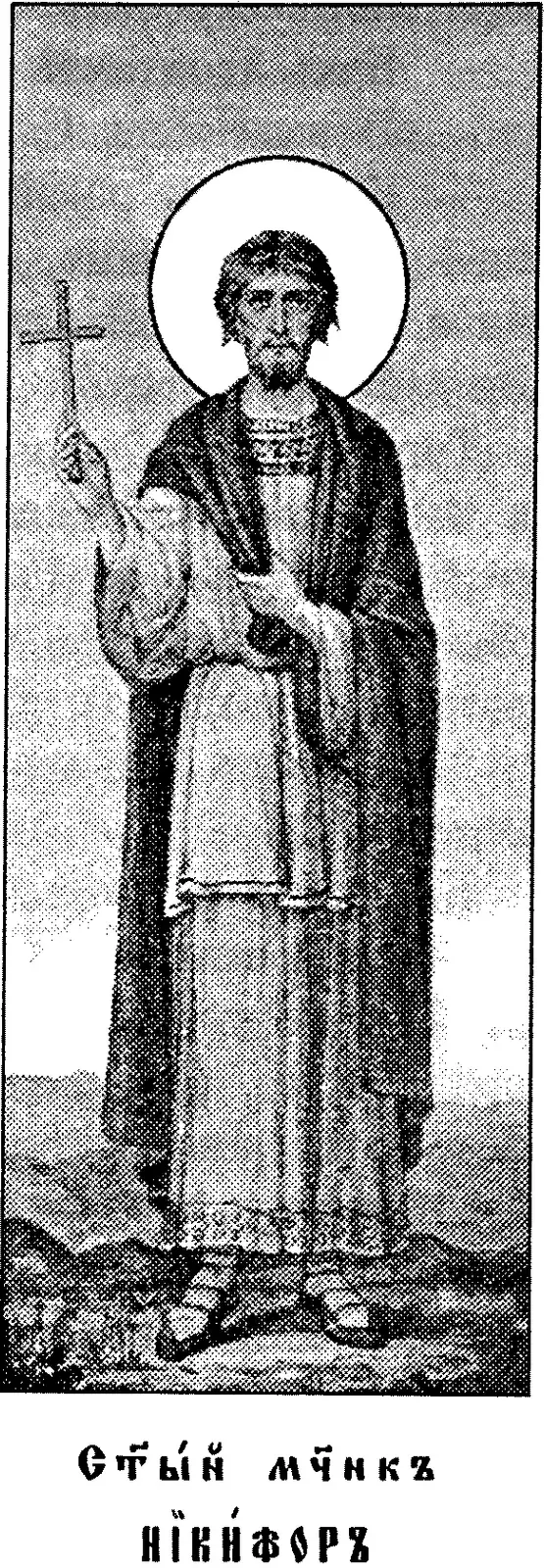
- Known for
- Seeking the forgiveness of the priest Sapricius, and dying in his place when Sapricius denied Christ 13
- Account
- The Acts printed by Ruinart, which Butler calls genuine 1
Saint Nicephorus was a layman of Antioch who had quarreled with his closest friend, a priest named Sapricius, and spent years asking to be forgiven. 1 When Sapricius, condemned to death for the faith, refused him even on the way to execution and then gave way and offered to sacrifice, Nicephorus declared himself a Christian and was beheaded in his place, in 260. 13 His feast is February 9. 12
Two friends in Antioch
Alban Butler tells the story from what he calls the "genuine Acts" printed by Ruinart. 1 "There dwelt in Antioch a priest called Sapricius, and a layman, named Nicephorus, who had been linked together for many years by the strictest friendship." 1 The Byzantine Catholic Menaion describes Nicephorus simply as a Christian from Syria. 3
Something broke between them. Butler does not say what; he says only that the friendship "was succeeded by the most implacable hatred, and they declined meeting each other in the streets." 1 It went on for a long time. Then Nicephorus, "reflecting on the grievousness of the sin of hatred," decided to make peace. 1
He sent friends to Sapricius to ask his pardon and to promise whatever satisfaction was reasonable. The priest refused. He sent others, and then a third time. Finally he went himself, threw himself at the priest's feet, admitted his fault and begged pardon for Christ's sake, "but all in vain." 1
Sapricius before the governor
Persecution broke out "under Valerian and Gallien in the year 260," Butler writes. 1 Sapricius was among those arrested. Before the governor he did not hesitate. Asked his profession, he said, "I am a Christian." Asked whether he was of the clergy, he answered, "I have the honor to be a priest." 1
He was tortured in a press and held firm. "My body is in your power; but my soul you cannot touch," he told his judges. 1 The governor sentenced him to be beheaded for despising the emperors' edict, and Sapricius, Butler says, "seemed to receive the sentence with great cheerfulness." 1
The road to execution
Nicephorus ran out to meet him as he was led away and fell at his feet. "Martyr of Jesus Christ, forgive me my offence." 1 Sapricius did not answer. Nicephorus went ahead to another street, pushed through the crowd and knelt again, begging pardon by the confession Sapricius had just made. Now the priest would not even look at him. 1
The soldiers found it funny. "A greater fool than thou was never seen, in being so solicitous for a man's pardon who is upon the point of being executed." 1 At the place of execution Nicephorus asked once more, and was refused once more. 1
Then the executioners told Sapricius to kneel. He asked why. Because he would not sacrifice to the gods, they said. And the priest who had borne the torture broke: "Stop, my friends; do not put me to death: I will do what you desire: I am ready to sacrifice." 1
"I am a Christian"
Nicephorus cried out to him. "Brother, what are you doing? renounce not Jesus Christ our good master. Forfeit not a crown you have already gained by tortures and sufferings." 1 Sapricius paid no attention. 1
So Nicephorus turned to the executioner. "I am a Christian, and believe in Jesus Christ, whom this wretch has renounced; behold me here ready to die in his stead." 1 The officers did not know what to do and sent to the governor, who ruled that if the man refused to sacrifice he should die by the sword. He was beheaded. 1 The older Roman Martyrology records only the bare fact: at Antioch, Saint Nicephorus, martyr, beheaded under the emperor Valerian. 2
Butler's summary is that Nicephorus "received three immortal crowns, namely, of faith, humility, and charity." 1 The Byzantine Catholic Menaion says it in one line: he took the place of Sapricius, who apostatized before a pagan judge. 3
In the Eastern liturgy
The Byzantine Churches, Catholic and Orthodox, keep his day with a full service. The Menaion published by the Archeparchy of Pittsburgh sings that he showed clearly that "he who does not love his neighbor cannot love the Lord," and that he "loved Sapricius, your companion in the service of God," while Sapricius, "who would not surrender his grudge against you, denied Christ, his Master." 3 The kontakion of his day begins, "You were wrapped in ties of love, O Nicephor, and you undid the evils of hatred." 3
What is Saint Nicephorus the patron saint of?
Saint Nicephorus's feast day
Saint Nicephorus's feast day is February 9. Butler places him on that day and says that "the Greek and the Roman Martyrologies mention him on this day." 1 The 1897 English edition of the Roman Martyrology enters him on February 9. 2 The Byzantine Catholic Menaion keeps him on February 9 as well, and moves his service to February 8 in years when the 9th is taken by the leave-taking of the feast of the Meeting of the Lord. 3
The current Roman Martyrology, in the text published by the Italian bishops, does not include him among its entries for February 9. 4 This page keeps the date given by the older Martyrology, by Butler and by the Byzantine Catholic calendar, and notes that the Roman entry is no longer there.
Praying with Saint Nicephorus
The story turns on two men and a grudge. Nicephorus owned his fault and asked to be forgiven, through friends and then in person, and kept asking. 1 Sapricius was ready to die for Christ and not ready to forgive his brother. 1
The story does not soften what happened to him. Sapricius had borne torture and accepted his sentence, and at the last moment he could not go through with it. 1 The Eastern hymn draws the line between the two failures plainly, and so does Butler. 13
Nicephorus never received the pardon he asked for. He was laughed at in the street for asking. 1 What he did at the end was not planned: he saw his old friend deny Christ, begged him not to, and when that failed offered himself. 1
Butler names three crowns: faith, humility and charity. 1 The humility came first, years before anyone was arrested. 1
Saint Nicephorus of Antioch, pray for us.
Sources
- 1.Alban Butler, "Saint Nicephorus, M.," February 9, in The Lives of the Fathers, Martyrs, and Other Principal Saints, Vol. I (New York, 1895), Project Gutenberg eBook #20450.
- 2.The Roman Martyrology, February 9 (Baltimore: John Murphy & Co., 1897).
- 3."Menaion - February 9," Metropolitan Cantor Institute, Byzantine Catholic Archeparchy of Pittsburgh.
- 4.Roman Martyrology, entries for February 9, Santo del giorno, Conferenza Episcopale Italiana (in Italian).
Saints to turn to next
Others in this collection who are turned to for some of the same things.