Saints Nazarius and Celsus
Martyred at Milan, date unknown
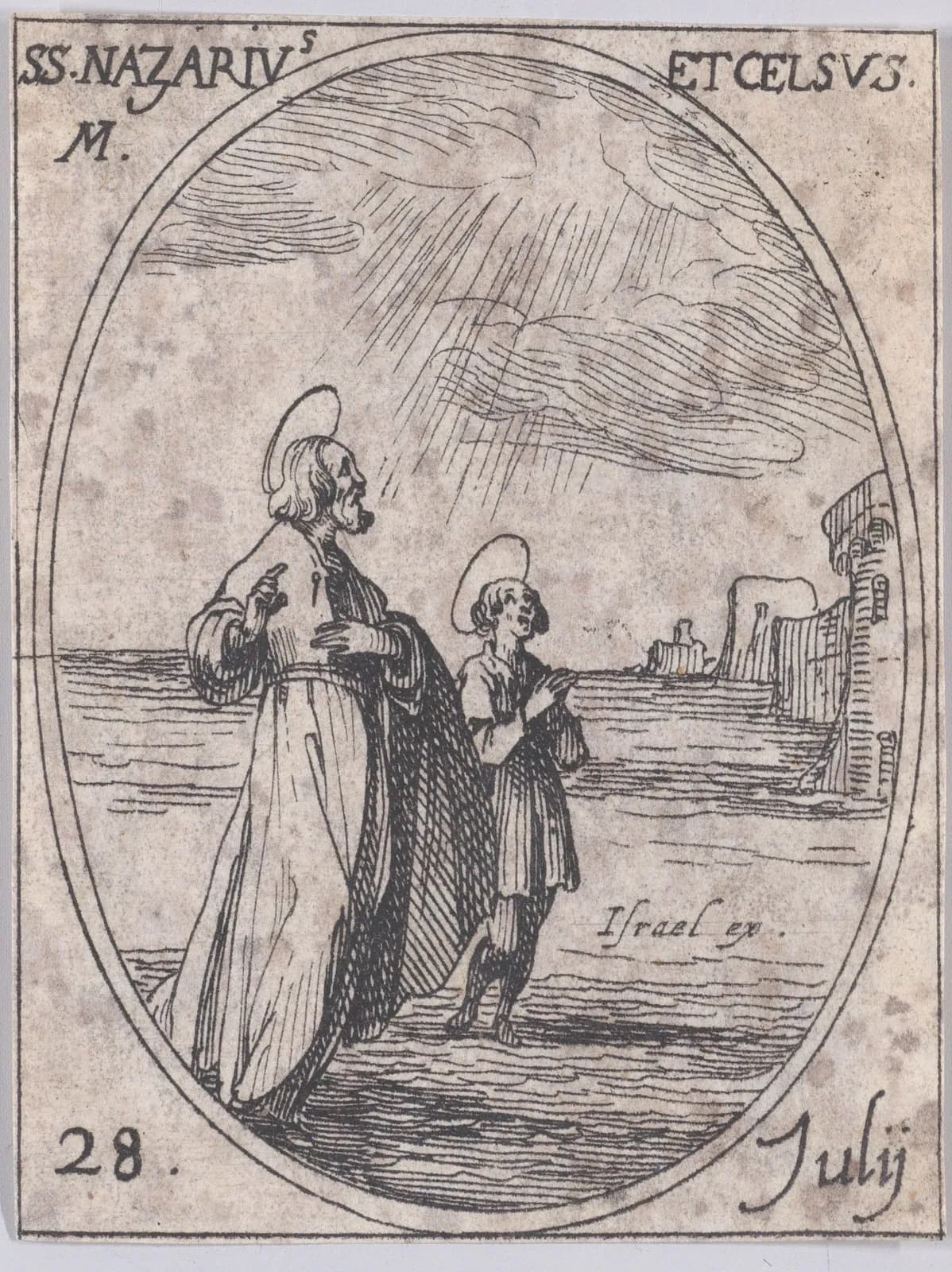
- Found
- By Saint Ambrose, in a garden outside the walls of Milan, after the death of Theodosius in 395 12
- Eyewitness
- Paulinus, Ambrose's secretary, who was present 2
Saints Nazarius and Celsus were martyrs of Milan whose bodies Saint Ambrose found in a garden outside the city in the last years of his life. 12 Nothing is known of them as history except that discovery. 1 Ambrose's secretary Paulinus stood at the open grave and wrote that the martyr's blood looked as fresh "as if it had been shed on that very day." 2
What history knows
Johann Peter Kirsch, writing in the 1911 Catholic Encyclopedia, puts it bluntly: "The only historical information which we possess regarding these two martyrs is the discovery of their bodies by St. Ambrose." 1 The account of that discovery comes from Paulinus, who served Ambrose as secretary and wrote his Life at Saint Augustine's request. 12 Sister Mary Simplicia Kaniecka, who translated the Life in 1928, notes that Paulinus records himself present and assisting at this finding, in 395. 2
Kirsch reasons that a tradition about the martyrs must have been alive among the Christians of Milan, since something led Ambrose to the two bodies. 1 The Norwegian bishops' saints database, katolsk.no, says the same. 3 Who they were and when they died, Paulinus could not say. 12
The garden outside Milan
Paulinus sets the scene after Ambrose returned from Aquileia and the emperor Theodosius died, leaving the bishop "about three years" to live. 2 "At this time he raised and transferred the body of St. Nazarius, the martyr, which had been buried in a garden outside the city to the Basilica of the Apostles which is near the Roman Gate." 2
What he saw in the grave stayed with him. "We saw, moreover, in the grave in which the body of the martyr lay - although when he suffered, we cannot learn even to this day - the blood of the martyr as fresh as if it had been shed on that very day." 2 The head, which had been cut off, was whole, with hair and beard, as though it had just been washed and laid there, and the grave gave off a scent sweeter than any perfume. 2 Paulinus recalls the Gospel promise that not a hair of their heads would perish. 2
When the body had been lifted onto a litter, Paulinus says, they went at once with the bishop to pray at the grave of the martyr Celsus, in the same garden. 2 He says Ambrose had never prayed there before, and that this was a sign a martyr had been revealed. 2 The keepers of the place told them a tradition handed down from their parents: their families were never to leave it, because great treasures lay buried there. 2 Kirsch says Ambrose had Celsus's body carried to the same basilica. 1
In the Basilica of the Apostles
The body of Nazarius was taken to the Basilica of the Apostles, where relics of the apostles had already been laid with great devotion. 2 While Ambrose was preaching there, a man in the crowd "filled with an unclean spirit" cried out that Ambrose was tormenting him. 2 Ambrose turned to him: "Be silent, devil, because Ambrose does not torment thee, but the faith of the saints and thy envy, because you see men rise to that place whence you have been cast down; for Ambrose knows not how to be puffed up." 2 The man fell silent, threw himself on the ground and made no more noise. 2
Kaniecka's notes say Ambrose had built the church in 382 on the model of the church of the Apostles at Constantinople, that it was later dedicated to Saint Nazarius, and that it was rebuilt in the eleventh century, keeping its cross-shaped plan. 2 Kirsch records that a fourth-century silver reliquary decorated with figures was found in the church of San Nazaro in Milan. 1
The legend
A fuller story grew up later, and Kirsch calls it "without historical foundation." 1 It sets the martyrdom under Nero, describes at length the travels of Nazarius through Gaul and Italy, and connects him with the martyrs Gervasius and Protasius. 1 katolsk.no retells it, with the warning that it lacks historical support. 3
In the legend Nazarius is the son of a pagan Roman officer, Africanus, and a Christian mother, Perpetua, said to have been baptized by Saint Peter. 3 He is baptized by Linus, preaches in Rome under Nero, gives away his property and leaves the city. 3 At Milan he visits Gervasius and Protasius in prison and is beaten and driven out; in Gaul a mother entrusts her nine-year-old son, Celsus, to him, and Nazarius baptizes the boy, who travels with him from then on. 3
Arrested again and brought before Nero, the two are ordered drowned. 3 A storm rises; they are said to walk calmly on the waves, and the frightened sailors take them back aboard and ask for baptism. 3 They land at Genoa, return to Milan, and are beheaded under a governor named Anulinus, about the year 68, and buried by Christians in a garden outside the walls near the graves of Gervasius and Protasius. 3 Kirsch notes that Paulinus "says distinctly" that the date of the martyrdom is unknown. 1
Relics and remembrance
katolsk.no cites Cardinal Baronius for the observation that, through Ambrose's generosity, parts of the relics went to churches far from Milan: in Rome, at Fondi and Nola, at Brescia and Pavia, at Beaucaire and Évron in France, and perhaps at Lorch. 3 Saint Paulinus of Nola praised Nazarius in one of his poems. 1 A sermon in their honor was once attributed to Ambrose; Kirsch says it is not genuine. 1
katolsk.no adds that both are named in the first Eucharistic Prayer of the Ambrosian rite, the liturgy of Milan. 3
What are Saints Nazarius and Celsus the patron saints of?
Saints Nazarius and Celsus's feast day
The feast of Saints Nazarius and Celsus is July 28. 134 The current Roman Martyrology keeps them on that day at Milan, as martyrs whose bodies Saint Ambrose found. 4 Kirsch notes that the day was shared with Saints Victor and Innocent, whom katolsk.no identifies as the popes Victor I and Innocent I. 13
katolsk.no adds that June 12 is also found, and that the finding of the relics was kept on May 10. 3 It says that in 1969 the feast was removed from the universal calendar and left to local and particular calendars. 3 In the East, it says, they are kept with Gervasius and Protasius on October 14, and the Armenians remember them on October 7. 3
Praying with Saints Nazarius and Celsus
Almost everything said of Nazarius and Celsus is legend, and the sources say so. 13 What is left is a grave in a garden, opened in the presence of a man who wrote down what he saw. 2
Paulinus did not know who the martyr was or when he died, and he said so plainly, in the middle of describing the blood. 2 He wrote only what he could vouch for.
The keepers of the garden knew even less. They had been told by their parents never to leave the place, because something precious was buried there, and they stayed. 2 Generations of them kept a grave whose occupant none of them could name.
Saints Nazarius and Celsus, pray for us.
Sources
- 1.Johann Peter Kirsch, "Sts. Nazarius and Celsus," The Catholic Encyclopedia, Vol. 10 (New York: Robert Appleton Company, 1911).
- 2.Paulinus of Milan, Vita Sancti Ambrosii, chapters 32-33, with introduction and notes, trans. Sister Mary Simplicia Kaniecka, Patristic Studies 16 (Washington, DC: The Catholic University of America, 1928), via the Internet Archive.
- 3."De hellige Nazarius og Celsus av Milano (d. 68?)," Den katolske kirke (katolsk.no), Catholic Diocese of Oslo (in Norwegian).
- 4.Roman Martyrology, entry for July 28, "Santi Nazario e Celso, martiri," as printed in "Santo del giorno," Conferenza Episcopale Italiana (in Italian).
Saints to turn to next
Others in this collection who are turned to for some of the same things.