Saint Moses the Black
c. 330 - c. 405, or about 407 by another account
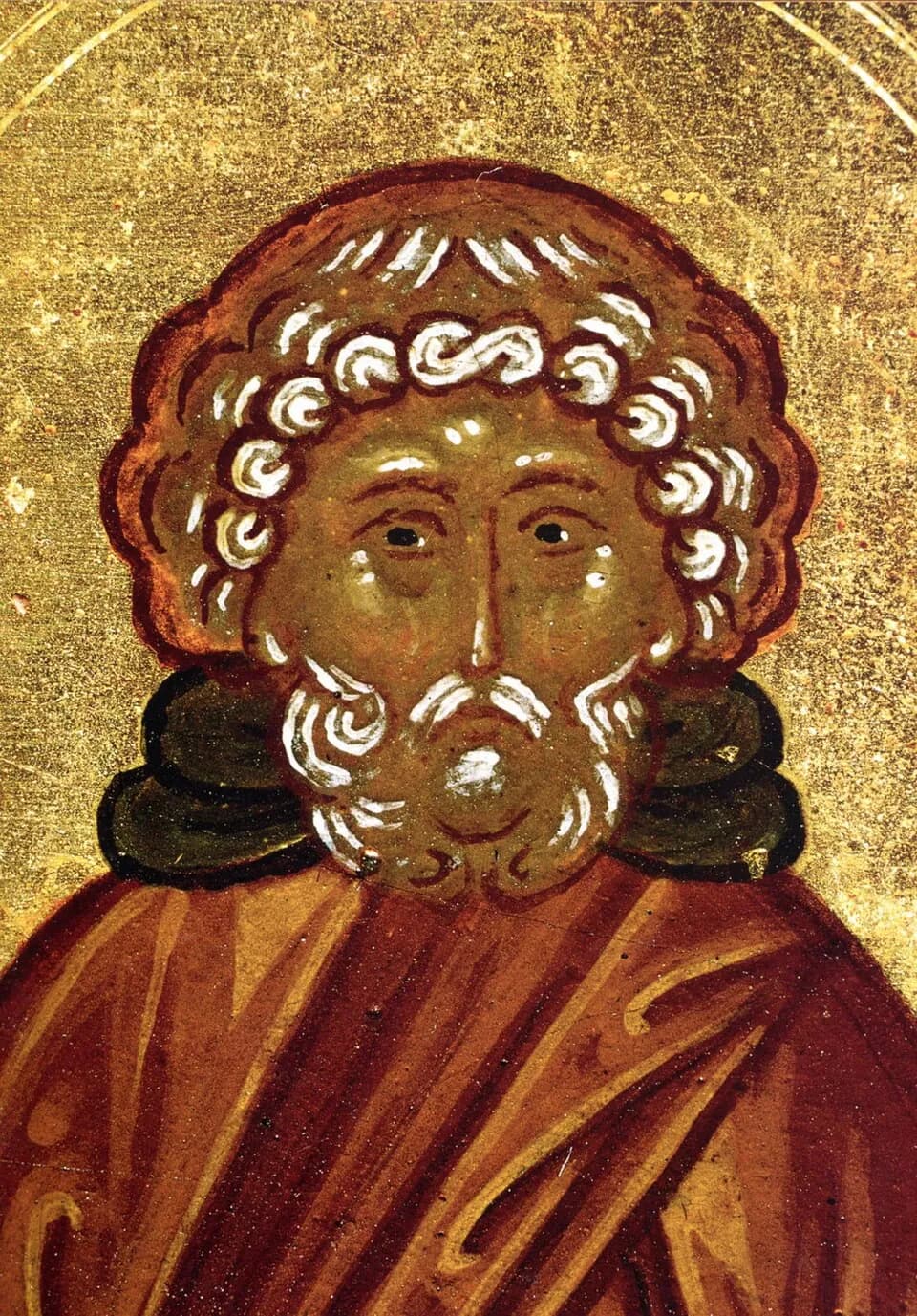
- Patron saint of
- No formal patronage in the sources consulted; Aleteia says many regard him as a patron of nonviolence 3
Saint Moses the Black was a slave who became a robber chief in fourth-century Egypt, and then a monk and priest of the desert of Scetis. 12 The fifth-century historian Sozomen said that "so sudden a conversion from vice to virtue was never before witnessed." 1 He is remembered for the violence he gave up, for the penances he took on in its place, and, in the account most sources now give, for refusing to defend himself when raiders came to kill the monks of Scetis. 26
A slave, then a robber
The sources agree on the outline and differ on almost every detail of it. Sozomen's Ecclesiastical History, the earliest account used here, says Moses "was originally a slave, but was driven from his master's house on account of his immorality. He joined some robbers, and became leader of the band." 1 Aleteia quotes the fifth-century Palladius, who called him a house servant of a government official, driven out for "immorality and brigandage," and adds: "For he was said to go even the length of murder." 3 EWTN says he was dismissed for theft and suspected murder. 2
Others tell it differently. Thomas Craughwell, writing in the National Catholic Register, says Moses was so tall and frightening that his master freed him simply to be rid of him. 6 The Diocese of Bridgeport says he ran away into the desert of Scete, fearing that his master or other criminals would kill him. 5
Where he came from is uncertain in the same way. Sozomen calls him "an Egyptian." 1 Aleteia says he was born in Ethiopia in 330, the Diocese of Bridgeport calls him an Ethiopian, and EWTN says he was "sometimes called the Ethiopian." 235 The name by which he is now best known, Moses the Black, is the one all the modern sources use. 2356
As a robber he was, in Sozomen's words, a man who "perpetrated many evil deeds and dared some murders." 1 Angelo Stagnaro, also in the Register, says the band numbered seventy-five and worked the Nile Valley. 7 Craughwell says they preyed on travelers, caravans, and even detachments of soldiers, until the governor sent troops after them and the band scattered. 6
One story survives from those years. EWTN tells it this way: a barking dog stopped Moses from carrying out a robbery, and he swore vengeance on the dog's owner, a shepherd. He swam the Nile with weapons in his mouth to reach the man's hut. The shepherd was warned again and hid, and Moses took some of his sheep instead. 2 Aleteia quotes Palladius on the same episode: Moses "plotted vengeance against a shepherd who had one night with his dogs impeded him in a project." 3
Scetis
Hiding from the authorities, Moses took shelter with the monks of Scetis, in the desert near Alexandria. 27 EWTN says their peace and contentment affected him deeply, and he gave up his old life and joined them; Aleteia adds that he was baptized. 23 Sozomen gives no circumstances at all, only "some sudden conversion." 1
The change was not easy. EWTN says he found monastic discipline hard and that his taste for adventure stayed with him. 2 Sozomen explains why in the language of his time: the strong, vigorous body built up by his former life kept stirring up desires, and Moses "resorted to every possible means of macerating his body." 1 He lived on a little bread with no cooked food, worked hard, and prayed fifty times a day, standing, without kneeling or sleeping. 1 At night he went secretly to the cells of other monks and filled their water jars, sometimes walking twenty or thirty stadia and more to find the water. 1 Even so, Sozomen says, it was a long time before he could master his own strength. 1
Then robbers broke into his cell. Sozomen says Moses seized and bound all four, carried them on his shoulders to the church, and left them with the monks to deal with as they saw fit, "for he did not consider himself authorized to punish any one." 1 EWTN and Aleteia add that the robbers, astonished, repented and became monks themselves. 23 The Roman Martyrology, as Aleteia quotes it, keeps the outcome: he "converted many of his flock of criminals and took them with him to the monastery." 3
Discouragement came too. EWTN says he grew downhearted when he concluded he was not yet perfect, and that the abbot, Isidore, took him up to the roof at dawn to watch the first light. "Only slowly do the rays of the sun drive away the night and usher in a new day," Isidore told him, "and thus, only slowly does one become a perfect contemplative." 2
An elder of the desert
Moses was ordained a priest over the monks at Scetis. 12 The Diocese of Bridgeport records an exchange at his ordination: the bishop remarked, "Now the black man is made white," and Moses answered, "Only outside, for God knows I am all black within." 5
Two of the sayings EWTN collects show the kind of elder he became. Once the abbot ordered a week's fast, and some visiting brothers came to Moses, who cooked them a meal. Neighbors reported him, but those who came to confront him changed their minds: "You did not keep a human commandment, but it was so that you might keep the divine commandment of hospitality." 2 Another time the brothers met to judge a monk who had committed a fault, and Moses refused to come. Called again, he arrived carrying a leaking jug of water on his shoulder, or in another version a basket of sand. Asked why, he said: "My sins run out behind me and I do not see them, but today I am coming to judge the errors of another." The brothers forgave the monk. 2
Sozomen says God made him "an object of dread to the demons," and that when he died he left behind "numerous eminent disciples." 1 Stagnaro quotes one more saying of his: "If a man's deeds are not in harmony with his prayer, he labors in vain." 7
His death
Sozomen says only that Moses died at the age of seventy-five. 1 He does not say how. The later account, which EWTN, the Register and CNA all give, is that he was killed by raiders. 268
EWTN tells it this way. At about seventy-five, around the year 407, word came that a band of renegades meant to attack the colony. The brothers wanted to defend themselves, and Moses forbade it, telling them to withdraw rather than take up weapons. He and seven others stayed behind, greeted the invaders, and all eight were killed. 2 Stagnaro dates the attack to July 1, 405, and says Moses quoted the Gospel, "All who take the sword will perish by the sword," and held that a violent death was fitting for a former robber. 7 Craughwell gives the years 330 to 405 and says simply that Moses would not lift his hand to defend himself, "and so he was cut down with his brother monks." 6 CNA says he was killed "around the year 400." 8
What is Saint Moses the Black the patron saint of?
Saint Moses the Black's feast day
His feast is kept on August 28. 345 Aleteia quotes the Roman Martyrology for that day: "In Egypt, Saint Moses the Black, who from a famous brigand became a famous anchorite." 3
August 28 is also the feast of Saint Augustine of Hippo, and it is Augustine whom Vatican News's Saint of the Day carries on that date. 49 Philip Kosloski, writing for Aleteia, finds the pairing apt: two great sinners who became great saints. 4 CNA notes that Moses is revered in both the East and the West. 8
Praying with Saint Moses the Black
The first thing the sources show is how far he had to come. Sozomen does not soften it: a slave driven out for his immorality, a gang leader, a man who "dared some murders." 1 The Martyrology still names him for it, "a famous brigand." 3 His conversion is remembered as sudden, and what followed it was slow. 1
Sozomen spends more words on the years after the conversion than on the conversion itself: the bread and no cooked food, the fifty prayers a day standing, the water carried by night to other men's cells, and the long time it took before his own strength stopped working against him. 1 Isidore's answer to his discouragement, as EWTN gives it, was not a remedy but a sunrise, and the reminder that the light comes slowly. 2
The sayings EWTN preserves are about judgment, and they cut both ways. He broke a fast to feed guests, and his accusers came round to calling it hospitality. 2 He came to a trial carrying a leaking jug, and the trial ended in forgiveness. 2 The reason he gave at the trial was his own sins, running out behind him where he could not see them. 2
The story of his death is the hardest part, and the sources do not agree on it. Sozomen knew only that he died at seventy-five. 1 The later account has him send the brothers away from the raiders and stay behind to be killed rather than lift a hand. 26 It is the reason many now look to him as a figure of nonviolence. 3 The page leaves both accounts standing.
Saint Moses the Black, pray for us.
Sources
- 1.Sozomen, Ecclesiastical History, Book VI, Chapter 29, trans. Chester D. Hartranft, Nicene and Post-Nicene Fathers, Second Series, Vol. 2 (Buffalo: Christian Literature Publishing Co., 1890), via New Advent.
- 2."St. Moses the Black," Saints, EWTN.
- 3.Philip Kosloski, "How Moses the Black went from gang leader to holy abbot," Aleteia, June 5, 2020.
- 4.Philip Kosloski, "St. Moses the Black's connection to St. Augustine," Aleteia, August 28, 2026.
- 5."St. Moses, the Black," Formation Reimagined, Diocese of Bridgeport.
- 6.Thomas J. Craughwell, "The Great Saints of Africa," National Catholic Register, November 21, 2017.
- 7.Angelo Stagnaro, "St. Moses the Black: From Violent Outlaw to Saint," National Catholic Register, May 19, 2026.
- 8.Francesca Pollio Fenton, "New movie to depict story of fourth-century saint Moses the Black through modern-day gangland drama," Catholic News Agency, April 6, 2025.
- 9."28 August," Saint of the Day, Vatican News.
Saints to turn to next
Others in this collection who are turned to for some of the same things.