Saint Michael de Sanctis
September 29, 1591 - April 10, 1625
- Beatified
- May 24, 1779, by Pope Pius VI 1
Saint Michael de Sanctis, in Spanish Miguel de los Santos, was a Trinitarian friar from Catalonia who ran away to join the order at eleven and died a priest at thirty-three. 24 He became known as the ecstatic, because he was so often carried out of himself in prayer, especially at Mass. 14 He was canonized in 1862, on the same day as the martyrs of Japan. 2
A boy from Vic
He was born at Vic, in Catalonia, on September 29, 1591, the feast of the archangel whose name he was given. 12 The Trinitarians preserve the note his father made in the family notebook that day, which ends: "May God make him a good Christian, to His honor and glory." 2 His father, whom the order calls Enrique Argimir, was a notary and mayor of the town; his mother was Monserrat Mitjana. The Diocese of Vic spells the names in the Catalan way. 24
He lost his mother at four and his father at eleven. 2 His Latin teacher remembered him as cheerful, a leader among the other boys, and willing to help teach the ones who struggled. A friend recalled that at eight he had the rest of them fired up with a plan to go and live as hermits on the Montseny. 2
He wanted to be a religious, and his guardians and older brothers kept refusing. So he planned an escape. In August 1603 he left Vic for Barcelona and presented himself at the church of the Trinitarians. 2 The 1911 Catholic Encyclopedia gives his age as twelve; the Diocese of Vic says he was eleven, which fits the August date. 14
From the Trinitarians to the Discalced
He made his novitiate with the Trinitarians and, according to the encyclopedia, took vows at their house of Saint Lambert in Zaragoza on September 5, 1607, after three years. 1 That same year a friar of the reformed, barefoot branch of the order came to stay at Saint Lambert's while he waited to be ordained. The Trinitarians name him as Fr. Manuel de la Cruz. 12 Michael "felt himself drawn to this more austere congregation," the encyclopedia says, and began to ask leave to move. 12
He got it. "After mature deliberation, and with the permission of his superior," he entered the novitiate of the Discalced Trinitarians at Madrid and took vows at Alcalá. 1 The Diocese of Vic dates the change to 1608. 4 The order's account notes that he stayed grateful all his life to the friars who had first taken him in. 2
Obedience then moved him around Spain. Vic lists Zaragoza, Pamplona, Madrid, Alcalá de Henares, Seville, Baeza, Salamanca and Valladolid among the places he lived. 4 He studied for six years at the universities of Baeza and Salamanca, and a companion wrote of those years that he was "a prodigy of holiness, skillfully combining active and contemplative life." 2
Baeza: accused and imprisoned
At Baeza, while he was a student of philosophy, someone made a false accusation against him. The Trinitarians admit they do not know what it was. It was serious enough that he was confined for a time in the friary prison. 2
A companion named Matías, who visited him every day, always found him in good spirits. "Here," Michael said, "I can devote all my time to prayer." To those sent to investigate the charge he answered, "If God abandons me, I am capable of worse things." 2 In the end his innocence was established, and the order says that the people who had slandered him changed their lives, moved by the way he returned good for evil. 2
Carnival at Salamanca
The best story the Trinitarians tell about him is set at carnival. As a student at Salamanca he had the idea, while praying, of doing public penance in the square in the middle of the festivities, and he talked several friars into it, among them a preacher, Fr. Marcos. Six of them went out behind a large crucifix, dressed as penitents and wearing crowns of thorns. 2
In the Plaza de San Juan the preacher climbed onto a stool and began to speak to a crowd in costume. Then, the order's account says, Michael "let out a formidable cry and went toward the Crucifix, remaining suspended in ecstasy." 2 The students were shaken, and the carnival turned into a procession of penance to the Trinitarians' church. Afterward they called him "Brother Michael, the soul hunter." 2
The ecstatic
That was the pattern of his prayer. The encyclopedia says he "is said to have been rapt in ecstasy several times during Consecration," and the Diocese of Vic says the ecstasies were frequent enough that he was known as the ecstatic. 14 Asked why he spent so long before the Blessed Sacrament, he used to answer, "It is because He has chained me." 2
The Trinitarians and the Diocese of Vic both mention a mystical exchange of hearts with Christ, the diocese adding that this is what is said of him. 24 The order adds that he was devoted to Saint Catherine of Siena, and that he left writings of his own, among them a Treatise on the Tranquility of the Soul. 2
He was not grim. "We must serve God with joy," he would say. "Sadness causes a lot of damage to the body and soul." 2 Witnesses in his cause described how he found out people who were poor and alone and took them food hidden under his cloak. 2
Valladolid
He was ordained a priest and was twice elected superior of the Discalced Trinitarian house at Valladolid. 1 He died there in the first hours of April 10, 1625, at thirty-three. 24 The Trinitarians write that he died "consumed by the love that burned in his heart" more than from any illness. 2 His tomb is in the church of San Nicolás de Bari in Valladolid. 4
Pius VI beatified him on May 24, 1779. 1 Pius IX canonized him on June 8, 1862, in the same ceremony as the martyrs of Japan, and the Trinitarians record that a hundred of the order's habits were counted in Saint Peter's Square that day. 12 The miracle accepted for his canonization was received, the order says, by a young Trinitarian of the house of Santa Maria alle Fornaci, Father Anthony of the Mother of God, who gave himself body and soul to the cause. 2
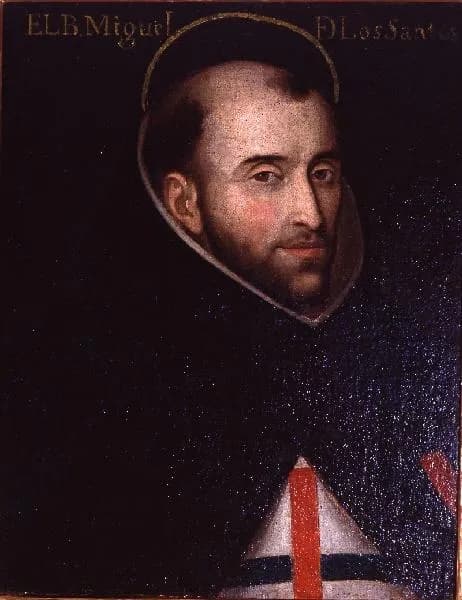
Painters usually show him, the encyclopedia says, "kneeling before an altar where the Blessed Sacrament is exposed." 1 The portrait on this page is plainer: a head and shoulders in a dark mantle, with the red and blue cross of his order on the white scapular beneath.
What is Saint Michael de Sanctis the patron saint of?
His own city claims him. The Diocese of Vic calls him patron of Vic, and in 2025 it organized a pilgrimage in his footsteps for the four hundredth anniversary of his death. 4 The Trinitarian Order names him patron, or protector, of Trinitarian youth, the title his feast carries in the order's calendar. 23 No source consulted for this page gives him any wider patronage, and the page does not add one.
Saint Michael de Sanctis's feast day
There are three dates, and all three are in use. The Roman Martyrology names him on April 10, the day he died, describing him as a priest of the Order of the Most Holy Trinity who gave himself entirely to works of charity and to preaching the word of God. 6
His own order keeps him on June 8. The Trinitarian calendar ranks the day as a feast and explains the choice: "his feast is celebrated on June 8, the day of his canonization in 1862." 3 The Archdiocese of Valladolid, where he is buried, lists him on July 5 as an obligatory memorial, and July 5 is also the date in the 1911 Catholic Encyclopedia. 145
Praying with Saint Michael de Sanctis
He knew what he wanted very early. At eight he was recruiting friends to be hermits, and at eleven he walked out on his guardians to knock at a friary door in another city. 2 Having got in, he asked to move again, to the stricter branch, and the encyclopedia is careful to say that he did it with deliberation and with his superior's leave. 1
His answer about the Blessed Sacrament is worth keeping whole. He did not say that he ought to pray or that he had learned to. He said, "It is because He has chained me." 2
The prison at Baeza is the hardest part of the record, because the order itself does not know what he was accused of. What it remembers is how he took it: glad of the time to pray, and unwilling to protest that he was above such things. "If God abandons me, I am capable of worse things." 2
The same man told people that sadness does damage to body and soul, and carried food to the poor under his cloak so that nobody would notice. 2 He lived thirty-three years. 4
Saint Michael de Sanctis, pray for us.
Sources
- 1.Michael Ott, "St. Michael de Sanctis," The Catholic Encyclopedia, Vol. 10 (New York: Robert Appleton Company, 1911).
- 2.Isidore Murciego Murciego, O.SS.T., "St. Michael of the Saints, Patron of Trinitarian Youth," in "Trinitarian Saints," Order of the Most Holy Trinity and of the Captives (trinitari.org).
- 3."Liturgical calendar - Feasts," entry for June 8, Order of the Most Holy Trinity and of the Captives (trinitari.org).
- 4."Quart centenari de la mort de sant Miquel dels Sants," Diocese of Vic, January 21, 2025 (in Catalan).
- 5."Calendario litúrgico propio de la Archidiócesis de Valladolid," 2019, entry for July 5, Archdiocese of Valladolid (in Spanish).
- 6.Roman Martyrology, entry for April 10, as printed in "Santo del giorno," Conferenza Episcopale Italiana (in Italian).
Saints to turn to next
Others in this collection who are turned to for some of the same things.
- Saint Bernardo TolomeiMay 10, 1272 - August 20, 1348DiscernmentPrayerSuffering and illness
- Saint Carmen RendilesAugust 11, 1903 - May 9, 1977PrayerDiscernmentSuffering and illness
- Saint Clare of Montefalcoc. 1268 - August 1308PrayerSuffering and illnessDiscernment
- Saint Claude de la Colombiere1641 - February 15, 1682DiscernmentPrayerSuffering and illness