Saint Maximinus of Trier
c. 280 - c. 347 to 352
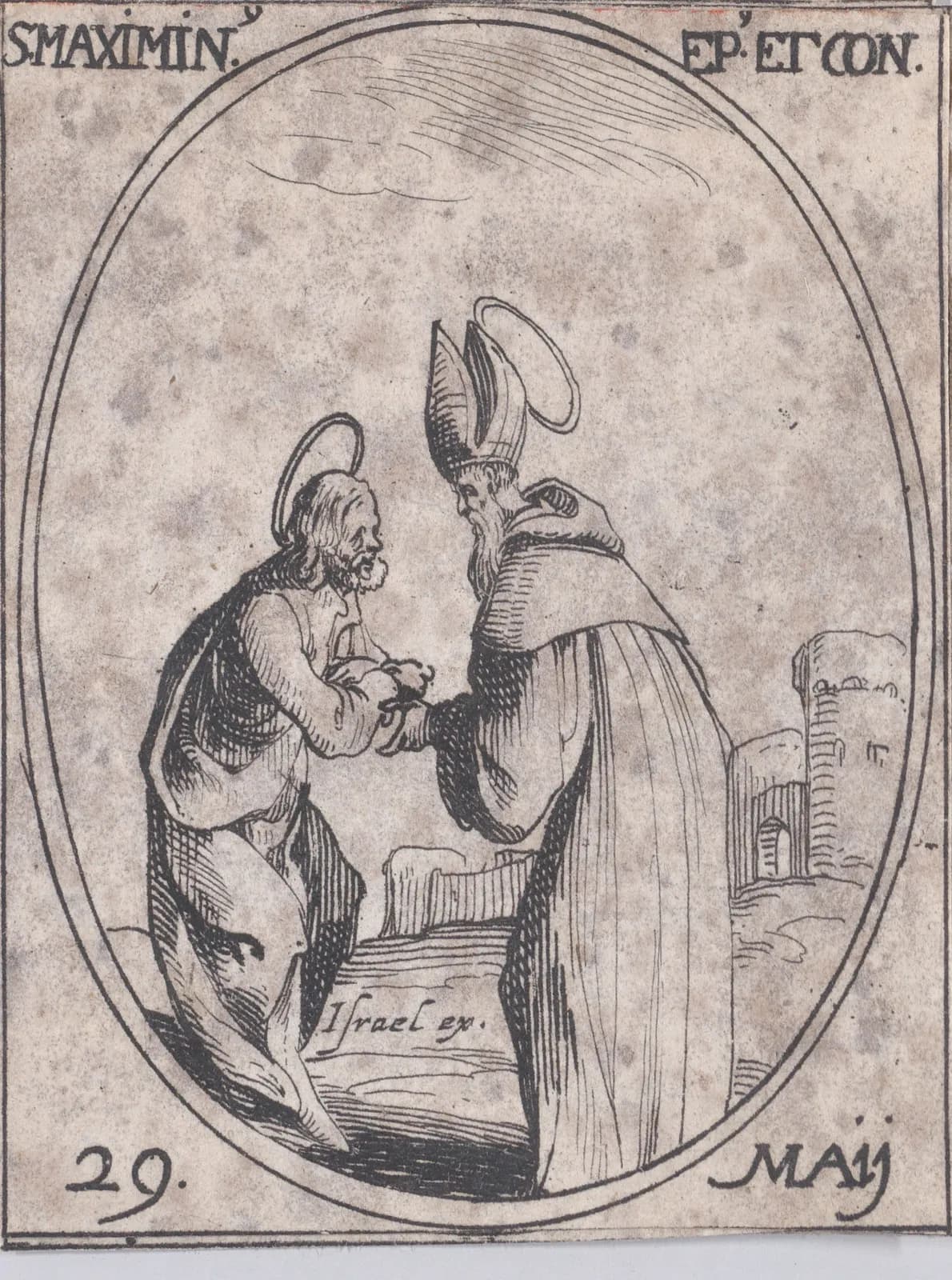
- Born
- At Silly near Poitiers, says the 1911 Catholic Encyclopedia 1; about 280, says katolsk.no 2; at Poitiers, says EWTN 6
- Died
- At Poitiers 23; on 29 May 352 or 12 September 349, says the encyclopedia 1; about 347, says katolsk.no 2
Saint Maximinus was bishop of Trier in the years when Trier was the seat of the Western emperor, and he used that position against the Arians. 1 When Athanasius of Alexandria was exiled to Gaul in 336, Maximinus took him in and kept him for more than two years. 125 The Arians thought him dangerous enough to condemn him by name alongside the pope. 1
From Poitou to Trier
Michael Ott, in the 1911 Catholic Encyclopedia, says Maximinus was born at Silly near Poitiers. 1 The Norwegian bishops' saints database (katolsk.no) dates his birth to about 280, following the oldest Lives, and places Silly near Loudun, in what is now the commune of Mouterre-Silly. 2 EWTN's short life says he was born at Poitiers of a noble family and was related to Maxentius, bishop of that city before Hilary. 6 katolsk.no names this Maxentius as a brother and adds two more brothers and a sister, but notes that no Maxentius appears on the list of fourth-century bishops of Poitiers. 2
As a young man he went to Trier, drawn by the reputation of its bishop, Agritius. 26 Joseph Lins, writing on Trier in the same encyclopedia, calls Agritius the first clearly authenticated bishop of the city, present at the Council of Arles in 314. 4 Agritius educated Maximinus and ordained him priest, and Maximinus succeeded him. 1 Ott dates the succession 332 or 335. 1 katolsk.no gives 329, with 330 and 333 as other readings, and EWTN 332. 26
Trier mattered. Ott explains that it was then "the government seat of the Western Emperor," so that its bishop stood in close relation with the emperors Constantine II and Constans. 1 For a bishop opposed to Arianism, that was an opportunity as well as a risk.
Host to Athanasius
Athanasius, the bishop of Alexandria, had been condemned by the Council of Tyre. In his Apologia contra Arianos he tells how his enemies accused him before the emperor Constantine of threatening the grain supply, and how the emperor "was immediately incensed, and instead of granting me a hearing, he sent me away into Gaul." 5 He came to Trier. 12
Ott calls Maximinus "an intimate friend of St. Athanasius, whom he harboured as an honoured guest during his exile of two years and four months (336-8) at Trier." 1 EWTN says he received him "not as a person disgraced, but as a most glorious confessor of Christ." 6 katolsk.no adds that Maximinus built the great church at Trier, and that Athanasius celebrated Mass there before it had been consecrated. 2
Athanasius kept the letter that ended the exile. It was written by the younger Constantine after his father's death, "Dated from Treveri," and told the people of Alexandria that their bishop had been sent into Gaul for his own safety and had been "supplied abundantly with all necessaries in this city, where he lived." 5 The letter speaks for the emperor's court and does not name the bishop of the city. 5 Lins sums up the episcopate in one clause: Maximinus "sheltered the excommunicated St. Athanasius at Trier." 4
He did the same for others. In 341 he received Paul, the banished bishop of Constantinople, with honor and worked for his recall. 126 The Martyrology remembers him for this above all: he welcomed Athanasius and other exiled bishops as brothers. 3
Against the Arians
In 342 four Arian bishops came from Antioch to Trier to win the emperor Constans to their side. 12 Maximinus refused to receive them and persuaded the emperor to reject what they proposed. 1 With Pope Julius I and Hosius of Córdoba, he then persuaded Constans to call the council of Sardica. 12
Whether he attended it is not certain. Ott dates Sardica to 343 and says Maximinus "probably took part in it." 1 katolsk.no calls his presence doubtful, while noting that Athanasius named him among the bishops who supported him, some present and some by letter. 2 EWTN puts him there among the faith's most illustrious defenders and dates the council 347. 6 What is certain is the response. The Arian bishops met at Philippopolis in 343 and condemned him by name together with Pope Julius and Hosius. 1 EWTN says he "had the honor to be ranked by the Arians with St. Athanasius." 6 katolsk.no adds that they declared him deposed and published a list of his supposed sins, and that bishops in the West rejected the slander. 2
Ott says he took part in a synod at Milan in 345 and "is said to have presided over a synod held at Cologne in 346," which deposed Bishop Euphratas of Cologne for leaning toward Arianism. 1 katolsk.no notes that the Bollandists deny that Euphrates was a heretic at all, and call him a holy man. 2 He also sent Castor and Lubentius as missionaries to the valleys of the Moselle and the Lahn. 12
Death, legend and the abbey
The sources do not agree on how or when he died. Ott gives two dates, 29 May 352 or 12 September 349. 1 katolsk.no prefers 12 September of about 347, and says Cardinal Baronius's 351 is now generally rejected. 2 It says he had gone to Constantinople to work for peace between East and West and died suddenly at Poitiers while staying with relatives on his way home. 2 Ott doubts that the Maximinus sent to Constantinople was the bishop of Trier. 1 The Martyrology says he was driven from his see by his enemies and died at Poitiers, in his own country. 3
His body came back to Trier. Ott says it was buried in the autumn of 353 in the church of St. John near the city. 1 katolsk.no says his successor Paulinus had it brought home on 29 May 353 by the priest Lubentius, and that the church later took Maximinus's name. 2 A Benedictine abbey was founded there in the seventh century and flourished until 1802. 12 katolsk.no adds that it was destroyed by the Normans in 882 and rebuilt, and that it was bombed in the Second World War and largely demolished. 2
From this point, katolsk.no says, his story is mixed with legend. 2 The best known has a bear kill the donkey he was riding to Rome; Maximinus saddled the bear, and it carried him the rest of the way. 2 Ott says the eighth-century Life of Maximinus is "full of fabulous accounts." 1
What is Saint Maximinus the patron saint of?
Saint Maximinus is the patron of Trier. Ott says simply that "Trier honours him as its patron." 1 katolsk.no also lists him as invoked against perjury, against the dangers of the sea, and against rain. 2 The first of these has a history: katolsk.no says that Gregory of Tours knew him as a protector of the city against the power of the devil, and that oaths of innocence were sworn at his tomb, where a false oath was believed to be punished at once. 2
Saint Maximinus's feast day
Saint Maximinus's feast day is May 29. 123 Ott says his name stands on that day in the martyrologies of Jerome, Bede and Ado. 1 katolsk.no explains that May 29 is the day his body was brought back to Trier, and that his death on September 12 and a date of December 5 are also found. 2 The current Roman Martyrology keeps him on May 29. 23
Praying with Saint Maximinus
Most of what can be known about Maximinus comes from other people's stories. Athanasius tells his own exile; Ott, Lins and the Martyrology all remember the bishop of Trier as the man who took him in. 1345 That is a modest kind of fame, and he earned it by giving a stranger a roof when the emperor had sent him away.
Hospitality to an exile was not a safe act. The man Maximinus housed had been condemned by a council and banished by the emperor, and the Arian party that pursued Athanasius went on to condemn his host by name. 15 Maximinus kept his door open to Paul of Constantinople and to others afterward. 13
He did not bend toward the powerful party. He refused to receive the bishops sent to win over the emperor, and the Arians answered by naming him in the same sentence as the pope. 12 The Martyrology calls him a fearless defender of the integrity of the faith. 3
His end is uncertain, and the Martyrology tells it as an exile of his own: driven from his see, he died far from it. 3 His people brought him home, and kept the day of his return as his feast. 2
Saint Maximinus of Trier, pray for us.
Sources
- 1.Michael Ott, "St. Maximinus," The Catholic Encyclopedia, Vol. 10 (New York: Robert Appleton Company, 1911).
- 2."Den hellige Maximin av Trier (~280-~347)," Den katolske kirke (katolsk.no), Catholic Diocese of Oslo (in Norwegian).
- 3.Roman Martyrology, entry for May 29, "San Massimino, vescovo," as printed in "Santo del giorno," Conferenza Episcopale Italiana (in Italian).
- 4.Joseph Lins, "Trier," The Catholic Encyclopedia, Vol. 15 (New York: Robert Appleton Company, 1912).
- 5.Athanasius, Apologia contra Arianos, Part II, section 87, trans. M. Atkinson and Archibald Robertson, Nicene and Post-Nicene Fathers, Second Series, Vol. 4 (1892), via New Advent.
- 6."St. Maximinus of Trier," Saints, EWTN Global Catholic Network.
Saints to turn to next
Others in this collection who are turned to for some of the same things.