Saint Maximilian of Lorch
Died c. 284
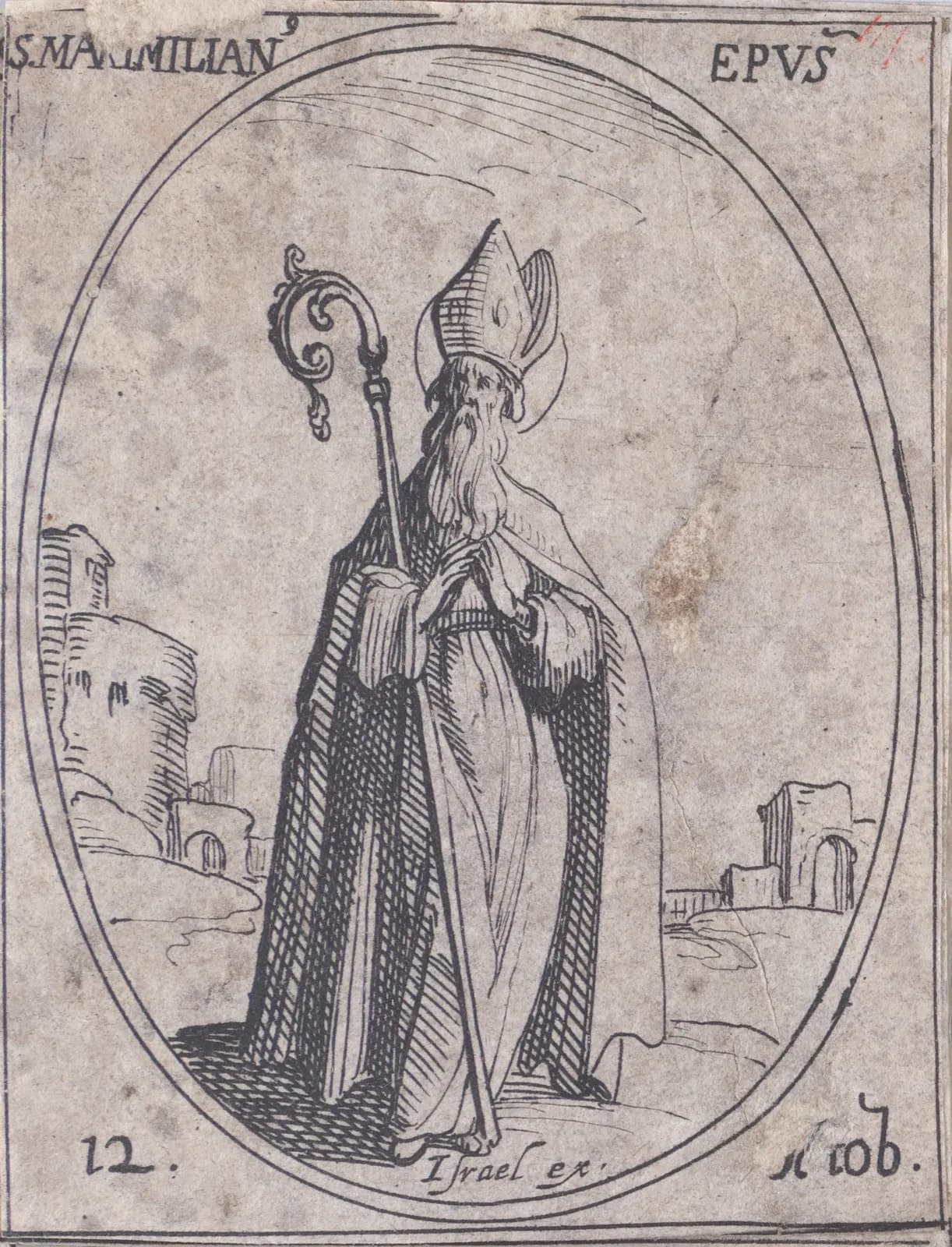
- Also called
- Maximilian of Celeia, of Cilli, or of Pongau 1
- Mission
- Noricum, in the second half of the third century 3
- Patron of
- Austria and the diocese of Passau 1
Saint Maximilian of Lorch was a missionary bishop of the third century in Noricum, the Roman province on the Danube that is now part of Austria, and is honored as the founder of the church at Lorch and the first martyr of the region. 137 The Catholic Encyclopedia calls it historically certain that he preached there, founded the church of Lorch and died a martyr, while calling the thirteenth-century account of his life unreliable. 3 katolsk.no calls him the national patron saint of Austria. 1
A bishop on the Danube
Lorch was the Roman Laureacum, which Joseph Lins in the Catholic Encyclopedia describes as "a Roman station and an important stronghold at the junction of the Enns and the Danube." 4 Christianity, he writes, "found a foothold" there in the third century, "and a Bishop of Lorch certainly existed in the fourth." 4 Today the place is part of the town of Enns, in Upper Austria. 1
Michael Ott, writing on Maximilian in the same encyclopedia, separates what can be known from what is told. His Acts, "composed in the thirteenth century and unreliable," make him a native of Celeia who went on pilgrimage to Rome, worked as a missionary in Noricum, became archbishop of Lorch and was martyred under the emperor Numerian (283-84). 3 But, Ott goes on, "it is historically certain that Maximilian was a missionary in Noricum during the latter half of the third century, founded the church of Lorch, and suffered martyrdom." 3
katolsk.no is a little bolder. It says he was born sometime in the third century, possibly at Celeia, now Celje in Slovenia, and that his death is most often put about 284. 1 It calls it historically certain that Pope Sixtus II, who reigned in 257 and 258, sent him to preach in Pannonia and in the Pongau, and probable that he founded the church at Lorch and is rightly counted its bishop. 1 Wolfsgrüber, in the encyclopedia's article on Salzburg, names him "the first martyr of Noricum during the era of the persecutions." 7
The legend
The fuller story is the one the thirteenth-century Acts tell, and katolsk.no retells it as legend. 13 Maximilian was a devout boy taught by a holy priest named Oranius, and grew up humble, chaste and gentle. 1 When his parents died he gave his inheritance to the poor and freed all the slaves who had served in the house. 1 Then he went to Laureacum, where he was ordained a priest and later, against his will, chosen bishop. 1 Before his consecration he went to Rome for the approval and blessing of Pope Sixtus. 1
As bishop he brought many pagans to baptism, but above all, katolsk.no says, he looked after the poor and the persecuted, who found a refuge at Lorch. 1 He is remembered as one of the first missionaries into Bavaria, going as far as Freising, where he founded a small church in honor of Mary, Queen of Heaven. 1
Then came persecution under Numerian. 13 Maximilian heard that the governor, whom the legend calls Evilasius, had shut up the Christians of Lorch and was forcing them to sacrifice to Mars, and he went back to them. 1 When he spoke to them of Christ the frightened community took heart again. 1 The governor arrested him and sentenced him to death, and on October 12, 284, the legend says, he was beheaded outside the walls of his home town, and the Christians buried him in secret. 1
Rupert, Piligrim and the relics
His cult, Ott says, "dates at least from the eighth century." 3 About 710, Saint Rupert, the first bishop of Salzburg, built a church in his honor at Bischofshofen in the Pongau; Ott says Rupert brought Maximilian's relics there, and katolsk.no says the church stood over his grave. 136 Ulrich Schmid, in the encyclopedia's article on Rupert, lists "Maximilianszelle (now Bischofshofen in Pongau)" among Rupert's foundations. 6 From there, katolsk.no says, King Carloman took the bones to Altötting. 1
The next move had politics in it. Bishop Piligrim of Passau, who held the see from 971 to 991, wanted his diocese raised to an archbishopric and freed from Salzburg. 45 To him, Ott writes in a separate article, are attributed "some, if not all, of the 'Forgeries of Lorch'," a series of documents, chiefly papal bulls, "fabricated to prove that Passau was a continuation of a former archdiocese named Lorch." 5 Lins says Piligrim was "completely frustrated" in both aims. 4 Piligrim also, Ott notes, "transferred the relics of St. Maximilian from Oetting to Passau." 5
katolsk.no tells the same story from Maximilian's side: the bishop of Passau, eager to raise his see by claiming descent from the archbishops of Lorch, of whom Maximilian counted as the first, brought part of his relics there in 976 together with those of a Roman martyr, Felicitas. 1 Ott's article on Maximilian gives the year as 985. 3 Since the seventeenth century, katolsk.no says, the relics have been lost. 1
What is Saint Maximilian of Lorch the patron saint of?
Saint Maximilian of Lorch's feast day
Saint Maximilian of Lorch's feast day is October 12. 123 The current Roman Martyrology keeps him on that day, in the territory of present-day Austria, as a Saint Maximilian "believed to have been" bishop of Lorch, without the title of martyr. 2 Ott says the feast is kept on October 12, "at some places 29 Oct." 3
The older Martyrology had him on both days. Its 1897 English edition reads, for October 12, "At Cilly, in Styria, of St. Maximilian, bishop of Lorch," and for October 29, "of the holy bishops Maximilian, martyr, and Valentine, confessor." 8 katolsk.no also says his name stood in the Martyrology under both dates. 1
Praying with Saint Maximilian
Very little of Maximilian survives as fact: a bishop on a river frontier of the empire, a church founded in a garrison town, a death for the faith, and a memory kept long enough for Rupert to build in his name four centuries later. 134
The legend fills in a recognizable shape. A young man of property frees his slaves and gives away his inheritance, accepts a bishopric he did not want, and makes his town a refuge for the poor. 1 When the persecution comes, he goes back to the people who are being forced to sacrifice rather than away from them. 1
The later history of his relics is less edifying. A bishop of Passau wanted Maximilian's prestige for his own see and forged documents to claim it, and the relics themselves were eventually lost. 15 The Church still keeps his day, with the caution of a Martyrology that says only what it believes. 2
Saint Maximilian of Lorch, pray for us.
Sources
- 1."Den hellige Maximilian av Lorch (-284)," Den katolske kirke (katolsk.no), Catholic Diocese of Oslo (in Norwegian).
- 2.Roman Martyrology, entry for October 12, "San Massimiliano, vescovo," as printed in "Santo del giorno," Conferenza Episcopale Italiana (in Italian).
- 3.Michael Ott, "Maximilian," The Catholic Encyclopedia, Vol. 10 (New York: Robert Appleton Company, 1911).
- 4.Joseph Lins, "Diocese of Passau," The Catholic Encyclopedia, Vol. 11 (New York: Robert Appleton Company, 1911).
- 5.Michael Ott, "Piligrim," The Catholic Encyclopedia, Vol. 12 (New York: Robert Appleton Company, 1911).
- 6.Ulrich Schmid, "St. Rupert," The Catholic Encyclopedia, Vol. 13 (New York: Robert Appleton Company, 1912).
- 7.Cölestin Wolfsgrüber, "Salzburg," The Catholic Encyclopedia, Vol. 13 (New York: Robert Appleton Company, 1912).
- 8.The Roman Martyrology, October 12 and October 29 (Baltimore: John Murphy Company, 1897).
Saints to turn to next
Others in this collection who are turned to for some of the same things.