Saint Martin de Porres
December 9, 1579 - November 3, 1639
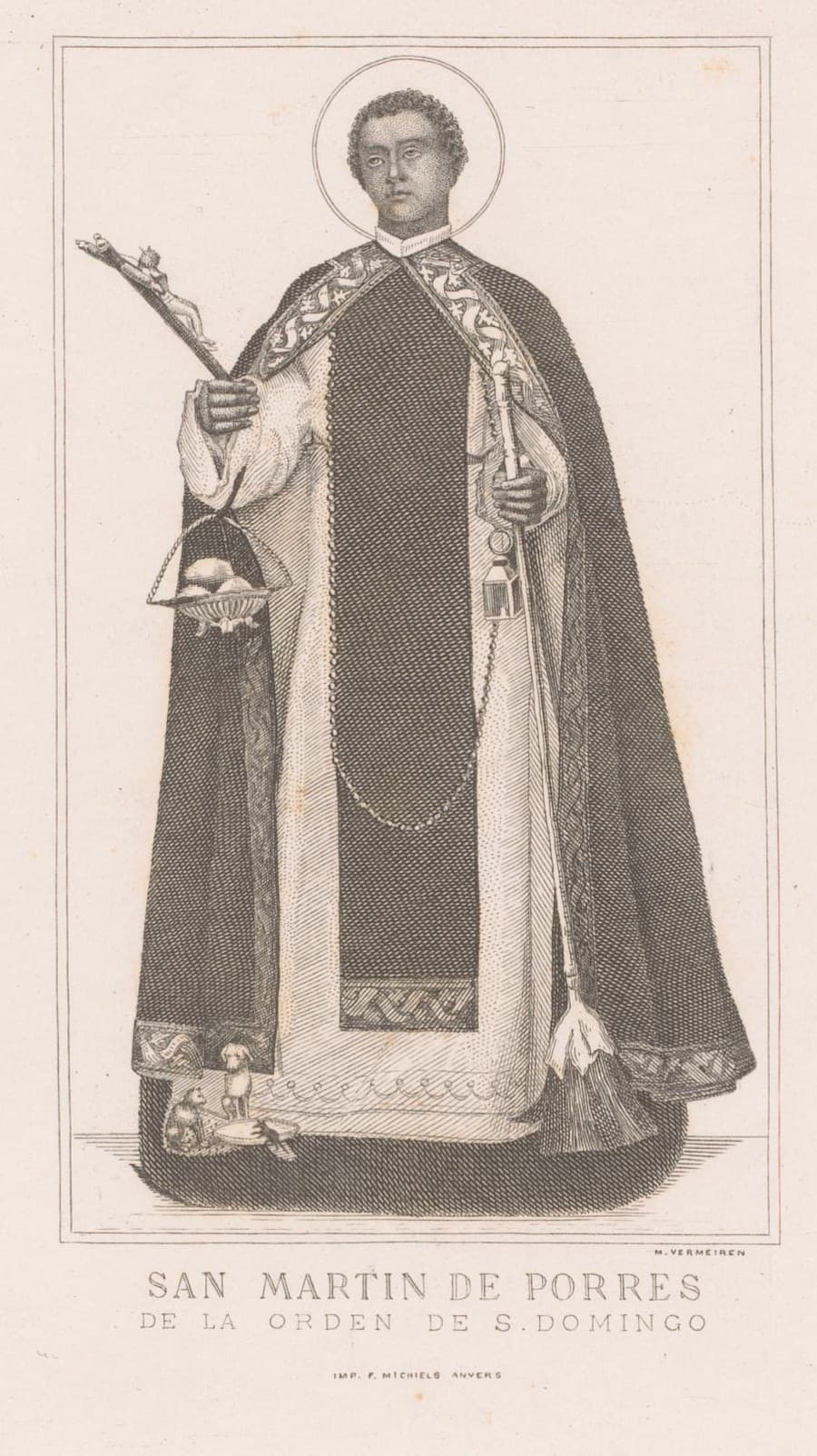
- Patron saint of
- African Americans, barbers, hairdressers, race relations, radio and social justice 2
- Canonized
- May 6, 1962, by Pope John XXIII 7
- Patron of hairdressers
- So proclaimed by Pope Paul VI in 1966 3
Saint Martin de Porres was a Dominican brother in Lima who cut his fellow friars' hair, ran the priory infirmary, and nursed noblemen and slaves in the same rooms. 12 He was the son of a Spanish nobleman and a freed woman of African descent, born in 1579 into a society that held his birth and his skin against him, and the law of his day barred men like him from religious vows. 12 He took them anyway, and Lima came to treat him as its saint long before Rome did. 1
A boy from the bottom of Lima
Martin was born in Lima, Peru, in 1579; Franciscan Media gives the date as December 9. 12 His parents never married. His father was a Spanish nobleman. Vatican News names his mother as Ana Velasquez, a freed slave, black and possibly indigenous; Franciscan Media describes her as a freed woman of Panama, probably black but possibly of indigenous stock. 12
Martin had his mother's dark complexion, and his father resented it. He acknowledged the boy as his son only after eight years, and then abandoned the family, leaving Ana to raise Martin and his sister alone. 12 Franciscan Media opens his story with the words used against children like him: "Father unknown" on the baptismal record, and "half-breed" from people who thought their own blood purer. 2
At twelve his mother apprenticed him to a barber-surgeon. 12 In the custom of the time that was a medical trade as much as a cosmetic one. Martin learned to cut hair, but also to draw blood, dress wounds, and prepare and give medicines. 23 Pope Francis, speaking to a group of Italian hairdressers in 2019, noted that he had first picked up his knowledge in a pharmacy before training under the barber-surgeon. 3 Vatican News adds that during these years he began praying for hours each night. 1
A Dominican the law did not allow
Martin wanted religious life, and Peruvian law stood in the way: descendants of African slaves could not become professed members of religious orders. 1 He asked the Dominican priory in Lima to take him as a lay helper. Franciscan Media says he chose that status because he did not feel worthy to be a brother. 2
The sources agree on what came next and differ on the details. Vatican News says that after eight years of the lowliest work, cutting hair, scrubbing and sweeping, Martin asked at 24 to be admitted to vows, and that the prior, Juan de Lorenzana, decided to ignore the law and let him. 1 Franciscan Media puts the wait at nine years and says it was the community, moved by his prayer, penance and humility, that asked him to make full profession. 2 Pope Francis describes the same path in canonical terms: received first as a tertiary, then as a co-operator brother, a condition Martin accepted and lived in great humility. 3
Not every friar welcomed him. Vatican News records that some called him "mulatto dog," and that one priest mocked his illegitimate birth. 1 It also records the episode both sources tell. When the priory fell into debt and the prior began selling its valuables, Martin offered himself. In Franciscan Media's version he said, "I am only a poor mulatto. Sell me. I am the property of the order. Sell me." 12 Nobody sold him. 1
The infirmary, and the precept of charity
At 34 Martin was put in charge of the priory infirmary. 1 He nursed the sick friars, and he nursed people who were not friars at all, noblemen and slaves alike. 1 Franciscan Media singles out that he treated everyone regardless of color, race or status, and credits him with helping to found an orphanage and with caring for slaves brought from Africa. 2 People began to say he could cure the sick by bringing them a glass of water. 1
Two stories from Vatican News show how he handled the rules that got in his way. He once carried a beggar covered in sores to his own room, and when another friar objected that the man was filthy, Martin answered, "Compassion, my brother, is preferable to cleanliness." 1 Later, during an epidemic, he had been forbidden to bring the sick into the priory for fear of contagion. The prior found him tending a bleeding Indian in his room and began to reprimand him. Martin replied: "Forgive me and please instruct me, for I did not know that the precept of obedience took precedence over the precept of charity." 1
He also ran the practical side of things. Franciscan Media says he managed the priory's daily alms with as much practicality as generosity, raised money for dowries so that poor girls could marry or enter a convent, and became the person both priory and city went to for "blankets, shirts, candles, candy, miracles or prayers!" 2 His care reached animals as well. He excused the mice and rats raiding the kitchen on the grounds that they were underfed, and kept stray cats and dogs at his sister's house. 2
Franciscan Media also lists the extraordinary gifts attributed to him: ecstasies that lifted him into the air, light filling the room where he prayed, bilocation, miraculous knowledge and instant cures. 2 It records them alongside his work in the kitchen, the laundry and the infirmary, and Vatican News, for its part, says nothing of them. 12
Death, and a saint of two cultures
Many of the friars came to Martin for spiritual direction, and even the prior who had admitted him learned from him. 12 He went on calling himself a "poor slave." 2 Franciscan Media notes his friendship with another Dominican saint of Lima, Rose of Lima. 2
He died on November 3, 1639, at the age of 59. 12 By then, Vatican News says, the friars and the city already regarded him as a saint, and his body was found incorrupt 25 years after his death. 1 Pope John XXIII canonized him on May 6, 1962. 7
Popes since have kept returning to him. On his visit to Lima in 2018, Pope Francis called him "a son of two cultures" who "showed the strength and richness that comes about when people focus on love." 4 Writing to the Dominicans in 2021, Francis described countless men and women who, "imitating the simplicity and compassion of Saint Martin de Porres, have brought the joy of the Gospel to the peripheries of societies and our world." 5 And Pope Leo XIV, in a 2025 message to Peru, named Martin's "ardent charity" as one of the signs of the Gospel's presence in that country. 6
What is Saint Martin de Porres the patron saint of?
Franciscan Media lists Saint Martin de Porres as patron of African Americans, barbers, hairdressers, race relations, radio and social justice. 2 The hairdressers have the clearest paper trail: Pope Francis recalled in 2019 that Pope Paul VI proclaimed Martin patron of their trade in 1966. 3
Franciscan Media's reflection explains the rest of the list. It calls racism "a sin almost nobody confesses" and says that one could hardly imagine a more fitting patron of Christian forgiveness, on the part of those discriminated against, and Christian justice, on the part of reformed racists. 2
Saint Martin de Porres's feast day
Praying with Saint Martin de Porres
Martin's holiness was worked out with a pair of scissors, a broom and a glass of water. The trade he learned at twelve was the trade he practiced in the priory, and Pope Francis, speaking to hairdressers, asked them to practice it in a Christian style: kindly, with an encouraging word for each customer, and without the gossip that creeps into any shop. 13
He also lived for decades among people who thought less of him. Some of his own brothers called him a dog. 1 Vatican News says the taunts did not disturb his peace, because he was God's servant and the servant of his brothers, "even if they were cruel." 1 That is a hard sentence to read if you are the one being insulted, and nothing in it makes the cruelty less cruel. Franciscan Media names racism plainly as a sin, and asks forgiveness of those discriminated against only alongside justice from those who did the discriminating. 2
His answer to the prior during the epidemic is worth sitting with. He did not argue that the rule was foolish. He asked to be taught which precept came first, and in asking, made plain that he already knew. 1 For anyone caught between a regulation and a person in front of them, that is a way of speaking the truth without contempt.
Pope Francis called him a son of two cultures. 4 His father's world was Spanish and noble; his mother's was African, freed and poor, and possibly indigenous as well. 12 He spent his later years running an infirmary that took in noblemen and slaves alike. 1
Saint Martin de Porres, pray for us.
Sources
- 1."St. Martin de Porres, Dominican," Saint of the Day, 3 November, Vatican News (Dicastery for Communication).
- 2."Saint Martin de Porres," Saint of the Day, Franciscan Media.
- 3.Pope Francis, Address to Hairstylists of the Committees of Saint Martin de Porres, 29 April 2019. The Holy See.
- 4.Pope Francis, Apostolic Journey to Peru: Meeting with Authorities, the Civil Society and the Diplomatic Corps, Lima, 19 January 2018. The Holy See.
- 5.Pope Francis, Letter to Brother Gerard Francisco Timoner, O.P., Master General of the Order of Preachers, for the VIII Centenary of the Death of Saint Dominic, 24 May 2021. The Holy See.
- 6.Pope Leo XIV, Message to participants in the Social Week in Peru, 4 August 2025. The Holy See.
- 7.Pope John XXIII, Homily at the Rite of Canonization of Blessed Martin de Porres, 6 May 1962 (Spanish text; cited for the date only). The Holy See.
Saints to turn to next
Others in this collection who are turned to for some of the same things.
- Saint Mary MacKillopJanuary 15, 1842 - August 8, 1909Poverty and simplicityWork and vocationSuffering and illness
- Saint Alphonsus Rodriguez1532 or 1533 - October 1617Work and vocationSuffering and illness
- Saint BarnabasFirst centuryWork and vocationPoverty and simplicity
- Saint CajetanOctober 1480 - August 7, 1547Work and vocationPoverty and simplicity