Saint Mark, Pope
Died October 7, 336
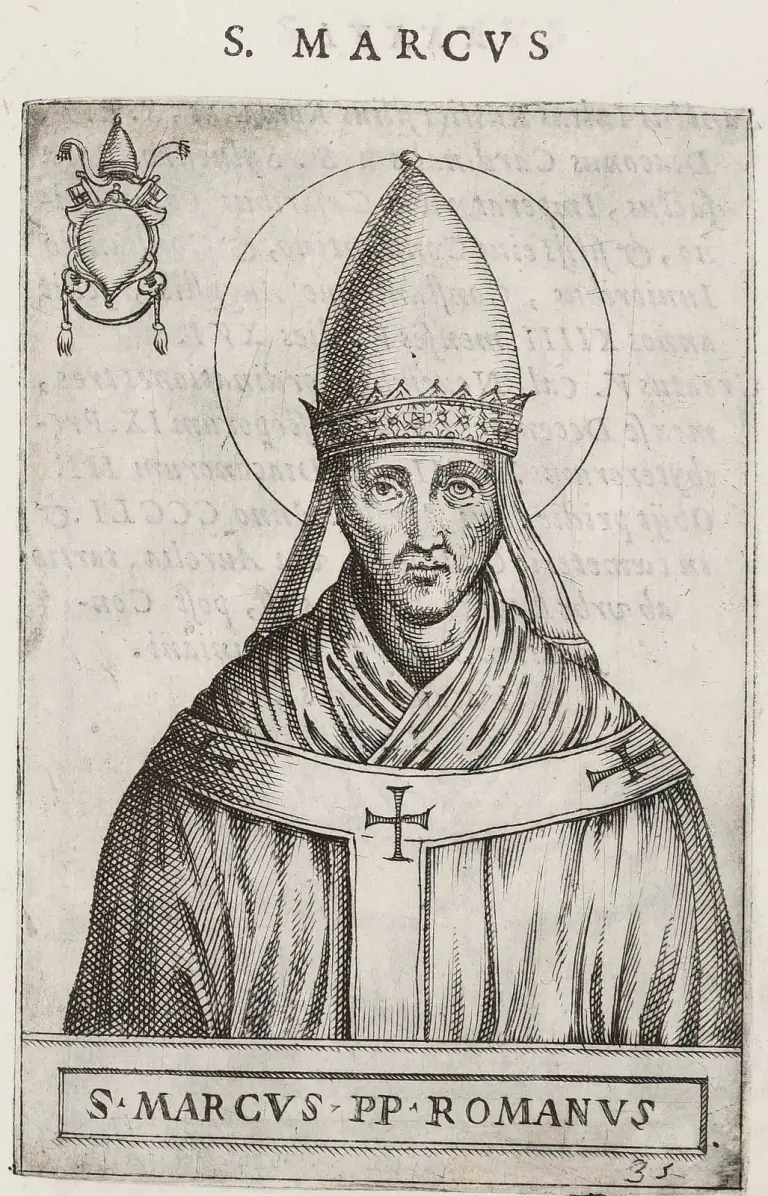
- Born
- A Roman, son of Priscus, says the Liber Pontificalis 23; nothing reliable is known of his background, says katolsk.no 5
- Before he was pope
- Probably a leading member of the Roman clergy, perhaps the Mark named in Constantine's letter of 313 245
- Pope
- January 18 to October 7, 336, by the Liberian Catalogue and the Depositio episcoporum 2; eight months and twenty days, says Butler 6; "2 years, 8 months and 20 days," says the Liber Pontificalis 3
- Built
- The church in Pallacinis, now San Marco in Rome, and a cemetery basilica over the catacomb of Balbina 123
Saint Mark was bishop of Rome for less than nine months, from January 18 to October 7 of the year 336, after the death of Pope Sylvester. 25 He was a Roman, the son of a man named Priscus, according to the papal chronicle called the Liber Pontificalis, and he built the church that still stands in Rome as San Marco, and a second basilica over a catacomb outside the walls, where he was buried. 123 Almost nothing else is known of him for certain, and the Church keeps his memory on October 7. 12
A Roman cleric in Constantine's time
In 313 the emperor Constantine wrote about the dispute over Caecilian, the bishop of Carthage, whom some of his colleagues in Africa had accused. 45 Eusebius kept the letter. It opens: "Constantine Augustus to Miltiades, bishop of Rome, and to Marcus." 4 The emperor asked the two of them, with three bishops from Gaul, to hear Caecilian and ten of his accusers in Rome, because, he wrote, "I have such reverence for the legitimate Catholic Church that I do not wish you to leave schism or division in any place." 4
Who this Marcus was, the letter does not say. J.P. Kirsch, in the Catholic Encyclopedia, judges that he "was evidently a member of the Roman clergy, either priest or first deacon, and is perhaps identical with the pope." 2 The Norwegian bishops' saints database (katolsk.no) puts it more cautiously: he may possibly be the same man, and if so he must have been a prominent figure among the Roman clergy. 5 It adds that nothing reliable is known of his background. 5
Alban Butler, writing in the eighteenth century, says that Mark served God among the Roman clergy through the last years of persecution, which ended in the West in 305 and was briefly revived under Maxentius in 312, and that he "contributed very much to advance the service of God during the pontificate of St. Sylvester." 6
Nine months in 336
Sylvester was buried on December 31, and the see stood empty fifteen days. 3 Mark was raised to it on January 18, 336, the date given by the Liberian Catalogue of the popes; Kirsch calls it "historically certain." 2 So is the day of his death, October 7, which is recorded in the same way in the Depositio episcoporum, the Roman list of the anniversaries of its bishops. 25 Butler gives the same two dates and counts eight months and twenty days between them. 6 katolsk.no says he governed the Church only nine months. 5
The Liber Pontificalis, compiled two centuries later, does not agree with itself. 38 It gives him "2 years, 8 months and 20 days," and then says he was bishop during the consulship of Nepotianus and Facundus, which is the year 336, "from February 1 until October 1." 3
These were not quiet months in the wider Church. katolsk.no notes that Athanasius had been exiled from Alexandria to Trier, that Marcellus of Ancyra and other defenders of the faith of Nicaea had been deposed, and that Arius himself was near death. 5 Of any part Mark took in it, Kirsch says, "nothing has been handed down." 2 A letter from him to Athanasius exists, but Kirsch calls it "a later forgery," and katolsk.no places it among the False Decretals, a collection of the ninth century. 25
The bishop of Ostia and the pallium
The Liber Pontificalis credits him with one decree: "He ordained that the bishop of Hostia, who consecrates the bishop, should wear the pallium and that by him the bishop of the city of Rome should be consecrated." 3 It adds that "he made regulations for the whole church," and Kirsch admits that no one knows which regulations it means. 23
The two halves of the decree fare differently. The bishop of Ostia certainly consecrated the new pope by the end of the fourth century, Kirsch says, and Augustine bears witness to it; it is possible that Mark confirmed a custom that already existed. 2 Louise Ropes Loomis, translating the Liber Pontificalis in 1916, adds that the bishop of Ostia "retains that right to this day." 3 The pallium is another matter. 25 Kirsch notes that the oldest pictures of it belong to the fifth and sixth centuries, and the first written mention of a pope bestowing one to the sixth. 2 Joseph Braun, writing on the pallium for the same encyclopedia, takes the passage as evidence for the time it was written: the life of Mark dates from the beginning of the sixth century, and it shows that the wearing of the pallium was usual by the fifth. 8
Two churches
The Liber Pontificalis says he built two basilicas, "one on the Via Ardeatina, where he is buried, and one in the city of Rome, in Pallacinis." 3 The one in the city is the church of San Marco. 23 Kirsch notes that it is named as a Roman title church in the fifth century, so its founding can be credited to Mark without difficulty, though its present shape comes from later rebuilding. 2 Loomis is firmer: nothing in the present building can be attributed to the fourth century. 3 katolsk.no thinks it was probably a simple house that Mark owned and turned into a church, later dedicated to Mark the Evangelist, and long since taken into what is now the Palazzo Venezia. 5 Butler places it "within the walls, near the capitol." 6
The other was a cemetery church over the catacomb of Balbina, between the Via Appia and the Via Ardeatina. 2 Kirsch says the pope obtained from Constantine gifts of land and of furnishings for the liturgy for both churches. 2 The current Roman Martyrology remembers him by these two foundations: the pope who built the title church in Pallacinis and a basilica in the cemetery of Balbina on the Via Ardeatina, where he himself was laid to rest. 1
Burial and memory
He was buried in the basilica he had built at Balbina, and seventh-century guides for pilgrims still point out his grave there. 2 The Liber Pontificalis gives the day of burial as October 6, one day before the date in the Depositio. 23 Loomis notes that the little church of Santa Balbina has since disappeared; katolsk.no says it survived as a ruin into the seventeenth century. 35 Butler adds that his remains were later moved into the church of San Marco by order of Gregory VII. 6
katolsk.no notes that the first Roman calendars of church anniversaries, the Depositio episcoporum and the Depositio martyrum, were begun during his pontificate. 5 Kirsch says the first edition of the collection that contains them appeared in 336 itself. 2 Butler: "His name occurs in the Liberian Calendar, compiled soon after his death, and in all other Martyrologies of the Western Church." 6
A poem by Pope Damasus in honor of a Saint Marcus survives in an old manuscript, in a damaged text. 2 The archaeologist de Rossi thought it was written for this pope; Duchesne could not accept that, and Kirsch, since the poem says nothing particular to Mark's life, does not think the question matters much. 2 Butler took it as Mark's epitaph, praising "his extraordinary disinterestedness and contempt of all earthly things, and his remarkable spirit of prayer." 6 katolsk.no, also on de Rossi's reading, gives its words as a man filled with the love of God, who despised the world, guarded justice and was a true friend of Christ. 5
What is Saint Mark the patron saint of?
Saint Mark's feast day
Pope Saint Mark's feast day is October 7, the day of his death. 12 The current Roman Martyrology, as the Italian bishops print it, commemorates him at Rome on that day. 1 The 1897 English edition entered him as "St. Mark, pope and confessor," at Rome on the Ardeatine road. 7 Kirsch traces the date to the old Roman calendar of feasts that was taken into the Martyrologium Hieronymianum, and Butler and katolsk.no keep it too. 256
katolsk.no adds that his memorial stood in the Roman calendar until 1969; the Martyrology still names him on October 7. 15 He is not to be confused with Mark the Evangelist, whose feast the 1897 Martyrology gives as April 25. 7
Praying with Saint Mark
Mark governed the Roman Church for about nine months, at a time when the great questions after Nicaea were being fought out elsewhere. 25 Nothing he said about them survives, and the one letter that bears his name was written by somebody else centuries later. 25
What he left were buildings: a title church inside the city, and a church over a cemetery outside it. 123 Both were the plain work of a bishop, and the Martyrology chose them, out of everything it might have said, as the way to remember him. 1
The pallium decree credited to him may be a later writer's back-dating, and the poem may not be his. 28 What is certain fits in two entries in the Roman lists of the fourth century: the day he was made bishop and the day he died. 2 The Church has kept the second of those days ever since. 12
Saint Mark, Pope, pray for us.
Sources
- 1.Roman Martyrology, entry for October 7, "San Marco, papa," as printed in "Santo del giorno," Conferenza Episcopale Italiana (in Italian).
- 2.J.P. Kirsch, "Pope St. Mark," The Catholic Encyclopedia, Vol. 9 (New York: Robert Appleton Company, 1910).
- 3.The Book of the Popes (Liber Pontificalis), "XXXV. Marcus," trans. Louise Ropes Loomis (New York: Columbia University Press, 1916).
- 4.Eusebius, Church History, Book X, 5, trans. A.C. McGiffert, Nicene and Post-Nicene Fathers, Second Series, Vol. 1 (1890), New Advent.
- 5."Den hellige pave Markus," Den katolske kirke, the saints database of the Catholic Church in Norway, katolsk.no (in Norwegian).
- 6.Alban Butler, "St. Mark, Pope, C.," October 7, in The Lives of the Fathers, Martyrs, and Other Principal Saints, Vol. X (Derby: Thomas Richardson and Son, 1846), Internet Archive.
- 7.The Roman Martyrology, October 7 (Baltimore: John Murphy Company, 1897), Internet Archive.
- 8.Joseph Braun, "Pallium," The Catholic Encyclopedia, Vol. 11 (New York: Robert Appleton Company, 1911).
Saints to turn to next
Others in this collection who are turned to for some of the same things.