Saint Mariana de Jesús de Paredes
October 31, 1618 - May 26, 1645
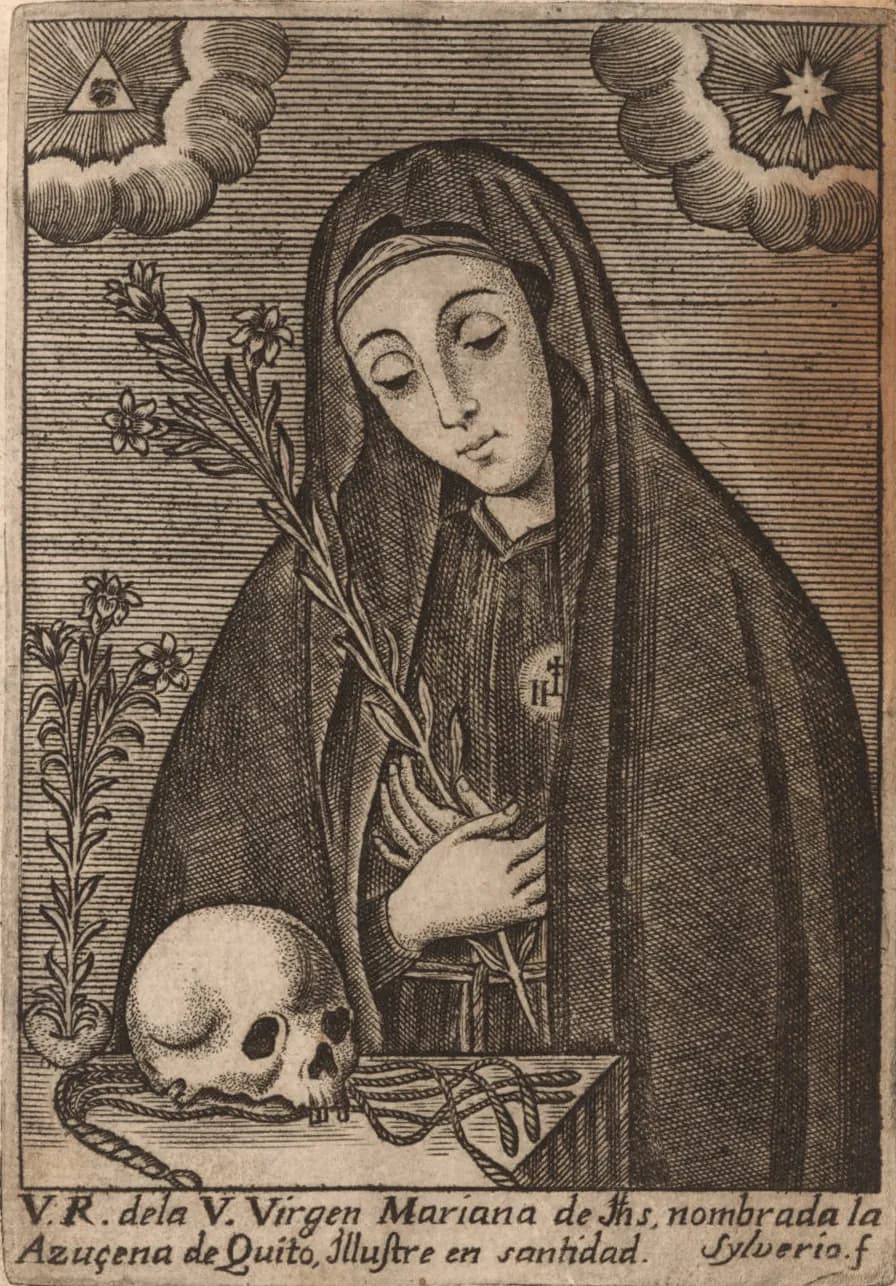
- Parents
- Don Girolamo Flores Zenel de Paredes, a nobleman of Toledo, and Doña Mariana Cranobles de Xaramilo 1
- Beatified
- November 10, 1853, in St. Peter's Basilica 1
- Canonized
- 1950, by Pope Pius XII 2
- Patronage
- None formally stated; the 1910 encyclopedia says she "seems pleased to show herself the especial patroness" of America 1
Saint Mariana de Jesús de Paredes was a young woman of Quito who never entered a convent, lived as a recluse in her family's house, ate almost nothing and died in 1645 at twenty-six. 12 Franciscan Media says she also opened a clinic and a school for Africans and indigenous people in Quito, and nursed the sick in an epidemic shortly before her death. 2 She was the first saint of what is now Ecuador, canonized by Pope Pius XII in 1950, and is called the Lily of Quito. 124
A daughter of Quito
She was born in Quito on October 31, 1618, the youngest of eight children. 12 Quito had been under Spanish rule since 1534. 2 The Catholic Encyclopedia stresses her family's standing: her father, Don Girolamo Flores Zenel de Paredes, was a nobleman of Toledo, and her mother, Doña Mariana Cranobles de Xaramilo, came from one of the best Spanish families. 1
The encyclopedia, written while she was still Blessed, says her birth was accompanied by "most unusual phenomena in the heavens," which were formally attested in the process for her beatification. 1 It says that almost from infancy she was drawn to prayer and penance and to devotion to the Virgin, and that at ten she made vows of poverty, chastity and obedience. 1
A hermit in her own house
She wanted to carry the faith to people who had not heard it, and later to enter a monastery. 1 In the encyclopedia's words, God "made it plain to her that He wished neither the one nor the other," and she accepted that. 1 Instead she made a hermitage inside her family's home and stayed there. 1 Franciscan Media says she left the house only to go to church and to do some work of charity. 2 The Secular Franciscan calendar lists her as a member of the Third Order Secular and as a hermit. 5
Her penances were severe even by the standards of her century. The encyclopedia says she ate scarcely an ounce of dry bread every eight or ten days, and that according to the sworn testimony of many witnesses she was kept alive by the Eucharist alone, which she received every morning. 1 The prioress of the Carmelite monastery that now stands on the site of her house told a reporter in 2024 that "she, precisely in the last few months, was not eating anything at all, according to the historical account," and called her "a Eucharistic soul who attended the Jesuits' holy Mass every day." 4
The same encyclopedia lists the gifts attributed to her in those years: ecstatic prayer, knowledge of the future and of distant events, the reading of hearts, cures worked with the sign of the cross or with holy water, and at least one person restored to life. 1 These come from the testimony gathered for her cause and are given here as the encyclopedia gives them. 1
Charity in the city
The encyclopedia's account stays inside the house. Franciscan Media's goes out into the city: it says she established in Quito a clinic and a school for Africans and for the indigenous peoples of the Americas. 2 Its reflection on her life draws the point that her penances made her "more sensitive to the needs of others and more courageous in trying to serve those needs." 2
Pope Francis, speaking in Quito in 2015, described her in the same terms. He asked the crowd how many of them had known what it was to be orphaned, to look after younger brothers and sisters while still young themselves, or to care every day for the sick and the elderly, and said, "Mariana did just this." 3 She and two women who took her as their example, Saint Narcisa de Jesús and Blessed Mercedes de Jesús Molina, he said, "accomplished no great feats in the eyes of the world. They simply loved much." 3
Her death and the lily
She died in Quito on May 26, 1645, at twenty-six. 12 Franciscan Media says that an epidemic had broken out, that she nursed the sick, and that she died shortly afterward; the encyclopedia does not give a cause. 12
The encyclopedia records that on the day of her death "there sprang up from her blood and blossomed and bloomed a pure white lily," and that this is why she is called "The Lily of Quito." 1 Pope Francis noted that her "sacrifice and her heroic virtue are usually represented by a flower, a lily." 3
Her house became the Carmelite monastery of San José, known as El Carmen Alto, a few years after her death; Catholic News Agency reports that she had asked for it to become a Carmel, and that she was devoted to Saint Teresa of Avila. 4 The nuns who live there now made some of the hosts for the International Eucharistic Congress held in Quito in 2024. 4
Beatification and canonization
The first inquiry into her life was opened by Monsignor Alfonso della Pegna, but the sworn testimony did not reach Rome until 1754. 1 Pope Benedict XIV formally introduced the cause on December 17, 1757, Pius VI declared her virtues heroic, and two miracles were approved at the request of John Roothaan, superior general of the Jesuits. 1 After another Jesuit general, Peter Beckx, asked for the papal brief to be published, she was beatified in St. Peter's Basilica on November 10, 1853. 1
Pope Pius XII canonized her in 1950. 2 Pope Francis said in 2015 that he had passed her statue in the apse of St. Peter's on his way out of the Vatican, and that there she holds "a whole bouquet of flowers," offering the Lord "the flowers of all the people of Ecuador." 3
What is Saint Mariana de Jesús de Paredes the patron saint of?
None of the sources consulted for this page names a formal patronage for Saint Mariana de Jesús de Paredes. 12 The Catholic Encyclopedia, writing before her canonization, said that many miracles had been granted to those who invoked her, "especially in America, of which she seems pleased to show herself the especial patroness." 1 Catholic News Agency calls her "Ecuador's first saint." 4
Saint Mariana de Jesús de Paredes's feast day
Praying with Saint Mariana de Jesús de Paredes
She wanted to go to the missions, and then to a convent, and did neither. 1 The encyclopedia does not present that as a loss. She stayed where she was and made a cloister of her own room. 1 Her life is a reminder that a vocation can look, from the outside, like nothing happening at all.
Her fasting is hard to read about now. The encyclopedia reports it as miraculous; Franciscan Media's reflection insists that self-denial which does not lead to charity is "practiced for the wrong reason." 12 On Franciscan Media's account, her penance led her to a clinic and a school for the poorest people in her city, and to the bedsides of the sick. 2
Pope Francis did not hold her up for the wonders. He held her up for the ordinary burdens, the brothers and sisters to care for and the sick to sit with, and for doing them "side by side" with others. 3 "It is not difficult," he said, "if God is with us." 3
Saint Mariana de Jesús de Paredes, pray for us.
Sources
- 1.J. Fisher, "Bl. Mary Anne de Paredes," The Catholic Encyclopedia, vol. 9 (New York: Robert Appleton Company, 1910).
- 2."Saint Mary Ann of Jesus of Paredes," Saint of the Day, Franciscan Media.
- 3.Pope Francis, Greeting to those gathered in Cathedral Square, Quito, Ecuador, July 6, 2015 (prepared address).
- 4.Eduardo Berdejo, "Hosts for International Eucharistic Congress made in home of Ecuador's first saint," Catholic News Agency, 2024.
- 5."Franciscan Saints, Blesseds, and Feasts," National Fraternity of the Secular Franciscan Order USA, 2023.
Saints to turn to next
Others in this collection who are turned to for some of the same things.
- Saint André BessetteAugust 9, 1845 - January 6, 1937PrayerSuffering and illnessPoverty and simplicity
- Saint Charles de FoucauldSeptember 15, 1858 - December 1, 1916PrayerPoverty and simplicitySuffering and illness
- Saint Francis CaraccioloOctober 13, 1563 - June 4, 1608PrayerPoverty and simplicitySuffering and illness
- Saint Germaine Cousin1579 - 1601Suffering and illnessPoverty and simplicityPrayer