Saint Malachy
1094 - November 2, 1148
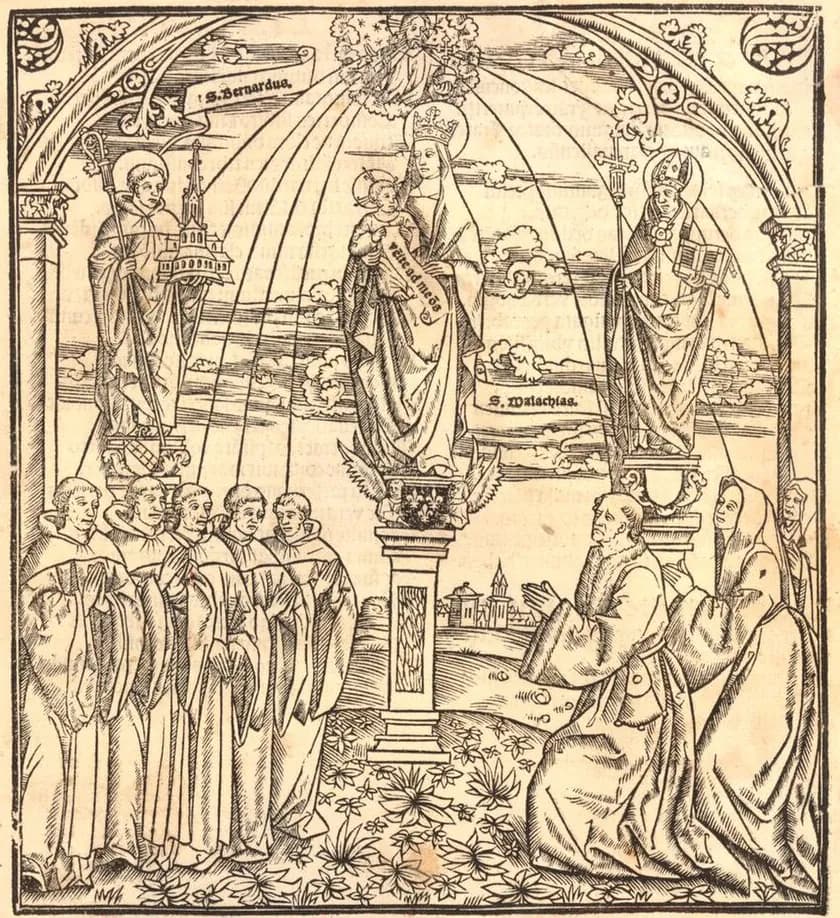
- Patron saint of
- The Diocese of Down and Connor, according to Catholicireland.net 4
- Irish name
- Maelmhaedhoc O'Morgair in the 1910 Catholic Encyclopedia; Maolmhaodhóg Ua Morgair in the Archdiocese of Armagh's spelling 13
Saint Malachy was the twelfth-century Archbishop of Armagh who spent most of his life prying the Irish Church loose from the families that had owned its offices for generations. 34 At Armagh that meant a fight lasting years against a lay dynasty that held the see as an inheritance, and he won it, then resigned. 13 He brought the Cistercians to Ireland through his friendship with Bernard of Clairvaux, and he died in Bernard's arms at Clairvaux on November 2, 1148. 13
A student of Armagh
Malachy was born in Armagh in 1094, and his birthplace in the city is marked by a plaque. 13 The 1910 Catholic Encyclopedia gives his baptismal name as Maelmhaedhoc, Latinized as Malachy, and says Bernard describes him as of noble birth. 1 Catholicireland.net names his father as Mogrón Ua Morgair, chief lector of the church of Armagh, who died when the boy was eight, and reads the name as "the servant of Mogue," an Irish saint also called Aidan. 4
The great church centers of Ireland were ruled by lay abbots who inherited the office within their extended family, and at Armagh, the archdiocese says, one family, the Clann Sínaigh, had kept a monopoly on clerical office for almost two hundred years. 34 The reform began inside that family, with Ceallach, known as Saint Celsus, who inherited the abbacy and then had himself ordained priest and bishop. 34
Malachy studied under Imhar, later abbot at Armagh, and was ordained priest by Ceallach in 1119. 1 According to the archdiocese, Ceallach ordained him five years younger than was then the custom and had him act as his vicar while he was away. 3 He then went south to Lismore to study liturgy and theology under Saint Malchus, staying nearly two years in the encyclopedia's account. 1
Bangor and Connor
He was chosen Abbot of Bangor in 1123 and consecrated Bishop of Connor a year later, and he went on living at Bangor while he was bishop. 1 Cardinal Seán Brady, preaching on his feast in 2008, said he refused Bangor's land and revenues and accepted the work. 5
In Connor, the cardinal said, the trouble was a shortage of priests and neglect of the sacraments, and Malachy's reform of it went well enough that after three years he was driven out by a local chieftain. 5 The encyclopedia says local princes sacked Connor, and that Malachy took the Bangor monks south to Iveragh in County Kerry, where King Cormac MacCarthy welcomed them. 1
The fight for Armagh
Ceallach died in 1129 and named Malachy as his successor, sending him his crozier, a choice the archdiocese describes as a death blow to the hereditary hold on the see. 3 The family did not let it go. A layman of the Clann Sínaigh, Muircheartach, was installed as abbot and held the symbols of the office, the crozier known as the Bachal Isu and the Book of Armagh. 34
The sources differ on how the next years are counted. The encyclopedia says Malachy was appointed archbishop in 1132, with great reluctance, and could not take possession of the see for two years. 1 The archdiocese and Cardinal Brady say the see was his from 1129, and that for three years he made no attempt to claim it until the papal legate, Bishop Gilbert of Limerick, persuaded him to. 35 Muircheartach died in 1134, and even then, the encyclopedia says, Malachy had to buy the Bachal Isu from Muircheartach's successor, Niall. 13
Quoting Bernard, the encyclopedia says that in three years at Armagh he restored a discipline grown lax under the lay abbots and had the Roman liturgy adopted. 1 It continues in Bernard's words: "Having extirpated barbarism and re-established Christian morals, seeing all things tranquil he began to think of his own peace." 1 He resigned, in 1138 by the encyclopedia's date and 1137 by Cardinal Brady's, and saw Gilla Mac Líag, abbot of Derry and a reformer from outside the old family, installed in his place. 135 Catholicireland.net says Gilla Mac Líag was accepted by all and held the see for the next forty years. 4
It was not won cleanly. To keep the support of Donnchadh Ua Cearbhaill, king of Airghialla, Malachy moved the part of the diocese lying in present-day County Louth over to the Diocese of Clogher, whose bishop was his own brother. 34 The archdiocese calls it "this rather drastic alienation of diocesan territory." 3
Down, Clairvaux and Mellifont
Back in the north, he divided the see of Down and Connor, kept Down for himself, and founded a priory of Augustinian canons at Downpatrick. 13 In 1139, or late that year or early in 1140 by the archdiocese's reckoning, he set out for Rome through Scotland, England and France to ask the pope to recognize Armagh and Cashel as archbishoprics by granting them the pallium. 13 At Clairvaux he met its abbot, Bernard, and the archdiocese says the two became firm friends. 3
Pope Innocent II received him kindly, refused him permission to spend the rest of his life at Clairvaux, and made him papal legate for Ireland instead. 13 The archdiocese says Innocent did not grant the pallia then and told the Irish to hold a national synod and ask formally. 3 On the way home Malachy left monks at Clairvaux to be trained: four of his own party in the archdiocese's account, while the encyclopedia says he obtained five Clairvaux monks under an Irishman named Christian. 13 From them came Mellifont Abbey, in 1142 according to the encyclopedia and the archdiocese and 1145 according to Catholicireland.net. 134 Cardinal Brady said Mellifont became the mother house of some thirty abbeys in Ireland. 5 Malachy also brought the canons of Arrouaise in Flanders to Saint Mary's Abbey in Louth. 34
Dying at Clairvaux
He spent the next six years as legate, the archdiocese says, holding synods and making new church law. 3 In 1145 a former monk of Clairvaux was elected pope as Eugene III, and Malachy judged it the moment to ask again. 3 In 1148 he convened a synod near Skerries to request the pallia formally, then set out to meet the pope in France. 34 King Stephen of England held him up at the Channel, and by the time he reached France the pope had left for Rome, so he went to Clairvaux instead, arriving in mid-October. 3
A few days later he had a fever; the monks were not alarmed, but he insisted he was dying and asked for the last rites. 3 He became critically ill on All Saints' Day and died on All Souls' Day, November 2, 1148, with the community gathered and in Bernard's arms. 13 Catholicireland.net places his death in the night of November 1 to 2. 4 The pallia were eventually granted, but he did not live to receive his. 4
Bernard wrote his Life, and Catholicireland.net says it was from that book that devotion to him spread, especially among the Cistercians. 4 The encyclopedia says that numerous miracles are recorded of him and that he was credited with the gift of prophecy. 1 Malachy himself left no writings. 4 In 1982, when Saint Patrick's Cathedral in Armagh was renovated, a portion of his relics was brought back from France and placed in its new altar. 3
The so-called Prophecy of the Popes
His name is best known today through a list of short Latin mottoes said to describe every pope from the twelfth century to the end of the world. Catholicireland.net calls the list "a forgery of the late 16th century, using the name of Malachy in an effort to gain credibility." 4 The 1911 Catholic Encyclopedia was more open. Its article says the list was first published by Arnold de Wyon and that its supposed discovery dates to 1590, and it calls the silence of four hundred years, and especially the silence of Bernard, who wrote Malachy's Life, "a strong argument against their authenticity, but it is not conclusive." 2
What is Saint Malachy the patron saint of?
Saint Malachy's feast day
His feast is November 3. 14 He died on November 2, and the 1910 Catholic Encyclopedia says the feast is kept the next day "in order not to clash with the Feast of All Souls." 1
It is chiefly an Irish observance. In his 2008 homily Cardinal Brady said that Armagh celebrates the day "in a big way," with a triduum ending in special Masses and the blessing of a relic of the saint. 5 Vatican News's Saint of the Day for November 3 is Saint Martin de Porres, and Malachy does not appear there. 6
Praying with Saint Malachy
Most of what the sources record of Malachy is administration: who held which office, which diocese was split, whose crozier was bought from whom. 13 The reform he pressed was about whether a parish had a priest, whether people went to confession, whether the sacraments were celebrated at all. 5
He was also willing to let things go. At Bangor he took on the work and turned down the revenues. 5 At Armagh he fought for years for a see and then, once a reformer could be put in his place, resigned it. 13 He asked to stay at Clairvaux as a monk and was refused, and went back to Ireland as legate instead. 3
The sources do not make him spotless. He paid the Clann Sínaigh for the crozier, and he gave away part of his own diocese to keep a king on his side, and the archdiocese that now keeps his relics calls that drastic. 13
He died a long way from home with his errand unfinished, in the house of a friend, on the way to ask once more for something the Irish Church received only after his death. 34
Saint Malachy, pray for us.
Sources
- 1.William Grattan-Flood, "St. Malachy," The Catholic Encyclopedia, Vol. 9 (New York: Robert Appleton Company, 1910).
- 2.Arthur Devine, "Prophecy," The Catholic Encyclopedia, Vol. 12 (New York: Robert Appleton Company, 1911).
- 3."St Malachy," Archdiocese of Armagh.
- 4."Nov 3 – St Malachy (Maol M'Aedhóg Ua Morgair) 1094-1148, patron of Down and Connor diocese," Saint of the Day, Catholicireland.net, November 3, 2012.
- 5.Cardinal Seán Brady, homily for the Feast of St Malachy, Cathedral of SS Peter and Paul, Ennis, November 3, 2008, Archdiocese of Armagh.
- 6."3 November," Saint of the Day, Vatican News.
Saints to turn to next
Others in this collection who are turned to for some of the same things.
- Saint Andrew Kim TaegonAugust 21, 1821 - September 16, 1846CourageWork and vocation
- Saint Ansgar801 - February 865CourageWork and vocation
- Saint Anthony Mary ClaretDecember 23, 1807 - October 24, 1870Work and vocationCourage
- Saint Augustine of CanterburyBirth unknown - 604 or 605CourageWork and vocation