Saint Macrina the Younger
c. 330 - 379
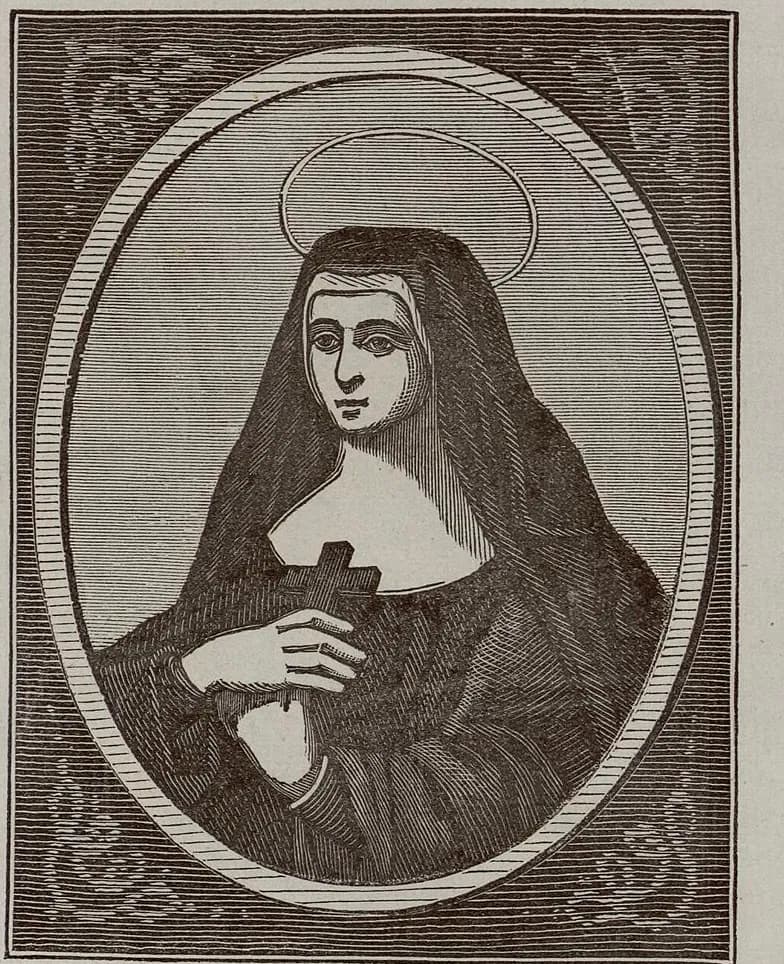
Saint Macrina the Younger was the eldest child of a large fourth-century Cappadocian family, and three of her younger brothers became bishops and saints: Basil the Great, Gregory of Nyssa and Peter of Sebaste. 129 She founded a religious community on the family estate in Pontus, and Benedict XVI presented both Basil and Gregory as men who followed her example. 234 She died in 379, and her feast is July 19. 19
The eldest daughter
She was born about 330, according to J. P. Kirsch in the Catholic Encyclopedia, or about 327 by Boyd Wright's reckoning, and was named for her grandmother, Saint Macrina the Elder. 15 Her father, Basil the Elder, taught in Caesarea of Cappadocia and had a reputation there. Her mother, Emmelia, was the daughter of a martyr. 2 Wright makes the father a rich lawyer and landowner. 5 The encyclopedia's article on Saint Basil and Meg Hunter-Kilmer both count ten children; Wright counts nine. 256
Kirsch says she received "an excellent intellectual training, though one based more on the study of the Holy Bible than on that of profane literature." 1 When she was twelve her father arranged a marriage for her with a young lawyer of good family. The young man died suddenly, and Macrina resolved to remain a virgin and give her life to Christ. 15 Hunter-Kilmer says she took a vow of chastity and encouraged many of her brothers and sisters to do the same. 6 Aleteia's page for her feast puts it differently, that she "refused to marry, seeing Jesus Christ as her bridegroom." 7
From then on she was, in effect, a second parent. Kirsch says she had great influence on the religious upbringing of her younger brothers, most of all Peter, the youngest, who became bishop of Sebaste. 16 Benedict XVI, speaking about Gregory of Nyssa, said that his Christian education was supervised with special care by Basil "and by his sister Macrina." 3 Hunter-Kilmer goes further and suggests that for much of her life it was Macrina, more than her mother, who was the head of the family. 6
The house on the Iris
Basil the Elder died while his son Basil was still young. 2 The family went to live on an estate at Annesi in Pontus, on the banks of the River Iris, which Joseph McSorley's article on Basil says belonged to the elder Macrina. 2 Kirsch says it was Basil who took his sister and mother there. 1 However they came, the women of the household began to live there as a religious community, with their servants and other companions. Kirsch names its chief concerns as strict asceticism, meditation on the truths of the faith, and prayer. 1
The sources divide the credit. McSorley says plainly that Macrina "founded a religious community on the family estate at Annesi," and Wright calls it a small community for religious women that she established. 25 Hunter-Kilmer says it was Emmelia who started it, at Macrina's prompting, and adds that many of the nuns were former slaves. 6 After Emmelia died, Macrina was its head. 1 The Roman Martyrology places her in the monastery of Annesi and remembers her as a woman versed in the Scriptures who withdrew to a solitary life. 9
Kirsch adds that Gregory of Nazianzus and Eustathius of Sebaste were connected with the circle at Annesi as well as her brothers. 1 Peter, the youngest, is described by Hunter-Kilmer as a great help to his mother and sister in the community. 6
What her brothers owed her
Basil came home from his studies in Athens a successful young teacher of rhetoric. 5 Wright says Macrina told him he was "being puffed up beyond measure with the pride of oratory," and that he ignored her until the sudden death of their brother Naucratius, after which he came to her to learn where her calm came from. 5 McSorley dates his turn to the Gospel to the time when he "fell under the influence of that very remarkable woman, his sister Macrina." 2
Benedict XVI made the same point in his catechesis on Basil. Basil gave himself to the monastic life, the Pope said, "also following the example of his sister, St Macrina, who was already living the ascetic life of a nun." 4 The monastery Basil then founded for men stood on the Iris, in McSorley's words "nearly opposite Annesi." 2 Wright presents it as Basil applying to men the pattern his sister had begun for women. 5
When Naucratius died, it was their mother who needed her. Hunter-Kilmer says Emmelia was heartbroken, and that Macrina told her, "it is not right for a Christian to mourn as one who has no hope." 6
Gregory was the brother who wrote about her. Benedict XVI says that Gregory "proposed the life of his sister Macrina, who was always a guide and example for him," as an outstanding model of consecrated virginity, and cites the Life of Macrina that Gregory wrote. 3 Kirsch calls that Life a biography "in the form of a panegyric." 1
The last conversation
Basil died in 379, and Macrina died the same year. 5 Gregory's dialogue On the Soul and the Resurrection opens with his journey to see her. "Basil, great among the saints, had departed from this life to God," he begins. "But his sister the Teacher was still living; and so I journeyed to her, yearning for an interchange of sympathy over the loss of her brother." 8 He found her "lying in a state of prostration even unto death." 8
He broke down, and she let him for a while. Then, he writes, "she tried to check me by speaking, and to correct with the curb of her reasonings the disorder of my soul," quoting Saint Paul on not grieving like those who have no hope. 8 The rest of the book is their conversation, with Gregory raising the objections and Macrina, whom he calls only the Teacher, answering them. Kirsch summarizes her subjects as "the soul, death, the resurrection, and the restoration of all things." 18 Hunter-Kilmer remarks that casting a woman as his teacher was a startling thing for a bishop of that time to do. 6
The dialogue ends with what the purified soul will receive: "life, and honour, and grace, and glory, and everything else that we conjecture is to be seen in God, and in His Image, man as he was made." 8
Kirsch dates Gregory's visit to the end of 379, on his way back from a synod at Antioch, and says she died soon afterward. 1 Aleteia gives the day as July 19, 379, in the family home she had made a monastery. 7
What is Saint Macrina the Younger the patron saint of?
None of the sources consulted for this page names Saint Macrina the Younger as the patron of any group, place or cause, and the page does not supply one. 1567 Aleteia says she "has long been held to be a standard of virtue for Christian women," and that she is honored in the Catholic and Orthodox Churches alike. 7 That is praise, and none of the sources turns it into a patronage.
Saint Macrina the Younger's feast day
Saint Macrina the Younger's feast is July 19. The Catholic Encyclopedia says "Her feast is celebrated on 19 July," the current Roman Martyrology enters her on that day, and Aleteia keeps her as its saint of the day for July 19. 179 Her grandmother, Saint Macrina the Elder, has a separate day; Hunter-Kilmer gives May 30 for the elder Macrina and Emmelia together. 6
Praying with Saint Macrina the Younger
What the sources know of Macrina comes through her brothers, above all Gregory. 13 Basil is considered the founder of monasticism in the East, and Gregory is a Father of the Church, and the accounts of both point back to an older sister at home. 246
Her influence worked through ordinary family channels. She taught the younger children, told a brilliant brother he was conceited, steadied her mother at a son's death, and ran a household that by degrees became a monastery. 156
Gregory's dialogue shows how she thought at the end. She was dying, her most famous brother had just died, and a second brother arrived in tears expecting to be comforted. She gave him a little time and then made him think, starting from a line of Saint Paul and following the question of what death is through to the resurrection. 8
It is fair to remember that the Teacher of the dialogue speaks in Gregory's prose. Even so, he chose to put his own doubts in his own mouth and the answers in hers, and Benedict XVI took him at his word that she "was always a guide and example for him." 38
Saint Macrina the Younger, pray for us.
Sources
- 1.Johann Peter Kirsch, "St. Macrina the Younger," The Catholic Encyclopedia, vol. 9 (New York: Robert Appleton Company, 1910).
- 2.Joseph McSorley, "St. Basil the Great," The Catholic Encyclopedia, vol. 2 (New York: Robert Appleton Company, 1907).
- 3.Pope Benedict XVI, General Audience, August 29, 2007: Saint Gregory of Nyssa (1).
- 4.Pope Benedict XVI, General Audience, July 4, 2007: Saint Basil (1).
- 5.Boyd Wright, "Those Amazing Cappadocians," Catholic Heritage (Our Sunday Visitor), July/August 1997, 20-22; Catholic Culture Library.
- 6.Meg Hunter-Kilmer, "A family and their friends with at least a dozen saints," Aleteia, May 25, 2017.
- 7."Saint of the Day: St. Macrina the Younger," July 19, Aleteia.
- 8.Saint Gregory of Nyssa, On the Soul and the Resurrection, trans. William Moore and Henry Austin Wilson (Nicene and Post-Nicene Fathers, Second Series, vol. 5), New Advent.
- 9."Santa Macrina, vergine," Santo del giorno, 19 luglio (Roman Martyrology entry, in Italian), Conferenza Episcopale Italiana.
Saints to turn to next
Others in this collection who are turned to for some of the same things.