Saint Macarius of Egypt
c. 300 - 390
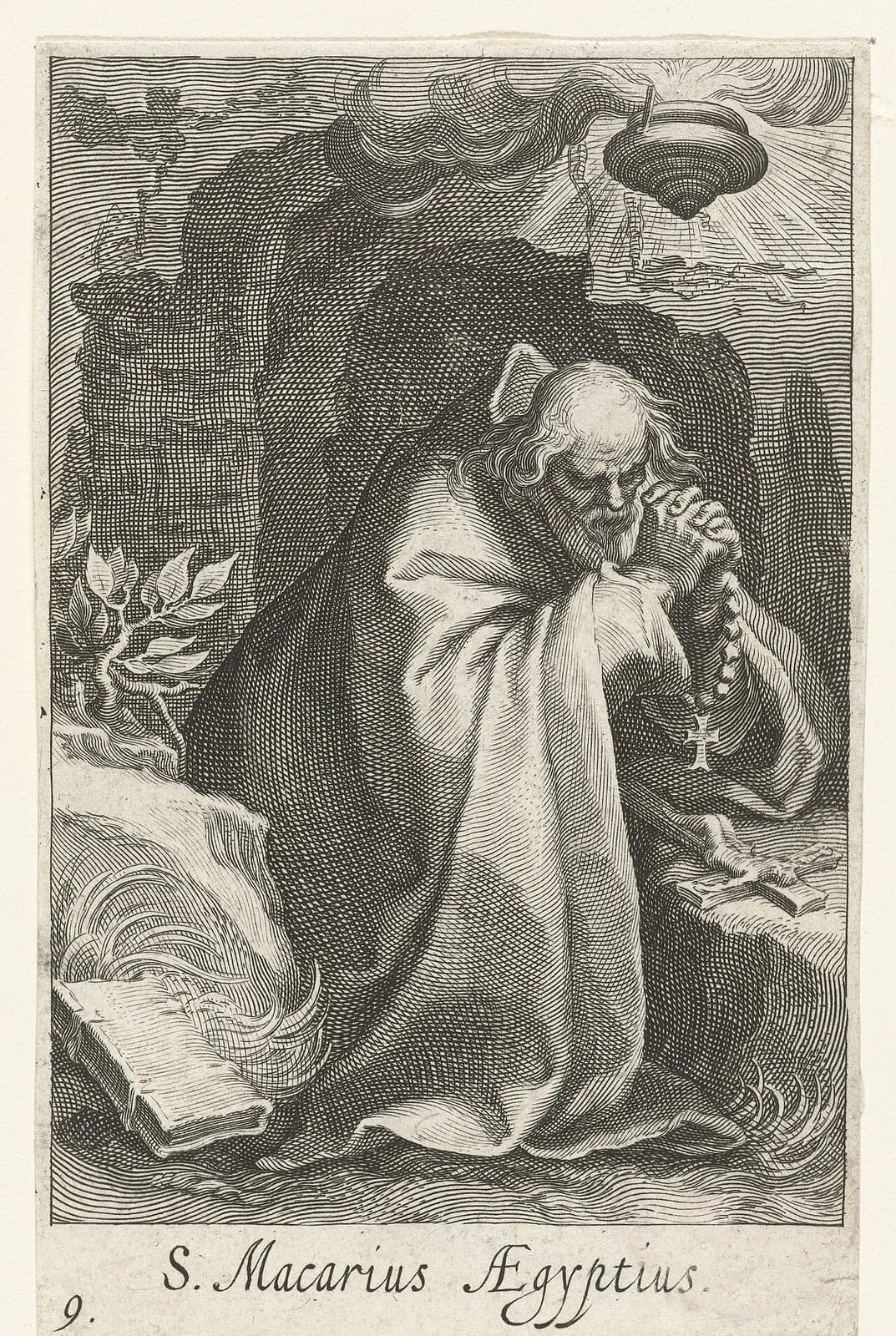
- Known for
- Founding the monastic settlement of Scetis, in the Egyptian desert 1
- Teacher
- Saint Anthony of Egypt 1
Saint Macarius of Egypt, called the Great, was a disciple of Saint Anthony and the founder of the monastic settlement at Scetis, in the Egyptian desert. 1 He lived about ninety years, sixty of them in the desert, and by his death in 390 the monks gathered around him numbered in the thousands. 12 The church historian Socrates, writing in the next century, said his cures and exorcisms would need a book of their own. 4
The old child
He was born in Egypt about the year 300. 15 The Spanish Catholic.net santoral says he spent his boyhood as a herdsman and acquired in the solitude of the fields a taste for prayer and silence. 5 Patrick Healy, writing the Catholic Encyclopedia's article in 1914, says that it was through the influence of Saint Anthony that he left the world at the age of thirty. 1
He made progress fast. Sozomen, a church historian of the fifth century, records that when he was young he advanced so quickly in what Sozomen calls philosophy, meaning the ascetic life, "that the monks surnamed him old child." 2 He was ordained a priest at forty, and both Healy and Sozomen give that age. 12 Catholic.net explains why a hermit needed to be a priest: so that he could say Mass for the many disciples who had come to live near him. 5
Catholic.net also tells a story from before he went into the desert. A woman accused him of being the father of her child, and the village dragged him through the streets. He prayed that the truth would come out, and when her labor would not progress until she named the real father, the people who had dragged him through the streets came to admire him instead. 5 None of the other sources has it.
Scetis
The place he settled was the desert of Scetis. 1 The community that grew up around him there and in the neighboring desert of Nitria was what Healy calls "of the semi-eremitical type." 1 There was no fixed rule. The cells stood close together, and the monks met for worship only on Saturdays and Sundays. 1 "The principle which held them together was one of mutual helpfulness," Healy writes, and the elders were obeyed not as superiors but as "guides and models of perfection." 1 Among them, he adds, the preeminence of Macarius was generally recognized. 1 Catholic.net says that four of his disciples were eventually ordained to serve the four churches built for the hermits. 5
Sozomen and Socrates both write of two famous monks of the same name, which has confused people ever since. One was a native of Egypt, the subject of this page. The other was a citizen of Alexandria, called Politicus, who became a priest later in life and is remembered for the extremity of his fasts. 24 Socrates distinguishes them by temperament. The Egyptian's "manner toward those who resorted to him was austere, yet at the same time calculated to inspire veneration," while the Alexandrian "was always cheerful to his visitors." 4 Healy, writing on the younger man, says there is "no reason for confounding or identifying him with his older namesake." 1
What Evagrius heard
One of the men who came to them was Evagrius, a deacon ordained by Gregory of Nazianzus, who stayed in the desert and wrote about it. Socrates copies several of his memories of Macarius into his history. 4 Evagrius calls him "That 'chosen vessel,' the aged Egyptian Macarius." 4
Macarius once asked Evagrius why remembering the wrongs done us by other people weakens the mind, while remembering the wrongs done us by demons does not. Evagrius had no answer. "Because," said Macarius, "the former is an affection contrary to nature, and the latter is conformable to the nature of the mind." 4
Another time Evagrius arrived at midday, worn out with heat and thirst, and asked for water. "Content yourself with the shade," Macarius told him, "for many who are now journeying by land, or sailing on the deep, are deprived even of this." 4 Talking later about fasting, he said: "for twenty years I have neither eaten, drunk, nor slept to satiety; my bread has always been weighed, my water measured, and what little sleep I have had has been stolen by reclining myself against a wall." 4 Catholic.net tells the same story differently: a disciple offered him a cup of water on a journey, and he said he preferred to quench his thirst by resting a little under a palm tree. 5
Sayings and stories
The sayings that Catholic.net collects are blunt. To a young man worried about what others thought of him, Macarius gave an assignment: go to the cemetery and insult the dead, then go back and praise them. 5 The dead said nothing either time. Be like them, he told the young man, neither saddened by insults nor puffed up by praise, because you are what you are before God and nothing more. 5
In the same collection he asks God how far he has come in holiness, and is told that he has not yet reached the level of two married women in the nearest town. 5 He goes to see them. They tell him that they guard their tongues, bear humiliations and poverty patiently, are kind to difficult husbands, rebellious children and harsh neighbors, and try to live the whole day offering everything to God. 5 For prayer, the site says, he advised few words: ask the Lord for the graces he knows you need, and repeat the psalm verse, "O God, come to my assistance; O Lord, make haste to help me." 5
Sozomen reports that the demons feared him and that, as the story goes, he raised a dead man to life to convince a heretic of the resurrection. 2 Socrates leaves the miracles in a single sentence: "The Egyptian Macarius performed so many cures, and cast out so many devils, that it would require a distinct treatise to record all that the grace of God enabled him to do." 4
Exile on an island
The emperor Valens ordered the orthodox persecuted in Egypt, and the Arian bishop of Alexandria, Lucius, went into the desert with soldiers to break the monks who held to the Council of Nicaea. 34 Both historians name the two Macarii among the leaders of the monks. 34 When violence failed, Lucius had them exiled. Socrates says they were sent to "an island where there was no Christian inhabitant"; Sozomen says they were seized by night and taken to an island hidden in the marshes. 34
The island had a temple, and the priest's daughter was possessed. 34 Both historians tell the same outcome: the monks freed her, and her father and the islanders were baptized and turned their temple into a church. 34 Sozomen adds that when the news reached Alexandria, Lucius, afraid of seeming to make war on God, sent secret orders for the monks to be taken home to the desert. 3
He went back to the desert and lived until about 390. 15 Catholic.net gives his last words to the monks who stood weeping around him: let us weep, but for our sins and for the sins of the whole world, because those are the tears that save. 5 Fifty homilies have come down under his name, but Healy says that they, and an "Epistle to the monks", "cannot be ascribed to him with absolute certainty." 1
What is Saint Macarius the patron saint of?
Saint Macarius's feast day
Saint Macarius's feast day is January 19. Catholic.net prints the current Roman Martyrology's commemoration on that day: Saint Macarius the Elder, priest and abbot of the monastery of Scetis, who counted himself dead to the world, lived for God alone, and taught his monks to do the same. 5 The Italian bishops' online edition of the Martyrology also has its January 19 entry for a priest and abbot at Scetis, though it heads the entry "Macarius, called the Alexandrian." 6
The older dates vary. New Advent's editor notes that the Roman Martyrology used to name Macarius the Elder on January 15 and the Alexandrian on January 2, and that the Byzantine calendars commemorate both on January 19. 1 Catholic.net says the old calendar kept him on February 16. 5
Praying with Saint Macarius
Most of what survives of him is talk: short answers to people who came to him with a question. 45 He did not explain much. He told a thirsty man to sit in the shade and think of the people who had none, and sent a young man who worried about other people's opinion to go and speak to the dead. 45
He kept his own rule hard. Twenty years without eating, drinking or sleeping his fill, by his own account to Evagrius. 4 And yet the story Catholic.net chooses to tell about his holiness is the one where God sends him to learn from two married women who managed difficult households with patience. 5 He went, and he listened.
Healy's phrase for what held his monks together, "mutual helpfulness", is a modest one for a man who drew thousands into the desert. 1 Even when Lucius sent him into exile, he spent it among strangers who had never heard of Christ, and they were baptized. 34
Saint Macarius of Egypt, pray for us.
Sources
- 1.Patrick Healy, "Macarius," The Catholic Encyclopedia, Vol. 16 (Index) (New York: The Encyclopedia Press, 1914), with the editor's note on New Advent.
- 2.Sozomen, Ecclesiastical History, Book III, chapter 14, trans. Chester D. Hartranft, Nicene and Post-Nicene Fathers, Second Series, Vol. 2 (Buffalo, NY: Christian Literature Publishing Co., 1890).
- 3.Sozomen, Ecclesiastical History, Book VI, chapter 20, trans. Chester D. Hartranft, Nicene and Post-Nicene Fathers, Second Series, Vol. 2 (Buffalo, NY: Christian Literature Publishing Co., 1890).
- 4.Socrates Scholasticus, Ecclesiastical History, Book IV, chapters 23 and 24, trans. A. C. Zenos, Nicene and Post-Nicene Fathers, Second Series, Vol. 2 (Buffalo, NY: Christian Literature Publishing Co., 1890).
- 5."Macario el Grande, Santo," Santoral, Catholic.net (in Spanish).
- 6.Roman Martyrology, entry for January 19, "San Macario, detto Alessandrino," as printed in "Santo del giorno," Conferenza Episcopale Italiana (in Italian).
Saints to turn to next
Others in this collection who are turned to for some of the same things.
- Saint Agnes of Bohemiac. 1200-1205 - March 1281 or 1282Poverty and simplicityPrayer
- Saint Aidan of Lindisfarnec. 590 - August 31, 651Poverty and simplicityPrayer
- Saint Alexius of RomeFifth century, by traditionPoverty and simplicityPrayer
- Saint André BessetteAugust 9, 1845 - January 6, 1937PrayerPoverty and simplicity