Saint Lupus of Troyes
c. 393 - c. 479
- Also called
- Loup, Leu; in Italy, Lupo 1
- Born
- About 393 at Toul, though 383 is the traditional date 1; the 1912 Catholic Encyclopedia gives 383 3
- Patron saint of
- Troyes, Benevento and San Lupo; invoked against possession, paralysis and epilepsy 1
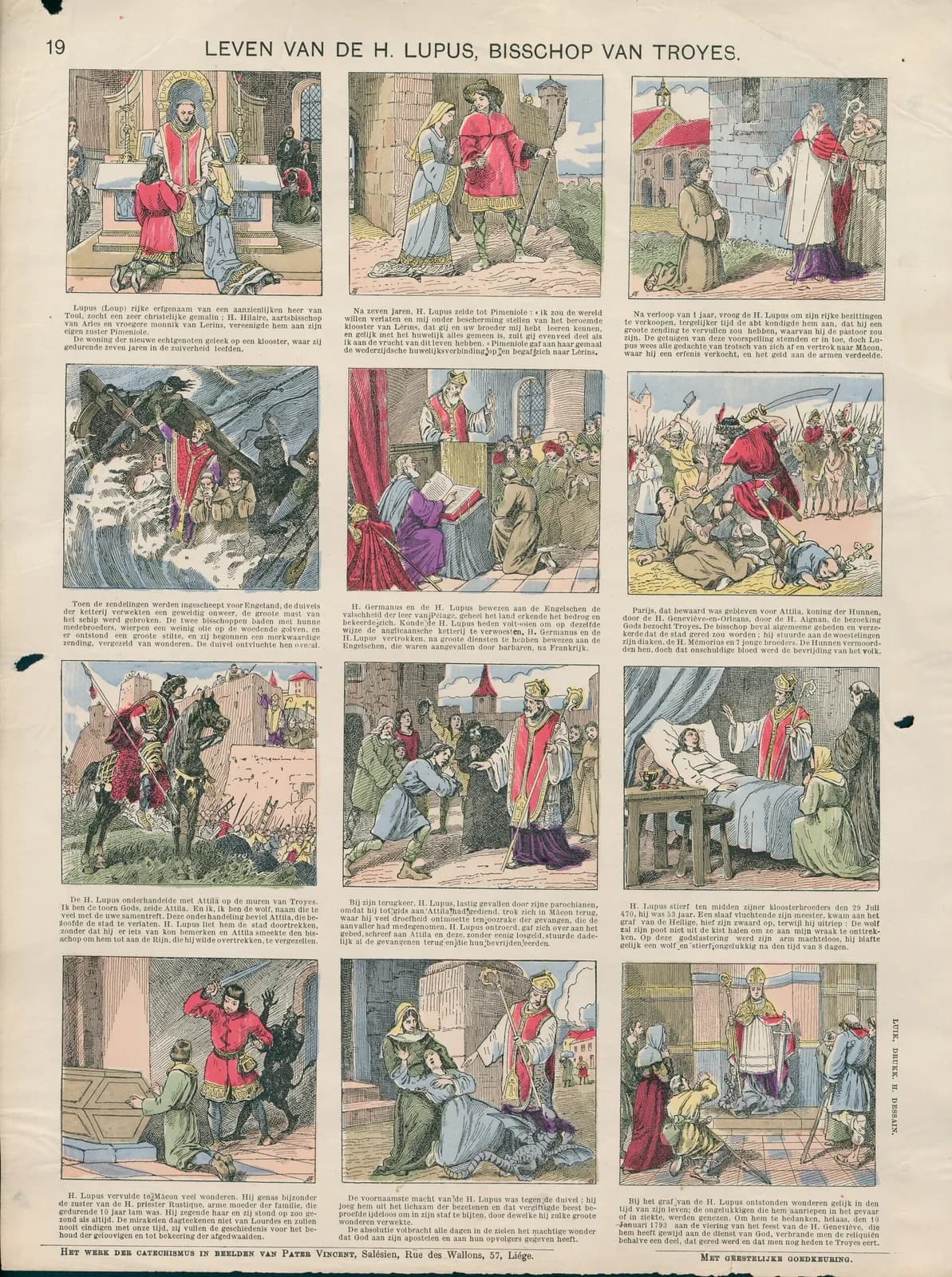
Saint Lupus of Troyes was a Gallic lawyer who left his marriage by mutual consent to become a monk, was made bishop of Troyes against his will, and held the see for fifty-two years. 12 He crossed to Britain with Germanus of Auxerre to argue against the Pelagians, met Attila when the Huns came through Champagne, and was, to the younger bishop Sidonius Apollinaris, "father of fathers, bishop of bishops." 2458
The lawyer who became a monk
Lupus was born at Toul, in Lorraine, about 393; the traditional date is 383, and that is the one the Catholic Encyclopedia prints. 13 He came of a distinguished family, lost his parents young, and was educated by an uncle. Learned and a good speaker, he went into law and made a name as an advocate. 1 About 420 he married Pimeniola, a sister of Hilary, the future archbishop of Arles. 1
After six years the couple agreed, in 426, to part and each enter religious life. With his wife's consent Lupus sold his property and went to the new monastery of Lérins, on a small island off Cannes, where he made his vows under its founder Honoratus. 1 The encyclopedia's article on Lérins names him among the bishops the abbey gave the Church, alongside Hilary, Eucherius of Lyon and Vincent of Lérins. 7 Sidonius would later remember his "hard vigils in the spiritual warfare at Lerins." 8
He did not stay long. In 427 he went to Mâcon to sell an estate he still held there and gave the money away. On the road back he was met by envoys from Troyes. Their bishop, Ursus, had died after a few months in office, and the people had chosen Lupus. He refused at first and accepted only on condition that he could go on living as a monk. 1
The mission to Britain
In the late fourth century the British-born monk Pelagius had taught that human nature was not corrupted by original sin and did not need grace, and a disciple named Agricola had brought the teaching to Britain. 16 The British bishops asked for help. The sources tell the next step in three ways. katolsk.no says Pope Celestine I asked the Gallic bishops to act and that a council at Arles in 429 gave the task to Germanus and Lupus. 1 The encyclopedia's article on Germain says Prosper of Aquitaine, who was in Rome in 431, records in his Chronicle that Celestine commissioned the Church in Gaul, and that Germain and Lupus were deputed. 4 Its article on Pelagianism says a synod "held probably at Troyes in 429" sent them. 6
They went the same year. Tradition places the main debate with the Pelagians at Saint Albans, the Roman Verulamium, and has it end in the defeat of the heretics. 14 The work was also to steady a British Church left exposed after the Roman army withdrew. 1 Lupus came home to his diocese afterward. When Germanus returned to Britain about 445, it was with Severus of Trier, a disciple of Lupus, and not with Lupus himself. 1
Attila at Troyes
In 451 Attila's Huns came into Gaul. The Roman Martyrology says only that Lupus defended his city from the fury of Attila by prayer. 2 katolsk.no gives the story that grew from it and labels it legend: that he lay prostrate for days, fasting and weeping, then put on his full vestments and went out at the head of a procession of his clergy; that Attila was moved, and after Lupus reminded him he could do only what God allowed, spared the town. 1 In reality, it says, the Huns marched into Troyes without doing the least harm, and afterward a legend formed that they had not even seen the city as they passed through it. 1 Pope Leo was credited with a similar deliverance of Rome, and so it was said that Attila could be tamed only by a lion and a wolf, Leo and Lupus. 1
The encyclopedia tells it more soberly and adds a cost. Lupus "prevailed upon Attila to spare the province of Champagne, and gave himself as a hostage while the Hunnish army remained in Gaul." 5 Its Troyes article goes further: he "was led away as a hostage by Attila and only returned to his diocese after many years of exile." 3 katolsk.no says only that he came back to Troyes once his innocence had been recognized, and governed it until he died. 1
The friend of Sidonius
His long episcopate made him a teacher of bishops. katolsk.no names Severus of Trier, Polychronius of Verdun, Alpinus of Châlons and his own successor Camelianus among his pupils, and says some of his writings survive. 1 He founded the monastery of Saint-Loup at Troyes. 1
The clearest picture of him comes from Sidonius Apollinaris, made bishop of Clermont about 472, who wrote to Lupus in something close to panic. The letter calls him "father of fathers, bishop of bishops," "the consoler of all the feeble, the counsellor of all men," and counts "the nine lustres passed in your apostolic see," forty-five years. 8 Another letter reports a small victory. A man named Gallus had left his wife, and Lupus wrote to him through Sidonius. When the letter was read out, Gallus "immediately promised to go back, made his preparations at once, and was off without delay." Sidonius admired the method: "What, indeed, could be more valuable than a reprimand aiding the sick mind to discover within itself a remedy which the sharp reproach of others could never find?" 8
Lupus was not above taking offense. Late in his life he complained, at length, that Sidonius had not sent him a book properly, and Sidonius answered with an apology and a compliment: there was no writer whom Lupus could not draw out, "just as the sun's rays by their absorbent power extract the moisture hidden in the bowels of the earth." 9 Writing to a friend whose son had come from Troyes, Sidonius called him "the foremost of our Gallic bishops." 10
Death and relics
Lupus died in 478 or 479, about eighty-six years old and after fifty-two years as bishop, and Camelianus succeeded him. 1 The encyclopedia dates his episcopate 426 to 478. 3 He was buried at Saint-Martin-ès-Aires, then outside the walls. In 570 two Merovingian kings, Guntram of Burgundy and Chilperic I, came to his tomb and swore peace with each other there. 1 Around 890 his remains were brought into the center of town, to a newly built church that was known from then on as the Abbey of Saint-Loup. 1
On the night of January 9 to 10, 1794, during the Revolution, his relics were desecrated and scattered, all but part of the head, which is kept in the cathedral of Troyes in a silver reliquary shaped like a bishop and set with precious stones. 1 His cult also took root far to the south, at Benevento, where a Benedictine monastery bore his name by the ninth century; when it closed in 1450 the archdiocese took him as its patron. 1
What is Saint Lupus the patron saint of?
Saint Lupus is the patron saint of Troyes, of the archdiocese of Benevento and of the village of San Lupo nearby, where processions with the new harvest are held from July 27 to 29. 1 He is invoked against demonic possession, paralysis and epilepsy. 1 In art he is shown saying Mass while a diamond falls from heaven, holding a chalice with a diamond in it, or handing a diamond to a king. 1
Saint Lupus's feast day
Saint Lupus's feast day is July 29, the date of his burial according to tradition, and the day on which the current Roman Martyrology enters him. 12 He was formerly kept on July 24, and Troyes celebrates the translation of his relics on May 10. 1 The Martyrology's entry sums up his life in three clauses: the mission to Britain with Germanus against the Pelagians, the defense of his city from Attila by prayer, and fifty-two years of priesthood honorably completed before he rested in peace. 2
Praying with Saint Lupus
Twice Lupus was pulled out of the life he had chosen. He left the law and his marriage for an island monastery, and within a year was on the road back to the mainland as a bishop he had not asked to be. 1 He agreed on one condition, that he could keep living as a monk, and by every account he kept it for half a century. 1
The famous scene with Attila may be mostly legend. 1 What the sources agree on is less dramatic and longer: a bishop who stayed with a frontier town as the empire came apart, and who, by the encyclopedia's account, went with the enemy as a hostage. 35
Sidonius's letters show him at closer range, writing a letter that sent a man home to his wife and writing another that sulked about a book. 89 Sidonius, newly a bishop and frightened by it, asked him for one thing: "Pray for me, that I may know at length how vast the burden is that weighs upon my shoulders." 8 He was asking an old man who had carried the same weight for forty-five years.
Saint Lupus of Troyes, pray for us.
Sources
- 1."Den hellige Lupus av Troyes (~393-479)," Den katolske kirke (katolsk.no), Catholic Diocese of Oslo (in Norwegian).
- 2.Roman Martyrology, entry for July 29, "San Lupo, vescovo," as printed in "Santo del giorno," Conferenza Episcopale Italiana (in Italian).
- 3.Georges Goyau, "Troyes," The Catholic Encyclopedia, Vol. 15 (New York: Robert Appleton Company, 1912).
- 4.Andrew MacErlean, "St. Germain," The Catholic Encyclopedia, Vol. 6 (New York: Robert Appleton Company, 1909).
- 5.John Bertram Peterson, "Attila," The Catholic Encyclopedia, Vol. 2 (New York: Robert Appleton Company, 1907).
- 6.Joseph Pohle, "Pelagius and Pelagianism," The Catholic Encyclopedia, Vol. 11 (New York: Robert Appleton Company, 1911).
- 7.Jean Besse, "Abbey of Lérins," The Catholic Encyclopedia, Vol. 9 (New York: Robert Appleton Company, 1910).
- 8.Sidonius Apollinaris, Letters, Book VI, letters I and IX to Bishop Lupus, trans. O. M. Dalton (Oxford, 1915).
- 9.Sidonius Apollinaris, Letters, Book IX, letter XI to Bishop Lupus, trans. O. M. Dalton (Oxford, 1915).
- 10.Sidonius Apollinaris, Letters, Book VII, letter XIII to Sulpicius, trans. O. M. Dalton (Oxford, 1915).
Saints to turn to next
Others in this collection who are turned to for some of the same things.