Saint Lambert of Maastricht
c. 635 - September 17, c. 700
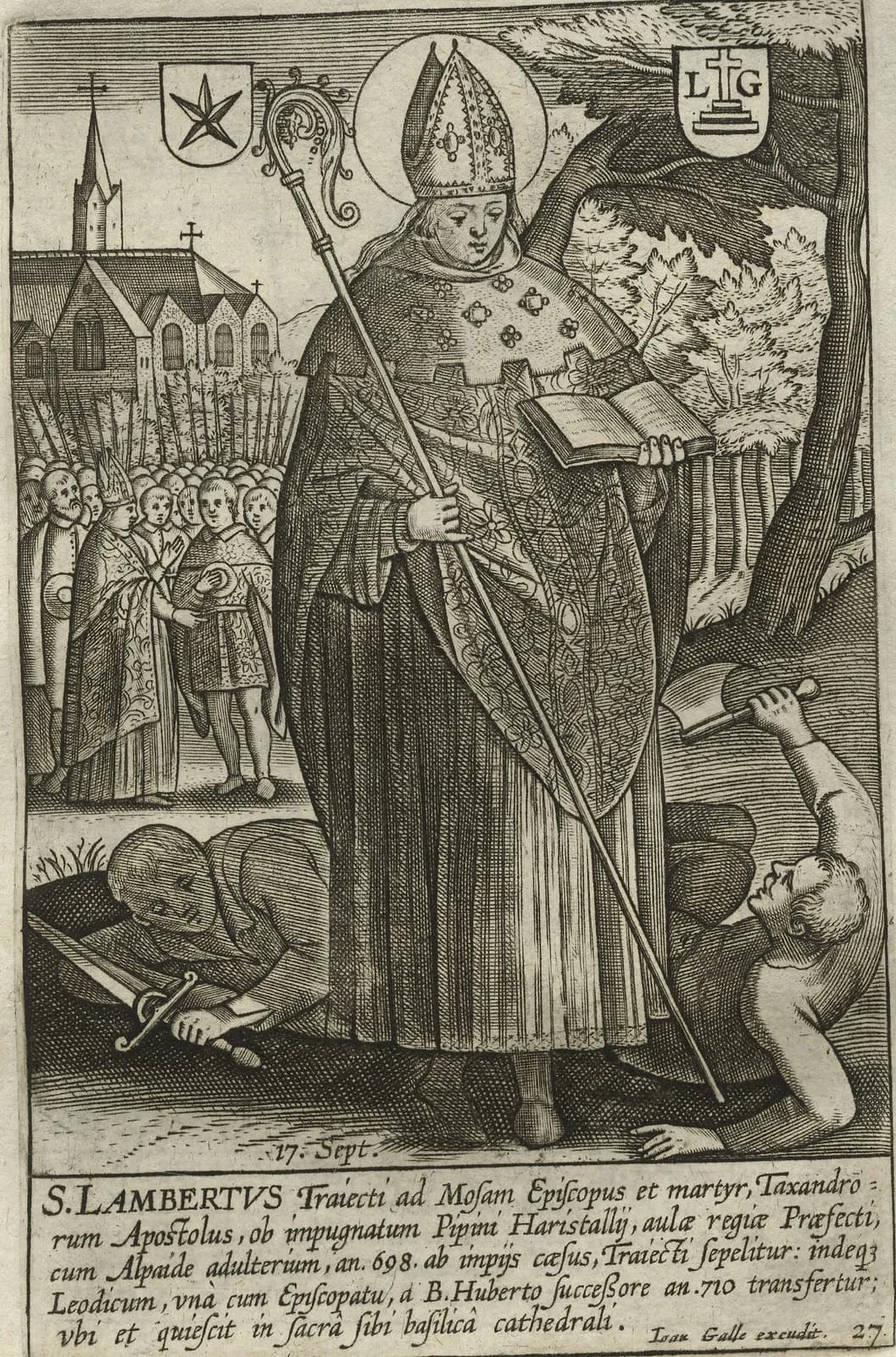
- Exile
- Seven years at the abbey of Stavelot, 674 to 681 1
- Mission
- Toxandria, the Campine and Brabant of today, with Saint Willibrord 1
Saint Lambert of Maastricht was a bishop on the river Meuse in the last decades of the seventh century, driven into seven years of exile by one mayor of the palace and murdered at Liège around the year 700. 12 His sources agree that he was killed and disagree about why: for rebuking a ruler's adultery, in the older tradition, or in a blood feud, by the chronicles that the Belgian Catholic news site CathoBel cites. 12 The village where he died grew around his tomb into the city of Liège, which keeps his feast on September 17. 24
Maastricht and Stavelot
Lambert, Landebertus in Latin, was born at Maastricht between 633 and 638, of a noble family; the encyclopedia names his parents as Aper and Herisplindis. 1 He was taught first by Saint Landoaldus, a priest of the cathedral, and then by the bishop, Saint Theodardus. 1 Nominis adds that he had distinguished himself as a soldier before he was a bishop. 4
Theodardus was murdered, and Lambert succeeded him, in 670 by the encyclopedia and CathoBel, in 668 by Nominis. 124 His diocese is called Maastricht in the encyclopedia and Tongeren-Maastricht in the Belgian sources, because the see had begun at Tongeren before it moved. 25
A few years later he fell foul of Ebroin, the mayor of the palace. Lambert had defended the interests of King Childeric, and he was forced to flee Maastricht. Another man administered his diocese, and Lambert spent seven years, 674 to 681, in the abbey of Stavelot. 1 The Martyrology entry as Nominis prints it says he followed the monastic observance there. 4
Nominis tells one story from Stavelot. On a winter night, while the monks were praying in choir, the bishop knocked over a bench and disturbed everyone. In the dark the abbot ordered whoever was responsible to go and pray barefoot outside, in front of the cross. The monks finished the long office and went to warm themselves, and only then did someone notice the bishop was missing. He came in covered with snow, having knelt outside for two hours, and thanked the abbot for letting him serve God in cold and nakedness, as Saint Paul says. 4
Back on the Meuse
Ebroin met his end in 681. Pepin of Heristal became mayor of the palace, liked Lambert, and let him go home. 14 Some time afterward the bishop turns up as a missionary in Toxandria, the country the encyclopedia identifies with the Campine and Brabant. He went down the Meuse as far as Tiel and worked along its banks with Saint Willibrord, who had come from England in 691. 1
CathoBel describes the region as only thinly Christian when he began, with the faith present in the towns and among the elite, and says his preaching moved many people, nobles among them, to change their lives. 3 Monasteries were founded with his encouragement. Saint Landrada worked with him to found the abbey of Munsterbilzen. 13 The Martyrology sums up these years by saying that once he had his see back he carried out his pastoral ministry worthily. 6
Why he was killed
He was assassinated at Liège, then a small and poorly defended village. 12 The encyclopedia gives the scene in the chapel of Saints Cosmas and Damian: "His heart was pierced by a javelin while he was at the altar." 1 Nominis says he forbade his escort to shed blood in his defense. 4 CathoBel adds a tradition that two nephews, Peter and Andolet, fought and died with him. 2
On the motive the sources divide, and the encyclopedia itself says the question had been argued for centuries. 1 The traditional account makes him a martyr for marriage. Pepin of Heristal had lived for years with his wife Plectrude and then took up with a woman named Alpais, who became the mother of Charles Martel. When no one else would speak, Lambert went to court, in the encyclopedia's phrase, "like another John the Baptist." Alpais feared that Pepin might listen, and turned to her brother Dodo, who had the bishop killed. 1
The encyclopedia notes that the Bollandists, Mabillon and other scholars had rejected this and held that Frankish nobles killed him in revenge for a failed plundering raid. It then sides with tradition, saying that Kurth, in 1876, "proved beyond further doubt that Lambert was martyred because of his defence of the marriage tie." 1
CathoBel, the Belgian Catholic news site, writing in 2025, does not treat the matter as settled that way. According to the chronicles, it says, Lambert was the victim of a vendetta. His relatives, defending the property of the church of Tongeren-Maastricht, had killed relatives of Dodo, and Dodo killed Lambert in return. It gives the story of Pepin and Alpais as what other hagiographical accounts say. 2 Nominis says he was murdered by men who wanted the Church's goods. 4 The Roman Martyrology avoids the question and calls him the innocent victim of men hostile to him. 6
The year is uncertain too. The encyclopedia puts his death between 698 and 701. CathoBel says it fell on a September 17 around 700, in a year not precisely known. The Diocese of Liège gives 705, and the Martyrology entry as Nominis prints it says about 705. 1245 CathoBel reports that a forensic examination of the bones in his shrine, asked for by the bishop of Liège, bore out that he had been assassinated. 2
The saint who made Liège
His servants put his body in a boat, went down the Meuse to Maastricht, and buried him in his parents' vault in the cemetery of Saint Peter. 1 His successor, Saint Hubert, built a church on the site of the murder and brought the body back, about 715 by CathoBel and between 714 and 723 by the encyclopedia. 12 Miracles multiplied around it, CathoBel says, and the place became a pilgrimage. 2
Pilgrims followed, and so did the bishop. The Diocese of Liège says it was Hubert who moved the seat of the diocese from Maastricht to Liège when he brought Lambert's relics there. 5 CathoBel counts more than eight hundred places where Lambert has been venerated, and Nominis counts 140 churches under his name in Belgium alone. 24 The cathedral of Our Lady and Saint Lambert stood on the site of the murder until it was destroyed in the French Revolution. 3
What is Saint Lambert of Maastricht the patron saint of?
Saint Lambert is the patron saint of the city of Liège and of its diocese. 23 CathoBel also says that he is invoked today for diseases of the eyes, and for rheumatism, gout, paralysis and nervous diseases. It connects the eyes with the lamp he sometimes carries in art, and it gives no authority for the rest of the list. 2 The encyclopedia says only this: "A large number of churches have St. Lambert as their patron." 1
Saint Lambert of Maastricht's feast day
Saint Lambert of Maastricht's feast is September 17, the day of his death. The Catholic Encyclopedia states it, the Roman Martyrology lists him under it, and Nominis records it as an optional memorial in Belgium. 146 Liège keeps it as the feast of its patron, with a Mass at the cathedral on or near the day, and in 2025 with the old custom of ringing the cathedral bells by hand. 23
Praying with Saint Lambert of Maastricht
The sources for Lambert do not agree on what he died for, and a page about him has to live with that. In one account he walked into a ruler's court to tell him the truth about his marriage, knowing no one else would. 1 In another he was the last casualty of a quarrel his own family had helped to start. 2
The Martyrology's word for him is innocent, and it does not depend on which account is right. 6 Nor does the detail Nominis preserves, that he would not let his men kill to save him. 4
The exile is the part of his life that the sources which mention it tell the same way, and the least dramatic. He lost his diocese for seven years and spent them as a monk under someone else's orders, and the one story told of that time has him kneeling in the snow for two hours over a knocked-down bench and then thanking the abbot. 14
CathoBel describes the feast at Liège as a day to pray for the bishop and the people who carry responsibility in the parishes. 3 That is a fitting use for a bishop who was sent away, came back, and went on working down the river. 1
Saint Lambert of Maastricht, pray for us.
Sources
- 1.Petrus Henricus Albers, "St. Lambert," The Catholic Encyclopedia, vol. 8 (New York: Robert Appleton Company, 1910).
- 2."Fête de saint Lambert : comment le sang de ce martyr a permis l'essor de la ville de Liège !", CathoBel, September 17, 2025 (in French).
- 3."Lambert, un guide pour les chrétiens," CathoBel, September 16, 2016 (in French).
- 4."Saint Lambert de Tongres," Nominis, Conférence des évêques de France (in French).
- 5."De la fondation à aujourd'hui," Diocèse de Liège (in French).
- 6.Roman Martyrology entry for September 17, "Santo del giorno," Chiesa Cattolica Italiana (in Italian).
Saints to turn to next
Others in this collection who are turned to for some of the same things.
- Saint Adelaide931 - December 16, 999Marriage and familyCourage
- Saint EustaceMartyred at Rome, in 118 by tradition; other accounts give 140 or 188CourageMarriage and family
- Saint Gianna Beretta MollaOctober 4, 1922 - April 28, 1962Marriage and familyCourage
- Saint HermenegildDied April 13, 585CourageMarriage and family