Saint Ladislaus of Hungary
1040 or 1041 - July 29 or 30, 1095
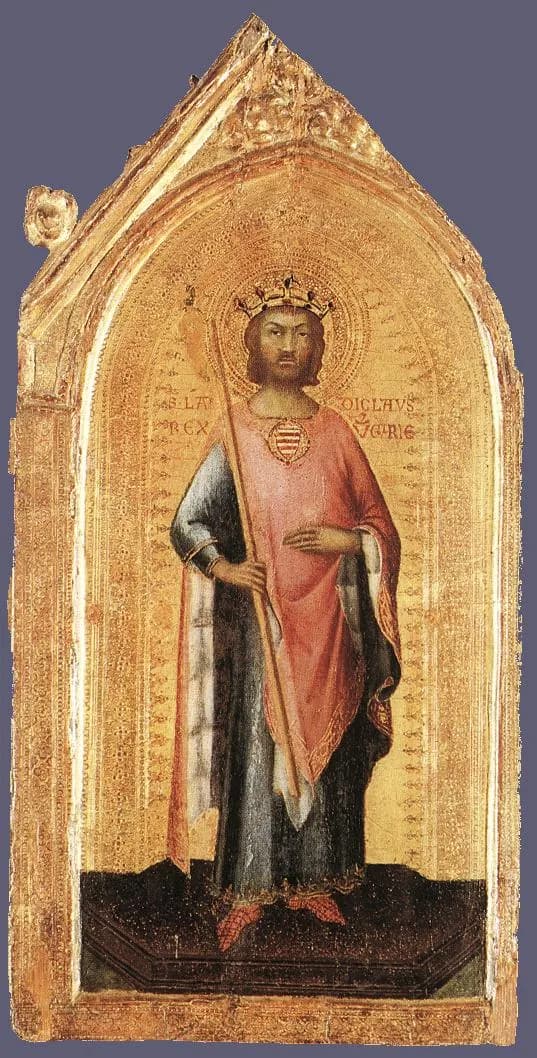
- Feast day
- June 27, the day of the translation of his relics 34. On the General Roman Calendar the day belongs to Cyril of Alexandria 12
Saint Ladislaus was the king who asked Rome to make saints of Stephen of Hungary and his son Emeric, forty-five years after Stephen died. 25 He was elected over a cousin who fought him for the crown, took Croatia, founded the see of Zagreb, and was chosen to lead the First Crusade before he died in 1095. 12 The 1910 encyclopedia calls him "one of Hungary's national Christian heroes," and says he "still lives in the sagas and poems of his people." 1
Chosen over his cousin
He was the son of King Béla I. 1 Michael Bihl, writing for the Catholic Encyclopedia in 1910, puts the succession in one sentence: "the nobles, after the death of Geisa I, passed over Solomon, son of Andrew I, and chose Ladislaus to be their king in 1077." 1 Solomon was a kinsman with a claim, and he did not accept it.
Alban Butler, in the eighteenth century, made the election something Ladislaus resisted: "By the pertinacious importunity of the people he was compelled, much against his own inclination, to ascend the throne in 1080, the kingdom being then elective." 3 Butler's twentieth-century revisers kept the reluctance and Bihl's year: "Entirely devoid of personal ambition, he accepted the dignity thrust upon him from a sense of duty." 2 The page gives both years because the sources do.
The quarrel with Solomon ran for a decade. Bihl records a peace, made when Solomon gave up his claim; a rebellion, after which Ladislaus held him prisoner in the fortress of Visegrád; a release; and then, in 1086, a second revolt in which Solomon brought the pagan Cumans in with him. 1 Ladislaus beat them, and beat the Cumans again in 1089. 1 The revised Butler sums up the whole affair more briefly: his rights were contested by Solomon, "whom eventually he defeated in battle." 2
Asking for Stephen
Stephen, the first king, had died in 1038 with his heir already dead and his nephews plotting against him. 5 For what came next, the revised Butler gives Ladislaus the credit for what followed: "It was at his solicitation that King Stephen I, his son Emeric, and the martyred bishop Gerard were recognized by the Holy See as worthy of veneration as saints." 2
Michael Ott's 1912 article on Stephen dates it: father and son were buried side by side, "and both were canonized together in 1083." 5 Bihl adds a detail that shows how the occasion was used. "On the occasion of the canonization of Stephen I, Ladislaus gave Solomon his freedom." 1 The release did not hold; Solomon revolted again three years later. 1
Croatia, Zagreb and the law
In 1091 his sister Helena, the widowed queen of Croatia, asked for his help. 12 The revised Butler says he went in against her husband's murderers and "restored some sort of order." 2 When she died childless he kept the country, and that same source does not pass over the objections: he annexed Croatia and Dalmatia "in the face of remonstrances from the emperor at Constantinople, the republic of Venice and the Holy See." 2
He founded the bishopric of Agram, now Zagreb, in 1092, and in the same year the bishopric of Grosswardein, though Bihl notes that some trace that see back to Stephen. 1 Aleteia credits him with Zagreb as well. 7 The 1912 encyclopedia's article on the diocese of Transylvania says its foundation is attributed to Stephen "but it was probably established by King St. Ladislaus." 6
At home he legislated. Bihl describes the assembly at Szabolcs as one "that might almost be called a synod," and says plainly that "He tried vigorously to suppress the remaining heathen customs." 1 Aleteia writes that he "imposed strict legislation against all offenses against the Christian faith." 7 The revised Butler sets beside this a policy that ran the other way, noting that he "allowed civil and religious liberty to the jews and the Ishmaelites, i.e. Mohammedans." 2 He also allied himself with Pope Gregory VII against the Emperor Henry IV, and married Adelaide, daughter of Duke Welf of Bavaria, chief supporter of the emperor's rival, Rupert of Swabia. 2
The knight in the stories
The revised Butler dwells on his bearing: "Towering head and shoulders above the crowd, he had the strength and courage of a lion, combined with a courteous affability that endeared him to all." 2 Aleteia calls him "a model of chivalry." 7 Butler's original adds that the Hungarians called him "St. Lalo, and in old French Lancelot." 3 The older Butler also notes that he was "frugal and abstemious, but most liberal to the church and poor," and "generous and merciful to his enemies." 3
Bihl, who is otherwise sparing, ends his article on it: he lives on in those sagas and poems "as a chivalrous king." 1 The revised Butler says his deeds "have formed the theme of many popular Magyar ballads and tales." 2
One of those tales belongs to a place. At Mátraverebély-Szentkút, a Marian shrine long served by the Hungarian Franciscans, the shrine's own history gives it as legend: Ladislaus, fleeing his enemies, "arrived at a chasm. Survival was nearly hopeless from here, but he managed to leap over it with his horse, and that was the first time a spring appeared here." 11 The same page reads the story as a type: the Hungarian literary tradition "regarded Saint Ladislaus as the new Moses who gained water from the rock, and who gave a legislative frame to the Hungarian people just like Moses did to the Jews." 11 It is told here as the shrine tells it, as legend.
The crusade he did not lead
By the revised Butler's account, Urban II looked to him for help with the First Crusade, and "it was Ladislaus who was chosen by the kings of France, Spain and England to be the commander-in-chief of that expedition." 2 The older Butler has him "preparing to command, as general-in-chief," when he died. 3
The revised Butler says he died "rather suddenly at Nitra" in 1095, at fifty-five. 2 Bihl gives the date as July 29; the older Butler gives July 30. 13 Aleteia reports that the Hungarian people kept three years of mourning. 7
He was buried at Grosswardein, the city the Romanians call Oradea and the Hungarians Nagyvárad. 12 The 1897 English Roman Martyrology prints, under June 27, "At Warasdin, in Hungary, of St. Ladislas, king, greatly renowned to this day for miracles." 4 Warasdin is a different town; the other three sources all name Grosswardein, and the Martyrology's place is quoted only as printed. 123
On when he became a saint the sources do not agree. Bihl: "In 1192 he was canonized by Celestine III." 1 Butler: "He was canonized by Celestine III. in 1198." 3 The revised Butler questions whether there was a formal canonization at all, "which appears to be doubtful," and says instead that "His relics were solemnly enshrined in 1192." 2 All three are given here.
What is Saint Ladislaus of Hungary the patron saint of?
Hungary, as one of several. Aleteia says he "is currently regarded as one of the patron saints of Hungary." 8 The 1912 encyclopedia, in its article on the diocese of Transylvania, calls him "King St. Ladislaus, patron of Transylvania." 6 No source consulted names a patronage beyond those two places, and this page claims none.
Popes have invoked him with the country's other saints. John Paul II, marking the thousandth anniversary of Stephen's coronation in 2000, named him first among the "noble figures who would distinguish Pannonia Sacra: one need only think of St Ladislaus, St Elizabeth and St Margaret!" 9 In April 2024 Pope Francis entrusted the Hungarian Church to the intercession of Mary, Stephen, Ladislaus, Elizabeth and Emeric. 10
Saint Ladislaus of Hungary's feast day
The feast of Saint Ladislaus is June 27. The 1897 Roman Martyrology lists him under that day, and Butler explains the date: the Martyrology keeps his festival on June 27 "on account of their translation," meaning the moving of his relics. 34 The revised Butler also places him on June 27. 2
He died in late July, on the 29th or the 30th depending on the source, so the feast is not his death day. 13 On the General Roman Calendar used in the United States, June 27 is the optional memorial of Cyril of Alexandria. 12
Praying with Saint Ladislaus of Hungary
The sources praise him as a knight, and they also record a ruler who used force. He fought a cousin for the crown for ten years, took a neighboring country when his widowed sister died, kept it over the objections of the Holy See, and suppressed the old religion by law. 12 The same reign also gave civil and religious liberty to Jews and Muslims, by the revised Butler's account. 2 The sources set these side by side and do not reconcile them, and neither does this page.
What stands out is the work he did for someone else's memory. The first king had died with his plans in ruins, his son dead and his nephews against him. 5 Ladislaus was the one who asked the Holy See to recognize Stephen, Emeric and Gerard, and the father and son were canonized together in 1083. 25
He was also stopped short. Three western kings chose him to lead the crusade and he died before it set out. 23 What lasted is less martial: two bishoprics, a set of laws, and a body of stories in which he is remembered as a new Moses who drew water from the rock. 111
Saint Ladislaus of Hungary, pray for us.
Sources
- 1.Michael Bihl, "St. Ladislaus," The Catholic Encyclopedia, Vol. 8 (New York: Robert Appleton Company, 1910).
- 2."St Ladislaus of Hungary (A.D. 1095)," June 27, from Butler's Lives of the Saints, ed. Herbert Thurston and Donald Attwater (Christian Classics, 1995), in "Hungarian Saints," Hungarian Catholic Bishops' Conference.
- 3.Alban Butler, "St. Ladislas I., Confessor, King of Hungary," June 27, The Lives of the Fathers, Martyrs, and Other Principal Saints, Vol. VI.
- 4.The Roman Martyrology, June 27 (Baltimore: John Murphy Company, 1897), and its index, "Ladislas, St., King June 27".
- 5.Michael Ott, "St. Stephen," The Catholic Encyclopedia, Vol. 14 (New York: Robert Appleton Company, 1912).
- 6.A. Aldasy, "Diocese of Transylvania," The Catholic Encyclopedia, Vol. 15 (New York: Robert Appleton Company, 1912), Catholic Answers.
- 7.Camille Dalmas, "The great saints who built Hungary," Aleteia, April 25, 2023.
- 8.Philip Kosloski, "4 Saints who were (good) kings and led their people justly," Aleteia, November 26, 2017.
- 9.John Paul II, Message to the Hungarian Nation on the first Millennium of St Stephen's coronation, August 21, 2000.
- 10.Lisa Zengarini, "Pope to Hungarian pilgrims: 'The gift of peace begins in our hearts'," Vatican News, April 2024.
- 11."History of the shrine," National Shrine of Mátraverebély-Szentkút.
- 12."Saturday of the Twelfth Week in Ordinary Time; Opt Mem of St. Cyril of Alexandria, Bishop and Doctor of the Church - June 27, 2026," Liturgical Calendar, Catholic Culture.
Saints to turn to next
Others in this collection who are turned to for some of the same things.
- Saint Andrew Kim TaegonAugust 21, 1821 - September 16, 1846CourageWork and vocation
- Saint Ansgar801 - February 865CourageWork and vocation
- Saint Anthony Mary ClaretDecember 23, 1807 - October 24, 1870Work and vocationCourage
- Saint Augustine of CanterburyBirth unknown - 604 or 605CourageWork and vocation