Saint Kilian
c. 640 - July 8, c. 689
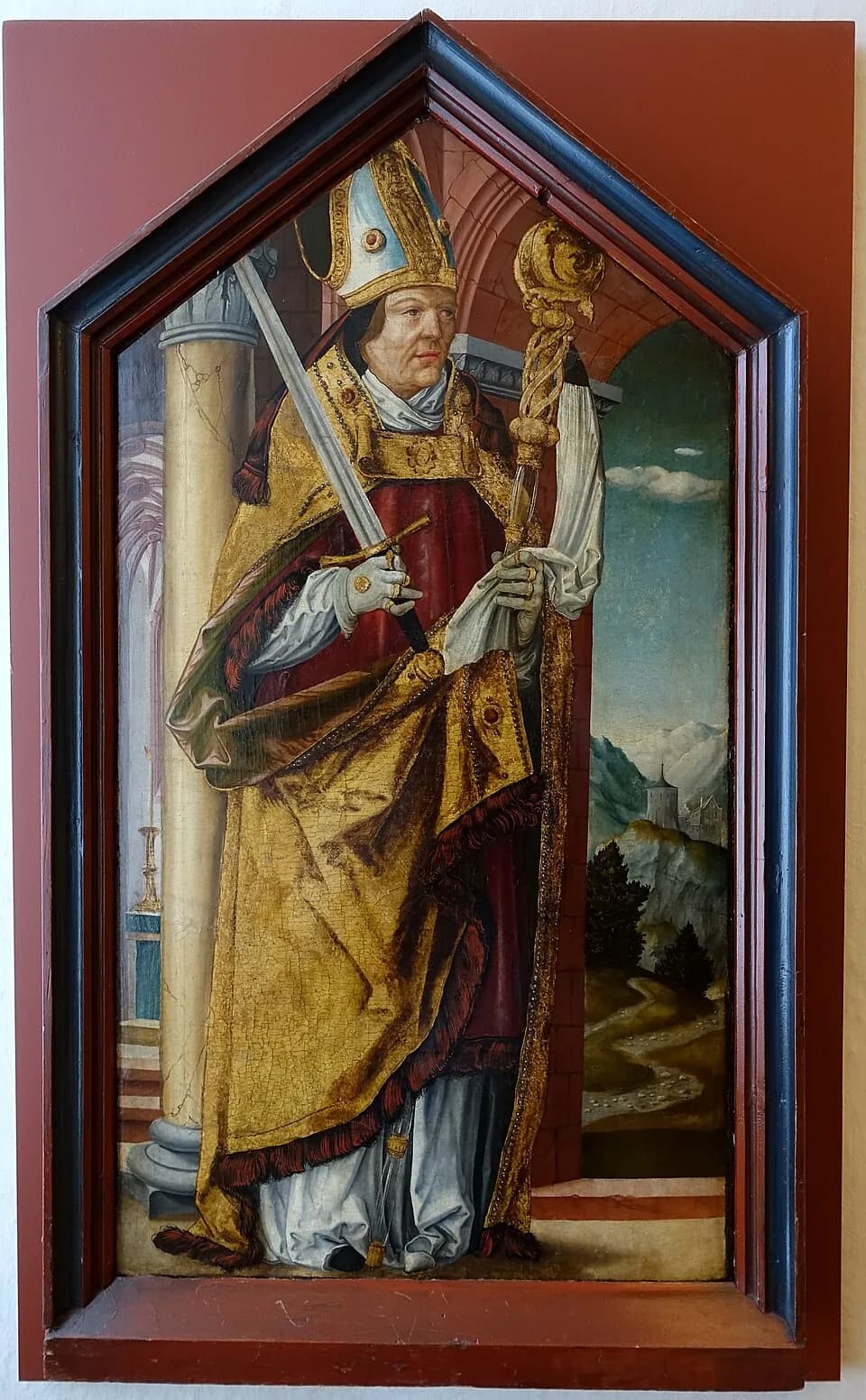
- Patron saint of
- The Diocese of Würzburg 13 and, as Benedict XVI names him, the Diocese of Erfurt 2. The Diocese of Würzburg adds whitewashers, and invokes him against rheumatism and gout 3; the Diocese of Sandhurst calls him patron of sufferers of rheumatism 4
- Born
- About 640, "probably in Ireland" 1; at Mullagh, County Cavan, according to the Diocese of Sandhurst 4
- Known as
- The Apostle of Franconia 1
- Relics
- In the crypt of the Neumünster in Würzburg; the three skulls are kept in the altar of the cathedral 3
Saint Kilian was an Irish missionary bishop who preached in Franconia and was killed at Würzburg with two companions, the priest Colman and the deacon Totnan, probably on July 8, 689. 13 According to the early accounts, he had told the newly baptized Duke Gozbert that his marriage to his brother's widow could not stand, and the widow, Geilana, had the three murdered while the duke was away. 14 Benedict XVI, preaching in Thuringia in 2011, put it more briefly: Kilian died "because he criticized the moral misconduct of the Duke of Thuringia." 2
An Irish bishop with no diocese
Friedrich Lauchert's article in the 1910 Catholic Encyclopedia gives his name as Kilian, Killena or Cillíne, and his birth as about 640, "of noble parents probably in Ireland." 1 The alternative is Scotland, but Lauchert notes that the phrase the older account uses could in the Middle Ages mean Ireland, and that the later account says so outright. 1 The Diocese of Sandhurst in Australia places his birth at Mullagh in County Cavan 4, and the Diocese of Würzburg reports that a townland near Mullagh, Cloughballybeg, claims him today. 3
He was known from his youth, Lauchert says, "for his piety and love of study," and the later account has him become a monk. 1 Some later writers make him a monk and then abbot of Iona; Lauchert says the abbacy is "a supposition" that "cannot be proved." 1
On his being a bishop the sources part ways. Lauchert accepts the older account, which has him consecrated before he left home, and explains that "in accordance with the custom then prevailing in the Irish Church, he was assigned to no particular diocese, but was district bishop or travelling bishop." 1 The later account moves the consecration to Rome. 1 The Diocese of Würzburg reports both readings, and adds that other scholars reject the episcopate entirely, suspecting it was written in afterward to make him a forerunner of Saint Boniface. 3
To Würzburg and to Rome
He left Ireland with eleven companions, crossed Gaul and the Rhine, and came to the castle of Würzburg, the seat of the Thuringian duke Gozbert, who according to Lauchert was "like his people, still pagan." 1 The Diocese of Würzburg is less sure of that, and suggests the ducal family may already have been baptized and simply let the faith lapse. 3
Kilian wanted faculties from the pope before he began, so the whole party went to Rome. 1 They expected to find John V, who had died in August 686, and received their commission from his successor Conon instead. 14 Lauchert puts the arrival at Würzburg and the journey in the summer of 686 and their work there in 687 and after. 1 The Diocese of Würzburg tells it in a different order, with Gozbert converted first and the Roman journey after, though it allows that the journey may have come first. 3
On the way back the group broke up. Some went off to other mission fields, and Kilian returned to Würzburg with two: Colman, a priest, and Totnan, a deacon. 13 From there the work "extended over an ever-increasing area in East Franconia and Thuringia," and, in Lauchert's account, he "converted Duke Gozbert with a large part of his subjects to Christianity." 1
The duke, Geilana, and the murder
Gozbert was married to Geilana, the widow of his own brother. 14 The Diocese of Würzburg explains that he had taken her according to the old custom, and that Christian law counted such a marriage as incest. 3 Once the duke was a Christian, Lauchert writes, Kilian told him the marriage "was unlawful under the Christian dispensation, and secured the duke's promise to separate from her." 1
What followed is told in the early accounts, and every source here gives it as such. Lauchert: "Geilana plotted vengeance against the saint, and caused him and his two companions to be secretly murdered in the absence of the duke, their corpses being immediately buried at the scene of the crime together with the sacred vessels, vestments, and holy writings." 1 The Diocese of Sandhurst says that "according to legend" Geilana had the three beheaded while Gozbert was away on a military campaign. 4 The Diocese of Würzburg describes the three as surprised at their night prayers in their cell, and says the deed was probably Geilana's but possibly ordered by the duke himself. 3
The Würzburg account keeps two details of the legend. The three are said to have held out the Gospels against the drawn swords, and the stains on the binding of the Kilian Gospels, now in the university library at Würzburg, are pointed to as the mark of it. 3 A horse stable is said to have been built over the hidden grave, and the horses would not use it. 3 Lauchert confirms that a New Testament belonging to Kilian was kept in the cathedral treasury until 1803 and in the university library since. 1
When Gozbert came home, Lauchert says, Geilana at first denied knowing anything; "the murderer, however, went mad, confessed his crime, and died miserably, Geilana also dying insane." 1 The Würzburg version has the murderers take their own lives, the instigator die mad, and Gozbert himself murdered in turn, so it is said. 3
Lauchert, writing in 1910, defended these details against German historians who doubted them, and, with the scholars who dated the older account to the translation of the relics in 752, judged it trustworthy. 1 He held that the mission and the martyrdom "are, however, accepted without question by everyone." 1 That is no longer quite so. The Diocese of Würzburg reports that Dagmar Ó Riain-Raedel, a historian at University College Cork, disputes that Kilian was ever in Würzburg at all, and says plainly that the testimony to his life is largely legendary. 3
What is Saint Kilian the patron saint of?
Lauchert says that "Kilian is the patron saint of the diocese" of Würzburg, and the diocese calls the three martyrs its patrons and the Apostles of Franconia. 13 Benedict XVI named him in 2011 with Elizabeth of Thuringia and Boniface as the patron saints of the Diocese of Erfurt, and called him "an itinerant missionary from Ireland" who was at work in Thuringia "even before the Anglo-Saxon missionaries." 2
The Diocese of Würzburg adds that he is regarded as patron of whitewashers and as a helper against rheumatism and gout. 3 The Diocese of Sandhurst lists him as patron of sufferers of rheumatism. 4
Saint Kilian's feast day
The feast of Saint Kilian is July 8, the day on which he is held to have died. 134 Lauchert writes that "his feast is celebrated in Würzburg on 8 July with great solemnity." 1
The bodies were found again about sixty years after the murder. 3 Saint Burchard, the first bishop of Würzburg, moved the relics in 743, and after Pope Zachary allowed their public veneration they were solemnly transferred, probably on July 8, 752, to the new cathedral. 1 The Diocese of Würzburg dates their elevation as the diocese's saints to that same July 8, 752. 3
In Würzburg the day opens a week of pilgrimage, the Kiliani octave. On its first Sunday the skulls of the three martyrs are carried through the city in procession, and thousands of pilgrims come to the cathedral during the week. 3 Their bodies lie in the crypt of the Neumünster, the church built where the martyrdom is held to have happened. 3
Praying with Saint Kilian
The story turns on one conversation. A duke had just been baptized, and the bishop who baptized him told him that the woman he lived with could not stay his wife. 1 Gozbert agreed. 1 The agreement cost Geilana her marriage and, in the accounts, cost the three men their lives. 13 None of the sources tells us how Kilian weighed it, and this page will not guess.
Benedict XVI, standing in Erfurt in 2011, set him among the saints whose "witness to the faith can also give us the courage to begin afresh today." 2 He was speaking to Catholics in the former East Germany, many of whom had kept the faith through decades of a hostile state, and he chose a seventh-century Irishman killed for saying something unwelcome to a ruler. 2
Very little of the life is certain. The year of death is likely rather than known, the episcopate is doubted, and at least one historian doubts he was ever in Würzburg. 13 What is recorded is that cures were reported at their burial place, and that within about sixty years the first bishop of Würzburg had raised their relics and obtained the pope's permission for their public veneration. 13
He worked with two companions and died with them, and the city has kept the three together for thirteen centuries: one shrine for the bodies, one for the heads, one feast, one procession. 3 Colman and Totnan have almost no story of their own in the sources. What is recorded of them is that when the others left for other mission fields, they went back to Würzburg with him. 1
Saint Kilian, pray for us.
Sources
- 1.Friedrich Lauchert, "St. Kilian," The Catholic Encyclopedia, Vol. 8 (New York: Robert Appleton Company, 1910).
- 2.Benedict XVI, Homily at the Eucharistic Celebration, Domplatz, Erfurt, September 24, 2011.
- 3.Anja Legge and Jerzy Staus, "Heilige Kilian, Kolonat und Totnan," Heilige und Selige im Bistum Würzburg, Diocese of Würzburg (in German).
- 4."St Kilian," Catholic Diocese of Sandhurst, Bendigo, Australia.
Saints to turn to next
Others in this collection who are turned to for some of the same things.