Saint Julius of Durostorum
Died May 27, about 302 or 304
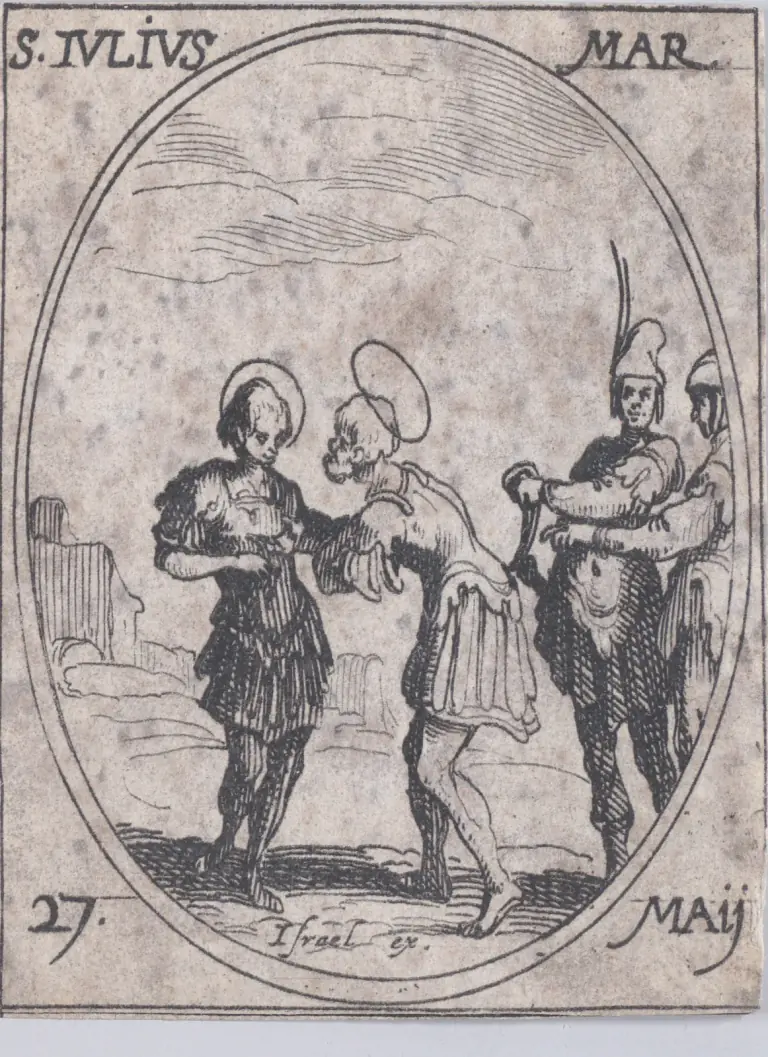
- Also called
- Julius the Veteran 1
- Career
- A retired veteran of the Roman army, who had served twenty-six or twenty-seven years and gone on seven campaigns 14
- Died
- Beheaded on May 27 at Durostorum on the Danube, today Silistra in Bulgaria; about 302, says Butler 3; about 304, says katolsk.no 1; the year is unknown, says Ruinart 4
- Not to be confused with
- Pope Saint Julius I, kept on April 12
Saint Julius of Durostorum was a Roman soldier who had served out his time, been discharged as a veteran, and was then arrested as a Christian and beheaded at Durostorum on the Danube, the modern Silistra in Bulgaria. 12 His trial survives in a short, plain record of question and answer that has never been doubted, and it ends with his embracing a fellow prisoner on the way to execution. 14 His feast is May 27, the day he died. 24
One short record
Everything known about Julius comes from a single document, the Acts of his martyrdom. Thierry Ruinart, the Benedictine scholar who collected the early martyr acts he judged genuine, printed it in 1713 from a manuscript of the abbey of Saint-Remi at Reims, compared with a manuscript in the Colbert library. 4 The Norwegian bishops' saints database (katolsk.no) says the authenticity of this simple account has never been called into question. 1 Alban Butler, writing in the eighteenth century, called them "his genuine acts." 3
The Acts name the place, Durostorum in the province of Moesia, the governor, Maximus, and the day, the sixth day before the Kalends of June, which is May 27. 4 They do not name the year or the emperor. Ruinart remarks on this: neither the Acts nor the old martyrologies nor any ancient author says when Julius suffered. Some earlier scholars had put his death under the emperor Alexander Severus; Ruinart thought the great persecution of Diocletian more likely, but preferred to admit that the date is simply unknown. 4 Butler puts it "about the year 302, in the reign of Dioclesian," and katolsk.no about 304. 13 katolsk.no also gives him a birth year, 255, which no other source read for this page repeats. 1
Durostorum, Ruinart adds, had once been a bishop's city under the archbishop of Marcianopolis, but in his day was reduced to a village. 4 The Roman Martyrology places it at Silistra in Moesia, in present-day Bulgaria; katolsk.no notes that the town lies on the border with Romania. 12
A soldier before the governor
The Acts begin in a time of persecution. Julius was arrested by officials and brought before the governor, Maximus. 24 Asked whether what was said of him was true, he answered that it was: he was a Christian. 4 Asked whether he did not know the emperors' orders to sacrifice to the gods, he said he knew them, but as a Christian he could not do what they wanted, and he could not deny his living and true God. 4
Maximus asked what was so hard about offering a little incense and going home. 4 Julius answered with his record. In what he calls his "vain" soldiering he had served twenty-six years, by the Reims manuscript, or twenty-seven, by the Colbert manuscript and the Bollandists, which is the figure katolsk.no gives. 14 He had never been brought before a judge as a criminal or a troublemaker. He had gone out to war seven times, had never disobeyed authority and had fought as well as any man. His commander had never found him at fault. Did the governor think that a man found faithful in lesser things would be found faithless in greater? 4
He had served under arms, he said, and gone on as a veteran, and all that time he had worshiped the living God who made heaven and earth, and he served him still. 14
The governor's offers
Maximus, by the Acts' account, did not want to kill him. He told Julius he could see he was a wise and serious man, and urged him to sacrifice on his advice. 4 When Julius said that would be sin, the governor offered to take the sin on himself: Julius could say he had been forced, go home in safety, and be given money besides, and no one would trouble him again. 14 katolsk.no reads the money as a generous ten-year bonus. 1 Butler sums up the whole exchange in a line: "The judge employed caresses, promises, and threats." 3
Julius refused the money and the persuasion alike, and asked the governor to pass sentence on him as a Christian. 4 When Maximus threatened to behead him, he thanked him for the thought and asked him to carry it out. 4 The governor tried another line: dying for one's country and its laws would win lasting praise. Julius answered that he was indeed dying for laws, but for divine ones. Maximus retorted that those laws came from a man who had died on a cross, and that Julius was a fool to put a dead man above living emperors. 4 Julius answered that Christ had died for our sins to give us eternal life, and that he is God and lives forever; whoever confesses him will have eternal life, and whoever denies him eternal punishment. 14
Maximus said he was sorry for him and advised him to sacrifice and live with the rest of them. Julius said that to live with them would be death to him, and that if he died he would live. 14 At last the governor said that Julius had chosen death over life, and Julius answered that he had chosen to die for a time and live forever. 4 Maximus gave sentence: since Julius would not obey the emperors' orders, he was to be beheaded. 4 Butler's summary has him profess "that to die for Christ, in order to live eternally with him, would be the accomplishment of all his desires." 3
Hesychius on the road
When Julius was led out to the usual place, the Acts say, everyone kissed him, and he told them to take care how they did it. 4 Among the bystanders was a Christian soldier named Hesychius, himself a prisoner. 34 Butler translates what he said: "Go with courage, and run to the crown which the Lord hath promised; and remember me, who shall shortly follow you. Commend me to the servants of God, Pasicrates and Valention, who, by confessing the holy name of Jesus, are gone before us." 3
Julius embraced him. "Dear brother, make haste to come to us; they whom you salute have already heard you." 3 Hesychius, Butler and katolsk.no both say, was put to death a few days later. 13
Then Julius bound his eyes with a cloth and bent his neck to the executioner. His last words, in Butler's English, were: "Lord Jesus, for whose name I suffer death, vouchsafe to receive my soul in the number of thy saints." 3 He was beheaded. 134
Pasicrates and Valentio
The two names Hesychius sent ahead belonged to soldiers already dead. Butler says Pasicrates and Valention were of the same regiment as Julius and had been martyred a little before him, two days before by his reckoning. 3 katolsk.no says Julius was once commemorated together with them and two companions, but that these appear only in Greek synaxaria, and that in the current Roman Martyrology, revised in 2001, Julius stands alone. 1
Ruinart notes a different martyr of the same name whose body was kept in an abbey at Fiesole, near Florence, and who was honored on the same day; he thought him another man, since that Julius was said to have died young, while this one was a veteran. 4
What is Saint Julius of Durostorum the patron saint of?
Saint Julius of Durostorum's feast day
Saint Julius of Durostorum's feast day is May 27, the day of his death. 1 The Acts date his martyrdom to the sixth day before the Kalends of June, which is May 27, and Butler enters him on that day. 34 The Roman Martyrology, in the text published by the Italian bishops, keeps him on May 27: at Silistra in Moesia, in present-day Bulgaria, Saint Julius, martyr, a veteran of the army already retired, who was arrested by officials in a time of persecution and brought before the governor Maximus, and who, having scorned the idols in his presence and confessed the faith of Christ with great firmness, was condemned to death. 2
Praying with Saint Julius of Durostorum
Julius defended himself with his service record. He had done everything a soldier should for twenty-six or twenty-seven years, and he asked the governor why a man who had been faithful in that would now be unfaithful in something greater. 14 He did not treat his years in the army as wasted, even while calling them vain. They were the evidence that he could be trusted.
The governor was not a monster in this account. He was patient, he offered a way out that cost almost nothing, and he offered to carry the guilt himself. 4 What Julius refused was the small compromise, made easy.
The last thing he did was turn to another prisoner. Hesychius asked to be remembered and asked Julius to carry greetings to two friends already dead, and Julius embraced him and told him they had heard. 3 A few days later Hesychius followed him. 13
Saint Julius of Durostorum, pray for us.
Sources
- 1."Den hellige Julius av Durostorum (255-~304)," Den katolske kirke (katolsk.no), Catholic Diocese of Oslo (in Norwegian).
- 2.Roman Martyrology, entry for May 27, "San Giulio, martire," as printed in "Santo del giorno," Conferenza Episcopale Italiana (in Italian).
- 3.Alban Butler, "St. Julius, M.," The Lives of the Fathers, Martyrs, and Other Principal Saints, Vol. 5, May 27 (Derby: Richardson and Son, 1842), via the Internet Archive.
- 4.Thierry Ruinart, ed., "Acta Sancti Julii martyris," with Ruinart's admonitio and notes, in Acta primorum martyrum sincera et selecta (Amsterdam, 1713), pp. 548-550 (in Latin), via the Internet Archive.
Saints to turn to next
Others in this collection who are turned to for some of the same things.