Saint Joseph Oriol
November 23, 1650 - March 23, 1702
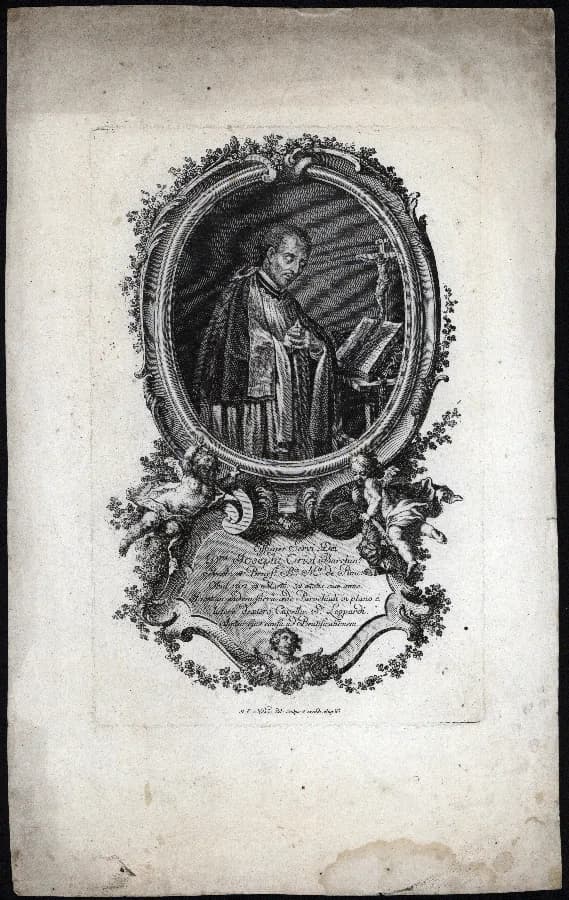
Saint Joseph Oriol was a parish priest in Barcelona who gave away his income as fast as it came, lived so austerely that the city called him Doctor Bread and Water, and spent his days with the sick. 2 People came to him to be healed, and the 1911 Catholic Encyclopedia gives him the title "Thaumaturgus of Barcelona," the city's wonder-worker. 1 His ministry was tied to one church, Santa Maria del Pi, and he is buried there in the chapel where he held his post. 23
A boy of the Ribera
He was born in Barcelona on November 23, 1650. 12 The Basilica of Santa Maria del Pi, which keeps his tomb, gives the street, the old carrer d'en Cuc, and says he was baptized the same day at Sant Pere de les Puel·les. He was the youngest of the eight children of Joan Oriol and Gertrudis Bogunyà. 2 The Archdiocese of Barcelona describes the family as very humble. 4
He grew up in the Ribera quarter and served as an altar boy at Santa Maria del Mar. 2 From there he went to the University of Barcelona, which made him a Doctor of Theology on August 1, 1674. 12
He was ordained a priest on May 30, 1676. 12 The basilica adds the details: the ordination took place in the palace of the bishop of Vic, on the strength of a small benefice at a shrine near Palamós, and he sang his first Mass on June 29 at Canet de Mar, the home of a family named Milans who were his friends and protectors. Years later one of them trusted him with the education of a son, Tomàs Milans, who became a noted Catalan composer. 26
A tutor who chose poverty
His first years as a priest were spent at the Oratory of Saint Philip Neri in Barcelona, to which the basilica says he was bound by close friendship and a strong bond of doctrine, and as tutor to the sons of an Italian officer living in the city, a knight named Gasneri. 2 Something happened in that house. The basilica calls it one of the miraculous episodes of his life and says that it led him to take up a life of poverty and penance, without saying what it was. 2
The basilica also says something unusual for a parish account of its own saint. It describes his prayer and meditation as following the principles of quietism, calls that spirit one of the main features of his spirituality, and reports that it once got him investigated by the Inquisition, with no consequences. 2 The encyclopedia and the archdiocese say nothing of this. 14
Rome, and the church of the Pi
In 1686 he went to Rome. The encyclopedia says only that he "visited Rome in 1686 and was granted a benefice in the church of Nuestra Señora del Pino, in Barcelona." 1 The archdiocese tells it more fully: when his mother died he walked to Rome to venerate the tombs of the Apostles, and Pope Innocent XI received him and asked him to return to Barcelona. 4 The basilica dates his appointment to 1686 and his first work there to June 1687. 23
He did not keep the income that came with the post. At the end of every month, when his share was paid out, the poor were already waiting for him at the door, and he handed over nearly all of it. 2 He held a number of offices in the parish community, above all the one that sent him to visit and look after its sick and its poor. 2
The basilica puts his work in its setting. There was no public health care, and only the rich could pay for a doctor. He went to the sick with what he had: he washed their wounds, gave them ointments and home remedies, looked after them and prayed with them. 2 That work and his own austerity earned him the name Doctor "Pa i Aigua," Doctor Bread and Water. 2 The archdiocese remembers another side of him, a director of souls to whom everyone went for advice. 4
The wonder-worker
In April 1698 he set out for Rome a second time. "Impelled by a desire of martyrdom," the encyclopedia says, he meant "to offer himself for the foreign missions, but, falling sick at Marseilles, he returned to Barcelona." 1 The basilica tells it the same way. 2
From then until his death, the basilica says, he exercised a gift of healing in the Chapel of the Blood, also called the chapel of the Blessed Sacrament, at the Pi, and the people loved him for it. 2 The encyclopedia is unreserved: "God bestowed upon him prophetic and miraculous power. The dying, the blind, the deaf and dumb, the lame, and the paralytic, were instantly cured by him." 1 His reputation, the basilica says, spread through the whole of Catalonia. 2
Barcelona still tells stories about him. The archdiocese's notice of the 2026 neighborhood festival lists a traditional remembrance of a miracle of the coins and mentions a legend of radishes and coins, without telling either one. 6 This page does not fill them in.
Death and burial
He died on March 23, 1702, in the street called Dagueria, after a short illness that the basilica says he had foretold. 2 He was fifty-one. 1 The whole city turned out for the funeral. On the orders of the bishop, Benet de Sala, the procession followed the route of the Corpus Christi procession, and his body was laid on the bed used on August 15 for the image of the sleeping Virgin. 2
He was buried in the chapel at the Pi where he had held his benefice, under a stone written by his friend Joan Tolleuda, the rector, which names him as a doctor of theology and beneficed priest of the parish who fell asleep in the Lord, rich in virtues, on March 23, 1702. 3 His relics were returned to that grave in 2012, and the altar there now carries a statue of him carved by Ramon Amadeu for the celebrations of his beatification in 1806. 34
The cause opened in 1759 at the request of a committee of citizens of Barcelona and parishioners of the Pi. 2 Pius VII beatified him on September 5, 1806, and Pius X canonized him on May 20, 1909. 12 The basilica says the canonization came at the request of Cardinal Salvador Casañas, bishop of Barcelona and a former rector of the Pi. 2
What is Saint Joseph Oriol the patron saint of?
The only patronage the sources state is a local one. The Archdiocese of Barcelona calls Saint Joseph Oriol patron of the Pi quarter, the neighborhood around his church. 4 The quarter's yearly festival is held in his name, and a parish in the Eixample district, consecrated on March 23, 1931, and later made a minor basilica, is dedicated to him. 46 No source consulted for this page names him patron of a trade or a cause, and the page does not supply one.
Saint Joseph Oriol's feast day
Saint Joseph Oriol's feast is March 23, the day he died in 1702. "His feast occurs on 23 March," the 1911 Catholic Encyclopedia says, and the Archdiocese of Barcelona keeps him on that day. 14 The Roman Martyrology names him on March 23 as a priest of Barcelona who, through bodily penance, a life of poverty and continual prayer, kept his mind always turned to God. 7
In Barcelona the day closes more than a week of festivities in the Pi quarter. In 2026 they ran from March 14 to March 23, with the parish's processional giants dancing in the basilica to the organ on the feast itself and the singing of a hymn to the saint that dates from 1909, the year he was canonized. 6
Praying with Saint Joseph Oriol
He had a doctorate in theology and spent it on bandages. The basilica's description of his days is entirely practical: wounds washed, ointments applied, remedies made at home, prayers said at a bedside. 2 His income went out at the church door on the day it came in. 2
He wanted something larger. Twice he went to Rome, and the second time it was to ask for the foreign missions and, the encyclopedia says, for martyrdom. 1 He got as far as Marseilles, fell sick, and went home to the same parish. 12 The basilica places his ministry of healing in the four years after that. 2
Cardinal Omella, preaching to elderly priests on his feast in 2026, summed him up in a sentence the archdiocese reported: he did not need to do extraordinary things, only to live ordinary things in an extraordinary way. 5 The cardinal called him a humble and devoted priest, and a reflection of the love of God for the poorest. 5
The Martyrology's entry adds one thing the stories of cures can crowd out. It says that he was filled with heavenly joy. 7
Saint Joseph Oriol, pray for us.
Sources
- 1.Charles Mullaly, "St. Joseph Oriol," The Catholic Encyclopedia, Vol. 11 (New York: Robert Appleton Company, 1911).
- 2."Saint Joseph Oriol, the Doctor 'Pa i Aigua' (Bread and Water)," Basilica of Santa Maria del Pi, Barcelona.
- 3."Saint Joseph Oriol," on his chapel and tomb, Basilica of Santa Maria del Pi, Barcelona.
- 4."23 de març," Santoral, Archdiocese of Barcelona (in Catalan).
- 5."El cardenal Omella agraeix la fidelitat dels preveres en la festivitat de Sant Josep Oriol," Archdiocese of Barcelona, March 24, 2026 (in Catalan).
- 6."Ja són aquí les festes de Sant Josep Oriol 2026 de Barcelona," Archdiocese of Barcelona, March 9, 2026 (in Catalan).
- 7.Roman Martyrology, entry for March 23, as printed in "Santo del giorno," Conferenza Episcopale Italiana (in Italian).
Saints to turn to next
Others in this collection who are turned to for some of the same things.
- Saint André BessetteAugust 9, 1845 - January 6, 1937Suffering and illnessWork and vocationPoverty and simplicity
- Saint Giuseppe MoscatiJuly 25, 1880 - April 12, 1927Work and vocationSuffering and illnessPoverty and simplicity
- Saint Ignatius of LaconiDecember 1701 - May 11, 1781Work and vocationPoverty and simplicitySuffering and illness
- Saint John Baptist de RossiFebruary 22, 1698 - May 23, 1764Poverty and simplicitySuffering and illnessWork and vocation