Saint Joseph of Arimathea
First century
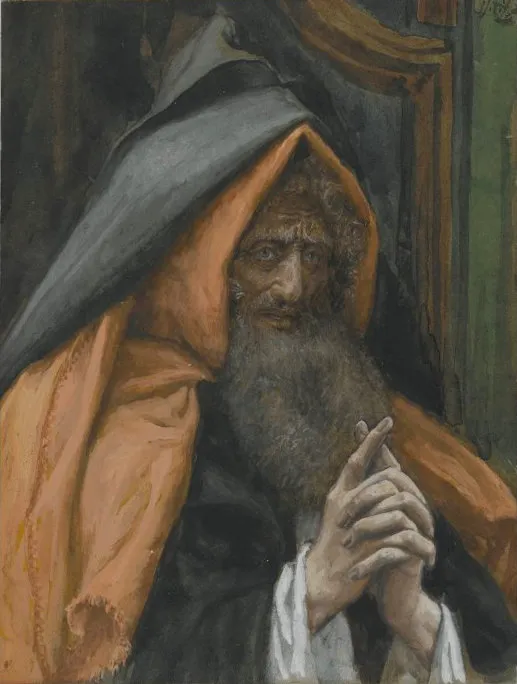
- Feast day
- August 31, with Saint Nicodemus 234; March 17 in the Roman Church of 1910, according to the Catholic Encyclopedia 1
- Patron saint of
- Grave-diggers and undertakers, according to Catholic Culture 4
- Sources
- The four Gospels; everything later is legend, by the Catholic Encyclopedia 1
Saint Joseph of Arimathea was the member of the Jewish council who went to Pontius Pilate on the evening of the crucifixion, asked for the body of Jesus, and buried it in a tomb cut from rock. 89 All four Gospels tell the story, and the Catholic Encyclopedia says that everything known for certain about him comes from them. 1 The medieval tales that carry him to Britain with the Holy Grail are legend, and the same encyclopedia says so plainly. 16 The Church remembers him with Nicodemus on August 31. 2
Four descriptions of one man
Each evangelist introduces him differently, and the portraits fit together. Matthew calls him "a rich man from Arimathea named Joseph, who was himself a disciple of Jesus." 7 Mark calls him "a distinguished member of the council, who was himself awaiting the kingdom of God." 8 Luke says he was "a virtuous and righteous man" who, "though he was a member of the council, had not consented to their plan of action." 9 John adds the detail the others leave out: he was "secretly a disciple of Jesus for fear of the Jews." 10
The council is the Sanhedrin, the governing body that had condemned Jesus. 13 Francis Gigot, in the Catholic Encyclopedia, takes Luke's remark to mean that Joseph "was most likely absent from the meeting which sentenced Jesus to death." 1 He also thinks Joseph had probably been a disciple since Jesus first preached in Judea. 1 Neither point is stated in the Gospels, and Gigot offers them as likelihoods.
Arimathea itself is uncertain. Luke calls it a Jewish town. 9 Gigot thinks it "very likely identical with Ramatha," the birthplace of the prophet Samuel, and notes that several scholars prefer Ramleh. 1
Before Pilate
It was already evening on the day of preparation, the day before the sabbath. 8 Mark tells what happened next and supplies the adverb: Joseph "came and courageously went to Pilate and asked for the body of Jesus." 8
Pilate was surprised that Jesus was already dead. He sent for the centurion to confirm it, and then released the body. 8 Gigot stresses what the request cost: Joseph acted "unmindful therefore of all personal danger, a danger which was indeed considerable under the circumstances." 1 Vatican News puts it more simply. Jesus is crucified, "and Joseph of Arimathea no longer cares if people find out that he is a disciple." 3
The burial
Mark says Joseph bought a linen cloth, took the body down, wrapped it, and laid it in a tomb hewn out of rock. 8 Matthew says the tomb was Joseph's own: he "laid it in his new tomb that he had hewn in the rock," and then "rolled a huge stone across the entrance to the tomb and departed." 7 Luke notes that no one had yet been buried in it. 9
John is the only one to give him a companion. Nicodemus, the Pharisee who had first come to Jesus by night, arrived "bringing a mixture of myrrh and aloes weighing about one hundred pounds." 310 The two of them "took the body of Jesus and bound it with burial cloths along with the spices, according to the Jewish burial custom." 10 The tomb, John says, was in a garden near the place of crucifixion, and they used it because of the preparation day and because it was close by. 10
Vatican News says the tomb was one Joseph had bought for himself. 3 Mary Magdalene and another Mary watched where the body was laid. 78 Gigot's account of him from the Gospels ends at the same point, with Joseph rolling a great stone to the opening and withdrawing. 1
Gigot sees a prophecy kept in the rich man's tomb. "Thus was fulfilled Isaiah's prediction that the grave of the Messias would be with a rich man," he writes. 1 The notes to Matthew in the bishops' conference Bible say the detail may be an allusion to that verse of Isaiah, and add that Matthew's care over the tomb has a purpose: "there could be no question about the identity of Jesus' burial place." 7
The legends
Later centuries could not leave him at the tomb. Gigot goes through the additions one at a time and dismisses each. The details in the apocryphal Acts of Pilate "are unworthy of credence." 1 The story of his coming to Gaul in A.D. 63 and going on to Britain, "where he is supposed to have founded the earliest Christian oratory at Glastonbury," is "likewise fabulous." 1 And the account of his body being moved from Jerusalem to Moyenmonstre, in the diocese of Toul, "originated late and is unreliable." 1
The encyclopedia traces the Glastonbury story to a named writer. Its article on the abbey says its chief authority is William of Malmesbury, writing about 1135 in a work composed "for the express glorification of Glastonbury." 5 In that telling the apostle Philip sent Joseph from Gaul with eleven companions, and a local king gave them an island on which they built a church of woven osiers in honor of the Virgin Mary. 5 Catholic Culture dates the story later, saying the legend that Joseph led twelve missionaries to England does not appear until about the middle of the thirteenth century. 4 The Glastonbury Thorn, a hawthorn that flowers at Christmas, was said to have grown from Joseph's staff; the encyclopedia finds that legend in circulation before the abbey was destroyed and cannot say when it began. 5
The Grail romances made him the first keeper of the Grail. In them, the encyclopedia's article on the Holy Grail explains, the vessel is the dish of the Last Supper, which passed to Joseph and in which he gathered the blood of Christ when the body was taken down from the cross. 6 Imprisoned, he is kept alive by it for forty-two years, and it is then carried west to Britain. 6 The same article is blunt about the standing of all this: clerical writers, with one exception, do not mention the Grail, "and the Church ignored the legend completely." 6 Catholic Culture reports a further embroidery in which Joseph was a relative of Jesus who traded in Cornish tin, and it calls this later tradition. 4
What is Saint Joseph of Arimathea the patron saint of?
Saint Joseph of Arimathea's feast day
Saint Joseph of Arimathea's feast day is August 31, which he shares with Saint Nicodemus. Vatican News lists the two together as disciples of the Lord and says, "They are celebrated on August 31." 2 Catholic Culture likewise has both under the Roman Martyrology for that day. 4
The date used to be different. When Gigot wrote in 1910, "The Greek Church celebrates the feast of Joseph of Arimathea on 31 July, and the Roman Church on 17 March." 1
Praying with Saint Joseph of Arimathea
Joseph enters each Gospel at the end and stays for a few verses. 78 Before that evening he had kept his discipleship to himself, and John gives the reason without softening it: fear. 10 Vatican News remarks that he and Nicodemus both began afraid, one hiding his allegiance and the other coming to Jesus only under cover of night. 3
What changed him, on Vatican News's reading, was the cross itself. The secrecy "gives way to small acts of courage," and then, after the crucifixion, to a large one. 3 Mark's word for how he went to Pilate is "courageously." 8
The work he did was practical and had to be done before the sabbath began. He bought cloth, he took a body down, he wrapped it, he gave up a tomb, and he rolled a stone. 789 Vatican News says of the two men that "their hands confess more than words ever could." 3
Gigot says the crucifixion "quickened Joseph's faith and love." 1 Matthew ends his part quietly: he rolled the stone across the entrance to the tomb "and departed." 7
Saint Joseph of Arimathea, pray for us.
Sources
- 1.Francis E. Gigot, "Joseph of Arimathea," The Catholic Encyclopedia, vol. 8 (New York: Robert Appleton Company, 1910).
- 2."31 August," Saint of the Day, Vatican News.
- 3."Sts. Joseph of Arimathea and Nicodemus, disciples of the Lord," Saint of the Day, Vatican News.
- 4."Thursday of the Twenty-First Week in Ordinary Time," Liturgical Year, August 31, 2023, Catholic Culture (section "St. Joseph of Arimathea").
- 5.Gilbert Huddleston, "Glastonbury Abbey," The Catholic Encyclopedia, vol. 6 (New York: Robert Appleton Company, 1909).
- 6.Arthur F. J. Remy, "The Holy Grail," The Catholic Encyclopedia, vol. 6 (New York: Robert Appleton Company, 1909).
- 7.Matthew 27. Bible, United States Conference of Catholic Bishops.
- 8.Mark 15. Bible, United States Conference of Catholic Bishops.
- 9.Luke 23. Bible, United States Conference of Catholic Bishops.
- 10.John 19. Bible, United States Conference of Catholic Bishops.
Saints to turn to next
Others in this collection who are turned to for some of the same things.