Saint Joseph Mary Tomasi
September 12, 1649 - January 1, 1713
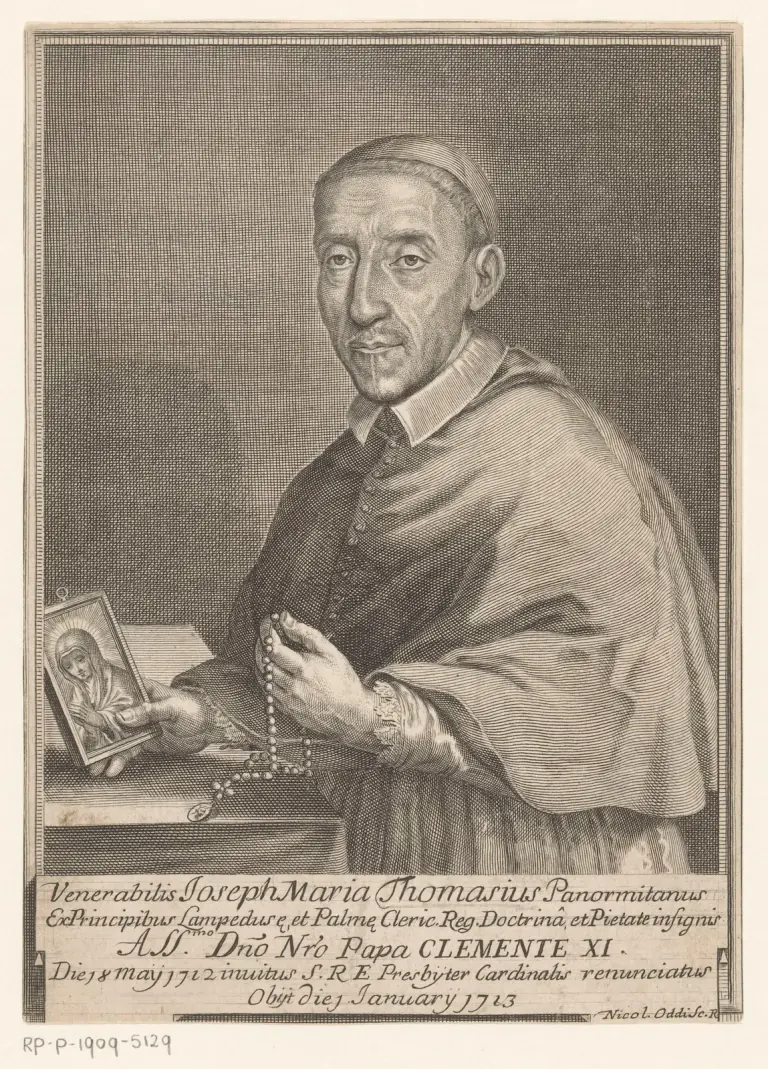
Saint Joseph Mary Tomasi was the heir to a Sicilian principality who gave it to his brother at sixteen, became a Theatine priest, and spent his life in the libraries of Rome bringing the ancient liturgical books of the Roman Church into print. 12 Made a cardinal against his will in 1712, he went on teaching the catechism to poor children in his titular church, and died on January 1, 1713. 13 John Paul II canonized him in 1986 as a model for the liturgical renewal after the Second Vatican Council, and his feast is January 1. 35
An heir who gave it up
He was born at Licata in Sicily on September 12, 1649, the eldest son of Don Giulio Tomasi, Duke of Palma and Prince of Lampedusa, and Donna Rosa Traina. 12 His family meant him for the Spanish court; Borrelli says he was taught Spanish and other modern languages to serve as a page to the King of Spain. 12 John Paul II, speaking to pilgrims the day after the canonization, said this was what families of their rank did, and praised his parents for letting him go once they saw where he was called. 4
He had felt drawn since childhood, the pope said, to the things of the Church and of God. 3 He joined the Theatines, the Clerks Regular founded by Saint Cajetan, at Palermo; Paoli dates his entry to March 24, 1665, and Borrelli says his parents consented in 1664 and he took the habit at San Giuseppe in Palermo. 12 On March 25, 1666, he made his profession and renounced his birthright in favor of his brother. 12 Had he stayed in the world, John Paul II said, he would have had the principality of Lampedusa and the duchy of Palma di Montechiaro, and with them immense wealth. 3
Languages and libraries
His health was poor, and he studied in several Theatine houses: philosophy at Messina, Ferrara and Modena, theology in Rome and Palermo. 12 Paoli says he was ordained priest on Christmas Day 1673; Borrelli places the ordination in Rome, at the order's mother house of San Silvestro al Quirinale, where he lived for many years in a small room later made into a chapel. 12
He learned Greek, and then Ethiopic, Arabic, Syriac, Chaldaic and Hebrew. 1 His Hebrew teacher was a learned rabbi, Moses of Cave, who was converted through him and baptized with the name Joseph. 12 Paoli says he gathered the titles of the Psalms from the Psalters of all these languages, and set out to recover the ancient discipline and worship of the Church from the chief libraries and archives of Europe. 1
He was admitted to the circle of scholars around Queen Christina of Sweden in Rome and allowed to use her library. 2 From her manuscripts he published, in 1680, his "Codices sacramentorum nongentis annis antiquiores," early sacramentaries of the Roman Church, part of which Mabillon later transcribed for his own work. 12 More followed: a Psalter in the old Roman and Gallican versions, using Origen's critical signs, which had been out of use for nine centuries; the responsories and antiphonaries of the Roman Church; the ancient Roman Mass book known as the "Comes"; and in his last years a three-volume digest of the theology of the Fathers. 1
Most of these appeared under the name Giuseppe Maria Caro. 1 Borrelli explains that Caro was his paternal grandmother's surname, and that he used it to escape the attention and praise of the learned. 2 In 1753 his works were collected in eleven volumes. 1
Restoring the old
"Tommasi's efforts at reform," Paoli writes, using the older spelling of his name, "were directed not to the introduction of the new, but to the restoration and maintenance of the old. He was not always upheld and was sometimes rebuked for his zeal." 1 John Paul II called him a scientist of the liturgy in the modern sense of the word, and said his scholarship led toward a knowledge, even an experience, of divine things. 3
For the pope the point was the liturgy itself. Tomasi saw divine worship not as external ritual but as the source of light and energy for the whole of a Christian's day, which ought to be a kind of extension of the Eucharist. 3 His work ran from learned discovery to the liturgical formation of ordinary people. 3
He did not forget his family's Sicily. In 1690 he wrote the constitutions for the Benedictine convent his family had founded at Palma, where three of his sisters were among the first nuns and his mother later entered. 2 Borrelli adds that he brought the Piarist Fathers to Palma to open schools, and told a nephew he would learn better at school than at home with a tutor. 2
A cardinal against his will
He refused offices in his order. 2 Innocent XII made him an examiner of the clergy, and Clement XI gave him a run of posts in the Roman Curia: consultor of the Theatines, of the Congregations of Rites and of Indulgences, theologian of the Congregation for Regular Discipline, and qualificator of the Holy Office. 1 On May 18, 1712, Clement XI created him cardinal priest of the title of San Martino ai Monti, and, Paoli says, "compelled him to accept the honour." 12 John Paul II said he tried in vain, out of humility, to refuse. 3
He took Saint Charles Borromeo as his model. 1 In his titular church he introduced Gregorian chant, and after he had finished his duties at the altar he would sit down, like a parish priest, to teach the children of the poor their catechism, giving prizes to those who made progress. 13 He served the poor and the sick, John Paul II said, in the humblest and most hidden works of charity, even as a cardinal. 34
Death and canonization
He fell ill within the year and died in Rome on January 1, 1713. 12 Paoli says everyone mourned him, the pope included, and that Clement XI had so admired his holiness that he consulted him before accepting the papacy. 1 He was buried in his titular church of San Martino ai Monti, where his body lies in an urn given in 1903 by Cardinal Vaszary, primate of Hungary. 12
Benedict XIV opened the process for his beatification before the fifty years then required after a death had passed. 2 Pius VII beatified him in 1803; Paoli gives the date as June 5, Borrelli as September 29. 12 John Paul II canonized him on October 12, 1986. 23 The miracle approved for the canonization took place at Torretta, near Palermo, and the pope crowned the image of Our Lady of Valverde, the town's patroness, for the pilgrims who came from there. 4
The chief reason for the canonization, John Paul II said in his homily, was his importance for liturgical worship, which he promoted by his life and by his scholarly writing; his witness came at the right moment, twenty years after the Second Vatican Council, and would help the renewal of the liturgy to be understood and carried out rightly. 3
What is Saint Joseph Mary Tomasi the patron saint of?
Saint Joseph Mary Tomasi's feast day
Saint Joseph Mary Tomasi's feast day is January 1, the day of his death in 1713. 12 The current Roman Martyrology enters him on that day at Rome, as a Theatine priest and cardinal who, longing to renew divine worship, spent almost his whole life searching out and publishing ancient texts of the liturgy, and who worked at teaching children the catechism. 5
Praying with Saint Joseph Mary Tomasi
He gave up a principality at sixteen and spent most of the next fifty years in libraries. 12 He signed his books with his grandmother's name so that no one would praise him for them. 2
His scholarship was not a hobby beside his priesthood. What he looked for in old sacramentaries and antiphonaries was the way the Church had prayed, and John Paul II saw in that a guide for the Church renewing its liturgy after the Council. 13
Made a prince of the Church, he tried to refuse, and when he could not, he went from the altar to teaching poor children the catechism and handing out prizes. 13 The two parts of his life, the learned and the humble, were the same work.
Paoli says he was sometimes rebuked for his zeal. 1 He kept on.
Saint Joseph Mary Tomasi, pray for us.
Sources
- 1.Francesco Paoli, "Bl. Giuseppe Maria Tommasi," The Catholic Encyclopedia, Vol. 6 (New York: Robert Appleton Company, 1909).
- 2.Antonio Borrelli, "San Giuseppe Maria Tomasi, Sacerdote teatino e cardinale," Santi, beati e testimoni (santiebeati.it) (in Italian).
- 3.John Paul II, Homily at the canonization of Giuseppe Maria Tomasi, October 12, 1986 (in Italian).
- 4.John Paul II, Address to pilgrims for the canonization of Giuseppe Maria Tomasi, October 13, 1986 (in Italian).
- 5.Roman Martyrology, entries for January 1, Santo del giorno, Conferenza Episcopale Italiana (in Italian).
Saints to turn to next
Others in this collection who are turned to for some of the same things.
- Saint Abercius of HieropolisSecond century; died at seventy-two or laterPrayerStudy and teaching
- Saint Aelred of Rievaulx1109 - January 12, 1166 (or 1167)PrayerStudy and teaching
- Saint Ambrosec. 340 - April 4, 397PrayerStudy and teaching
- Saint Anselm of Canterbury1033 or 1034 - April 21, 1109Study and teachingPrayer