Saint Josaphat Kuntsevych
1580 or 1584 - November 12, 1623
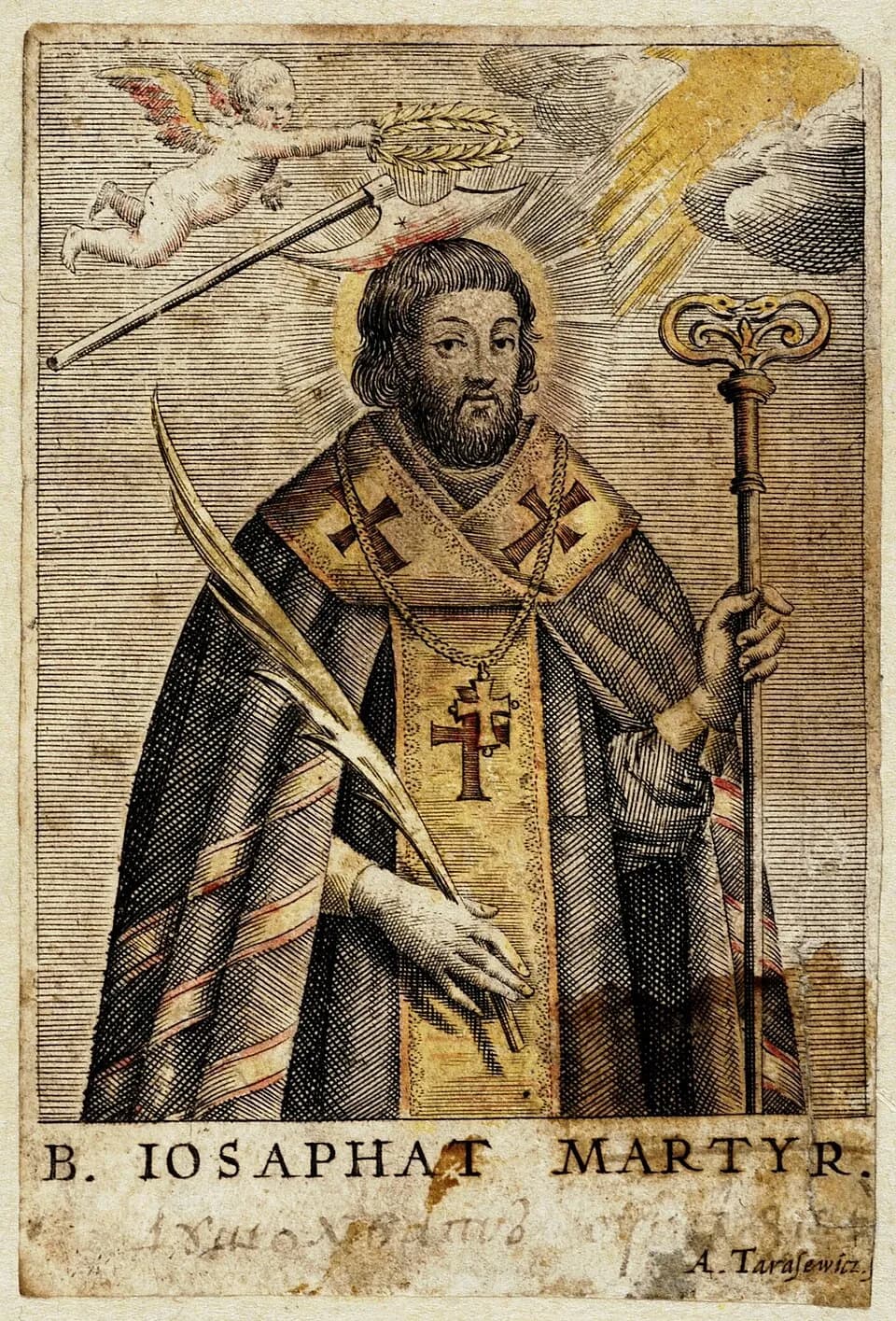
- Patron saint of
- No patronage in the 1910 Catholic Encyclopedia, Vatican News or Franciscan Media. Catholic Culture lists Ukraine and the eparchies of Edmonton and Toronto, and calls him "one of the patrons of Poland" 7
- Beatified
- 1643 1
Saint Josaphat Kuntsevych was a Ruthenian monk and Archbishop of Polotsk who gave his life to the union of his Byzantine-rite Church with Rome, and was killed for it by a mob at Vitebsk on November 12, 1623. 124 The son of a merchant, born around 1580, he became a Basilian monk, a priest and then a bishop at a moment when the Union of Brest had split his Church in two. 14 In 1867 he became the first saint of the Eastern Churches to be canonized in Rome, and his body now lies in St. Peter's Basilica. 25 His feast is kept on November 12. 34
A Church divided at Brest
In 1595, according to Franciscan Media, the Orthodox bishop of Brest-Litovsk and five other bishops, representing millions of Ruthenians, sought reunion with Rome. 4 The union was concluded at Brest in 1596 12, and Vatican News describes what it meant: the Ruthenian Church "accepted reunification with the Holy See, while maintaining its Byzantine liturgy and traditions." 2 Vatican News uses "Ruthenian" in its old sense, "to denote the peoples of the Ukraine and Belorussia." 2
John Paul II, writing for the fourth centenary in 1995, stressed the same point: the bishops who made the union kept "a full consciousness of the Oriental identity of their Metropolia," and the union "did not involve passing over to the Latin tradition, as some thought would happen." 5 Not everyone accepted it. The 1910 Catholic Encyclopedia says that after 1596 the Ruthenian Church "was divided into two contending parties," each with its own hierarchy, and that the opponents of the union worked "to enkindle popular hatred" against those who had joined it. 1 Josaphat, it says, was "the most celebrated of his victims." 1
The merchant's apprentice who became a monk
He was born John Kuntsevych in the town of Volodymyr, in Volhynia, in 1580 or, by some accounts, 1584. 1 Vatican News places his birth in western Ukraine and says his parents were Orthodox. 2 His father came of noble Ruthenian stock but had gone into trade and served on the town council. 1 At school the boy learned church Slavonic and almost the whole of the breviary by heart, and began reading it daily, which the encyclopedia says gave him the religious education the clergy of the day seldom offered. 1
Because his family was short of money, he was apprenticed to a merchant named Popovyc at Vilna. 1 He spent his free hours in prayer and study, and his master came to think so well of him that he offered John his fortune and his daughter's hand. 1 John turned both down. 1 At Vilna he came under the influence of clergy who supported the union, and came to know Benjamin Rutski, under whose direction he studied. 14 In 1604, at about twenty-four, he entered the Basilian monastery of the Trinity at Vilna and took the name Josaphat. 12
The encyclopedia describes a severe ascetic. He ate no meat, wore a hair shirt and a chain, slept on the floor, and prayed with repeated prostrations and the words "Jesus Christ, Son of God, have mercy on me, a poor sinner." 1 The Jesuits, it says, "frequently urged him to set some bounds to his austerities." 1 People began coming to him for advice, and Rutski, who followed him into the monastery, led a renewal of Ruthenian religious life from there. 12 Josaphat was ordained a priest in 1609 and preached and heard confessions "not just in the monastery, but everywhere," in the words of Vatican News: in the fields, the hospitals and the prisons, according to the encyclopedia. 12
Archbishop of Polotsk
On November 12, 1617, he was consecrated Bishop of Vitebsk with the right to succeed to the archdiocese of Polotsk, reluctantly, the encyclopedia says, and he became archbishop the next year. 1 He restored churches, gave his clergy a catechism to learn by heart, wrote rules for priestly life and held synods across his dioceses. 1 Franciscan Media credits synods, catechesis, reform of the clergy and his own example with winning most of the Orthodox in the area to the union. 4 The encyclopedia names his love for the poor among the reasons. 1
Vatican News insists that the union he worked for was not a Latinizing one. He "strove no less tirelessly to safeguard the Byzantine liturgy and traditions of his people," and the unity he hoped for "was a polyphony, a harmony of many liturgical rites and languages." 2 His opponents said otherwise. A rival Orthodox archbishop was consecrated for Polotsk, in 1620 according to Vatican News, and the rumor spread that Josaphat had "gone Latin" and meant his people to follow. 24 He had to discipline priests who preached against the union. 2 Franciscan Media adds that the Latin bishops of Poland gave him little support, and the encyclopedia that he resisted the chancellor Sapieha when he wanted to make concessions to the opposition. 14
His death at Vitebsk
He seems to have known where it was heading. Vatican News quotes him: "I am here among you as a shepherd, and you should know that I would be happy to give my life for you. I am ready to die for the union of the Church under St. Peter and his successor, the Pope." 2 The encyclopedia says he refused a chance to flee. 1
Franciscan Media gives the fullest account of the day. Despite warnings he went to Vitebsk, where a priest was sent to shout insults at him from his own courtyard. When Josaphat had the man taken and shut up in the house, his opponents rang the town hall bell, a mob gathered, and although the priest was let go, the crowd broke into the archbishop's residence. 4 The sources differ on what followed. The encyclopedia says only that "an axe-stroke and a bullet" killed him. 1 Franciscan Media says he was struck with a halberd, then shot, and his body thrown into the river, from which it was later recovered. 4 Vatican News says witnesses reported that he was dragged naked through the streets, shot, and beheaded. 2
Vatican News writes that his death horrified many, including some who had believed the slanders against him, and that his Orthodox rival was eventually reconciled with the Catholic Church. 2 Franciscan Media is more guarded: his death "brought a movement toward Catholicism and unity, but the controversy continued, and the dissidents, too, had their martyr." 4 After the partitions of Poland, it adds, the Russians forced most Ruthenians into the Russian Orthodox Church. 4
Urban VIII opened an inquiry in 1628 that heard 116 witnesses under oath, and the encyclopedia records that his body was then still incorrupt. 1 He was beatified in 1643 and canonized in 1867. 1 John Paul II wrote in 1995 that his body lies in the Vatican Basilica, "continuously venerated with devotion and gratitude by Catholics from throughout the world." 5 When Ukrainian pilgrims and Basilian monks came to Rome for the fourth centenary of his martyrdom in 2023, Pope Francis greeted them at the Angelus and prayed with them "for peace in your martyred country." 6
What is Saint Josaphat the patron saint of?
The 1910 Catholic Encyclopedia, Vatican News and Franciscan Media do not name a patronage for him. 124 Catholic Culture lists him as patron of Ukraine and of the Ukrainian Catholic eparchies of Edmonton and Toronto, and calls him "one of the patrons of Poland." 7 Vatican News gives him a title rather than a patronage, calling him the "martyr of unity." 3
Saint Josaphat's feast day
Saint Josaphat is remembered on November 12, the day he died. 134 Vatican News and Franciscan Media both list him on that date, and John Paul II dated his 1995 letter on the Union of Brest "12 November, Memorial of Saint Josaphat." 345 Catholic Culture notes that the 1962 calendar kept his feast on November 14. 7
Writing in 1910 about his own Church, the Catholic Encyclopedia gave his feast as the first Sunday after November 12 according to the Julian calendar. 1
Praying with Saint Josaphat
The prayer the encyclopedia says he repeated, bowing until his head touched the ground, was a short one: "Jesus Christ, Son of God, have mercy on me, a poor sinner." 1 He learned the breviary by heart as a boy and kept reading it daily, and the encyclopedia says that as archbishop he kept up the life of a monk, with its prayer and self-denial. 1
His is a hard story to pray with, and the sources do not soften it. He died at the hands of other Christians, in a quarrel about the unity of the Church, and the controversy did not end with him. 14 Franciscan Media reminds its readers that the other side, too, remembered a martyr. 4 John Paul II, marking the anniversary of the union Josaphat died for, asked for prayer for "the forgiveness of offences and injustices suffered in the course of history." 5
What the sources do agree on is the shape of his ministry: preaching wherever people were, care for the poor, and a refusal to run when he was warned. 124 Vatican News sums up what he wanted as a unity in which the Eastern Churches kept their own liturgy and traditions. 2
Four hundred years after his death, Ukrainian pilgrims and Basilian monks came to Rome to keep the anniversary. Pope Francis prayed with them for peace in what he called their "martyred country," and asked the crowd in St. Peter's Square, "let us not forget martyred Ukraine." 6
Saint Josaphat Kuntsevych, pray for us.
Sources
- 1.Josaphat Markevyc, "St. Josaphat Kuncevyc," The Catholic Encyclopedia, Vol. 8 (New York: Robert Appleton Company, 1910).
- 2."St. Josaphat Kuncewicz, Bishop and Martyr," Saint of the Day, Vatican News.
- 3."12 November," Saint of the Day, Vatican News.
- 4."Saint Josaphat," Saint of the Day, Franciscan Media.
- 5.Pope John Paul II, Apostolic Letter for the Fourth Centenary of the Union of Brest, November 12, 1995.
- 6.Pope Francis, Angelus, St. Peter's Square, November 12, 2023.
- 7."Memorial of St. Josaphat, Bishop and Martyr," Liturgical Year calendar, Catholic Culture.
Saints to turn to next
Others in this collection who are turned to for some of the same things.