Saint John the Evangelist
First century - died at Ephesus about A.D. 100
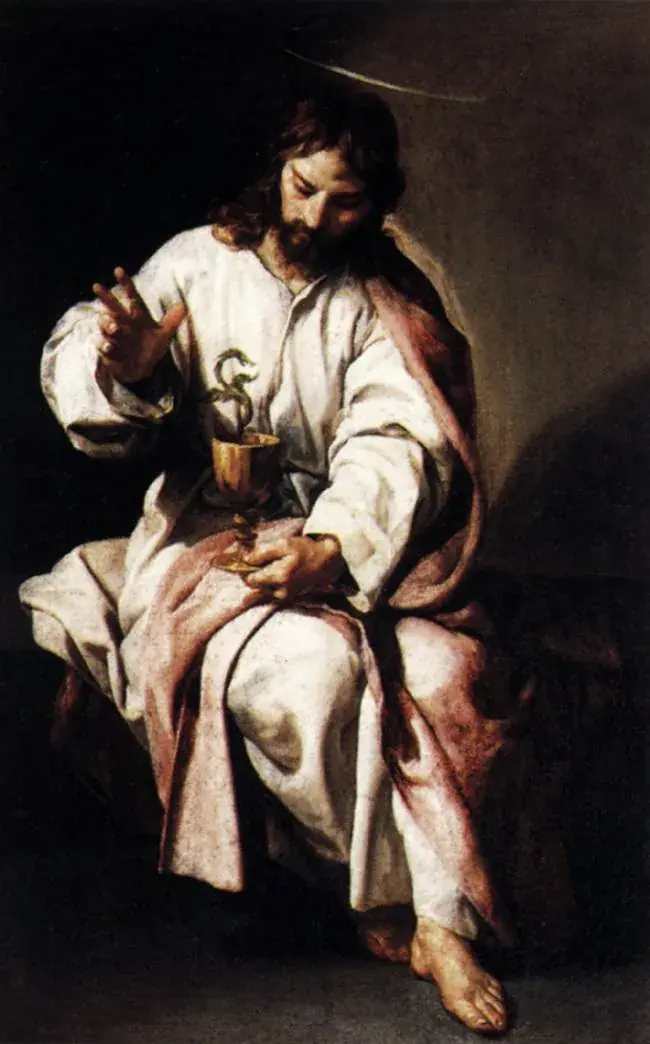
- Feast day
- December 27, originally shared with his brother James the Greater 2
- Family
- Son of Zebedee and Salome; brother of Saint James the Greater 2
- Called
- One of the "sons of thunder"; "the disciple whom Jesus loved"; in the East, simply "the Theologian" 12
- Symbols
- The eagle, and the chalice; the chalice may not have been adopted until the thirteenth century 2
Saint John was a fisherman on the Lake of Genesareth who, on Irenaeus' testimony, wrote the Fourth Gospel at Ephesus. 2 He was one of the three disciples taken along whenever Jesus went somewhere that mattered, he was at the foot of the cross, and he lived long enough to be a very old man at Ephesus around the year 100. 12 The Eastern Church does not bother with a longer title for him than "the Theologian." 1
One of the three
John was the son of Zebedee and Salome and the brother of James, and the two of them worked their father's boat on the Lake of Genesareth. Jesus called them "sons of thunder," Boanerges, which was not a compliment about their patience. 2 Before that they had probably been disciples of John the Baptist, and were called away from that circle together with Peter and Andrew. 2
In the lists of the apostles John comes second, third or fourth, but almost always after James, which is the reason he is generally taken to be the younger brother. 2 Benedict XVI simply walks through the places he turns up: in Peter's house at Capernaum when Jesus cured his mother-in-law, in the house of Jairus, up the mountain at the Transfiguration, on the Mount of Olives when Jesus spoke about the end of the city, and in Gethsemane. He and Peter were the two sent ahead to prepare the room for the Last Supper. 1
At the supper his place was next to Christ, on whose breast he leaned. He was at the foot of the cross with the mother of Jesus, and took her into his own care. After the Resurrection he ran to the tomb with Peter and was the first to believe. At the lake afterward, he was the first of the seven to recognize the figure on the shore. 12
The disciple whom Jesus loved
The Fourth Gospel never names its author. It refers instead to "the disciple whom Jesus loved," and the encyclopedia treats that as John being characteristically reticent about himself: "According to the general interpretation John was also that 'other disciple'" who followed Christ into the high priest's palace after the arrest. 2
Benedict XVI, teaching in 2006, put the same question differently. "According to tradition, John is the 'disciple whom Jesus loved'... We know that this identification is disputed by scholars today, some of whom view him merely as the prototype of a disciple of Jesus." He then declined to rule: "Leaving the exegetes to settle the matter, let us be content here with learning an important lesson for our lives: the Lord wishes to make each one of us a disciple who lives in personal friendship with him." 1
It is a small thing and a useful one. The pope had the authority to close the question and chose to say that the answer changes nothing about what the reader is supposed to do with it.
After the Resurrection
John and Peter turn up together repeatedly in Acts: at the healing of the lame man at the Temple, thrown into prison, sent to the newly converted in Samaria. 12 Paul lists him with Peter and James as a "pillar" of the church at Jerusalem. 12
Benedict picks out the sentence the two of them gave the Sanhedrin: "We cannot but speak of what we have seen and heard." 1 He reads it as frankness rather than defiance, and as the model for "putting faith before any human calculation or concern." 1
The encyclopedia reckons the apostles stayed roughly twelve years in Palestine before the persecution under Herod Agrippa I scattered them, and that John was back in Jerusalem for the Apostolic Council around A.D. 51. After Paul's later visits he seems no longer to have been there, which has led some to place his departure from Palestine between 52 and 55. 2
Patmos, Ephesus, and a very long old age
The Apocalypse says its author was on Patmos "for the word of God and for the testimony of Jesus," and the encyclopedia places that banishment in the reign of Domitian, between 81 and 96. Before it, on Tertullian's testimony, John had been thrown into a cauldron of boiling oil at Rome before the Porta Latina and came out unhurt. 2
He returned to Ephesus under Trajan and died there about A.D. 100 at a great age. 12 Justinian later built a great basilica over the site, whose ruins are still standing. 1 The encyclopedia keeps some of the stories from those last years: that he refused to stay under the same roof as the heretic Cerinthus, that he was anxious about a young man who had become a robber, and that at the end he said the same thing over and over - "Little children, love one another." 2
The two sources handle the apocryphal Acts of John in opposite ways, and both are right to. The encyclopedia says flatly that the stories in them "are unhistorical invention." 2 Benedict quotes them anyway, not as history but for the picture they preserve of a man who founded nothing and governed nothing and simply kept moving, "a perpetual wayfarer, a communicator of the faith in the encounter with 'souls capable of hoping and of being saved.'" 1
The Theologian
The Eastern Church calls him "the Theologian" - the one, as Benedict puts it, "who can speak in accessible terms of the divine, revealing an arcane access to God through attachment to Jesus." 1 Byzantine painters show him very old and deep in contemplation, in the attitude of someone asking for silence. 1
Benedict draws the practical conclusion himself: "without sufficient recollection it is impossible to approach the supreme mystery of God and of his revelation." 1 He then quotes the Patriarch Athenagoras: "John is the origin of our loftiest spirituality. Like him, 'the silent ones' experience that mysterious exchange of hearts, pray for John's presence, and their hearts are set on fire." 1
In Western art he is given the eagle, for the height the first chapter of his Gospel climbs to. The chalice, which some authorities date only to the thirteenth century, is variously explained by the Last Supper, by the legend of a cup of poisoned wine from which the poison rose as a serpent at his blessing, or - most naturally, the encyclopedia thinks - by Christ's words to him and his brother, "My chalice indeed you shall drink." 2
What is Saint John the Evangelist the patron saint of?
Nothing that either source cited here will state. Benedict XVI's catechesis names no patronage and neither does the encyclopedia article, so this page leaves the question unanswered rather than filling it in from the lists that circulate. 12
What he is for is a separate question and an easier one. He is the apostle people go to for contemplative prayer, and for reading Scripture as something to sit inside rather than get through.
Saint John the Evangelist's feast day
Saint John is commemorated on December 27, two days after Christmas. 2 The day was originally shared with his brother James the Greater, and at Rome it was reserved to John alone at an early date, though both names appear together in the Carthage Calendar, the Hieronymian Martyrology and the Gallican books. 2
His "departure" is noted on September 26 in the Menology of Constantinople and the Calendar of Naples, which seems to have been taken as the date of his death, and the separate feast of Saint John before the Latin Gate - commemorating the dedication of the church by the gate where the cauldron was said to have stood - is first mentioned in the Sacramentary of Adrian I, between 772 and 795. 2
Praying with Saint John
John outlived them. The persecution under Herod Agrippa I scattered the apostles out of Palestine in the 40s, and he was still alive at Ephesus around the year 100, at a great age. 2 Long life does not get counted as a hardship, and being the last person left who remembers something is its own kind of work.
Jerome preserved the sentence he repeated constantly at the end of his life: little children, love one another. 2 A man whose Gospel opens at the beginning of everything closed with the shortest thing he could have said, and went on saying it.
Benedict's reading of the beloved-disciple question is the useful one for prayer. Whether the phrase names John or stands for any disciple at all, "the Lord wishes to make each one of us a disciple who lives in personal friendship with him," and that takes living with him rather than following at a distance. 1 The scholarly question stays open; the invitation does not depend on it.
The image the East keeps of him is an old man in silence, asking for quiet. 1 Anyone whose prayer has gone wordless, and who suspects that means it has stopped working, has a patron in the apostle the Church calls the Theologian.
Saint John the Evangelist, pray for us.
Sources
Saints to turn to next
Others in this collection who are turned to for some of the same things.
- Saint Abercius of HieropolisSecond century; died at seventy-two or laterPrayerStudy and teaching
- Saint Aelred of Rievaulx1109 - January 12, 1166 (or 1167)PrayerStudy and teaching
- Saint Ambrosec. 340 - April 4, 397PrayerStudy and teaching
- Saint Anselm of Canterbury1033 or 1034 - April 21, 1109Study and teachingPrayer