Saint John of Lycopolis
c. 305 - 394 or 395
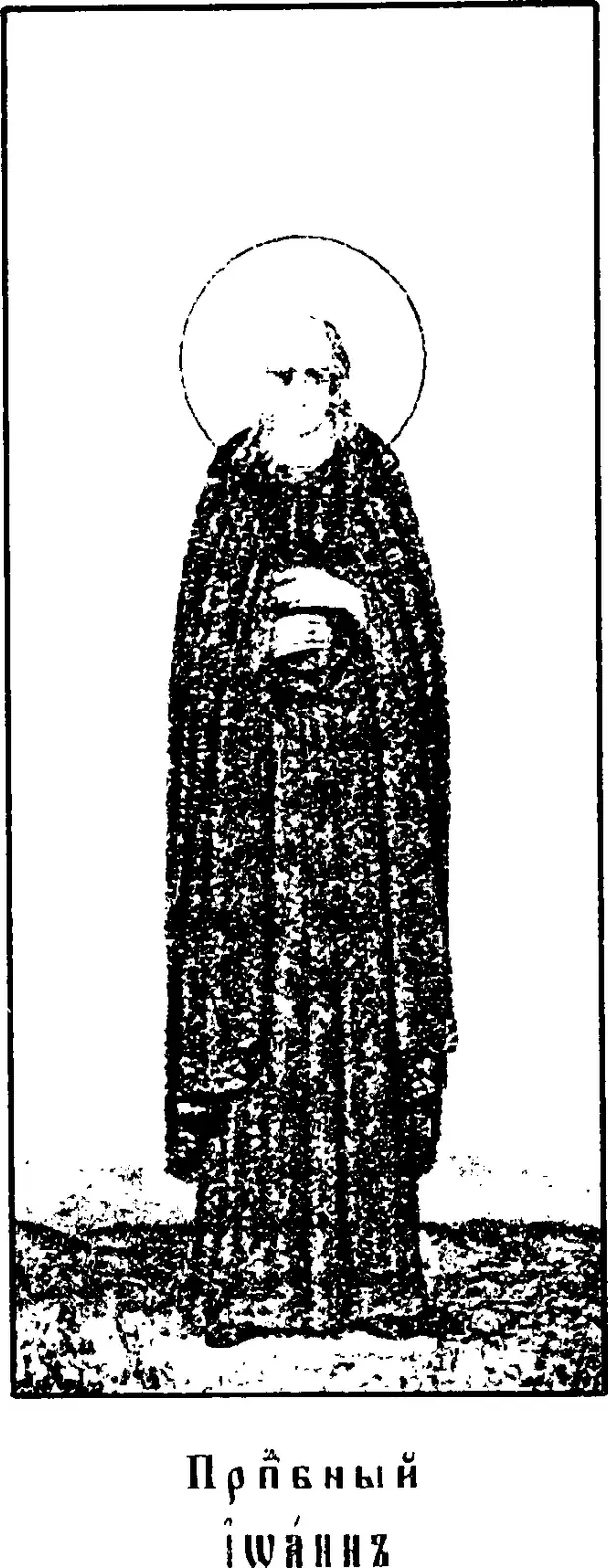
Saint John of Lycopolis was an Egyptian carpenter who became a monk, walled himself into a cell on a cliff above the town of Lycopolis, and spoke to visitors through a window for some forty years. 12 Before two civil wars the emperor Theodosius sent to ask him how they would end, and Palladius, who climbed up to see him in 394, wrote down what he was told. 12 His feast is March 27. 15
The carpenter and the dry stick
Palladius says that John "in his childhood learned the trade of carpentering," and that he had a brother who was a dyer. 2 Butler puts his birth about 305 and calls his family humble. 1 At about twenty-five he renounced the world. 12
What he did next is told two ways. Palladius says he lived in various monasteries for five years and then withdrew alone to the mountain. 2 Butler says he placed himself under an old anchorite, stayed about twelve years until the old man died, spent four more in nearby monasteries, and withdrew at about forty. 1 Cassian says only that John obeyed his elder "from his youth up even to a full and ripe age of manhood." 3
Cassian is the source for the training, and he tells it as a lesson. The old man took a stick from the woodpile, so long cut that it was "not merely dry but even mouldy," pushed it into the ground and told John to water it twice a day until it took root. 3 John carried water nearly two miles, every day for a year, through illness, feast days and winter. 3 At the end the old man asked whether the tree had put out roots, pulled it up, threw it away and told him he could stop. 3
There were other tests. Told to throw the community's only flask of oil out of the window, John did it at once. 3 Told to roll a stone that a crowd of men could not have moved, he set his neck and his whole body against it until the stone was wet with his sweat. 3 Cassian credits this obedience with the gift of prophecy that followed. 13
The cell on the mountain
On the summit of the mountain of Lyco, Palladius says, he built himself three rooms, "one chamber was for his bodily needs, and another where he worked and ate, and the third where he prayed," and shut himself in. 2 Someone passed him what he needed through a window. 2 Butler says he never ate before sunset and never ate anything cooked, not even bread. 1
He was enclosed, Palladius says, for thirty years before he "was counted worthy of the gift of predictions." 2 John himself told Palladius, "Forty years have I spent in the cell. I have not seen the face of woman nor the appearance of money." 2 Butler has him in the cell from about forty to about ninety. 1
On five days of the week he spoke only with God. On Saturdays and Sundays men could come to his window for advice. 12 When visitors grew many, his disciples built a guesthouse near the cell and a vestibule large enough, Palladius says, for about a hundred men, which they kept locked except on the weekend. 12 He sent oil he had blessed to the sick, and Butler says the cures drew attention from all over the empire. 1
The emperor's questions
Palladius says that John sent predictions to "the blessed emperor Theodosius," one that he would defeat the usurper Maximus and come back from Gaul, and good news also about the usurper Eugenius. 2 Cassian says Theodosius "did not venture to declare war against the most powerful tyrants before he was encouraged by his utterances and replies." 3
Butler gives the detail. Before the war with Maximus, John promised a victory almost without bloodshed. 1 Before the war with Eugenius in 394, the emperor sent the eunuch Eutropius to bring John to Constantinople if he would come; John would not, but said the emperor would win, this time with heavy losses, and would then die in Italy and leave the West to his son. 1 Butler notes that each part came true. 1
The Catholic Encyclopedia adds one more story, from Lycopolis itself: Theodosius threatened to destroy the town after a civil war, "and it was saved only by the intervention of St. John of Lycopolis, one of its most celebrated citizens." 6
Palladius at the window
Palladius, then a young monk in the desert of Nitria with Evagrius, set out to see him and arrived after eighteen days, partly on foot and partly by boat, in the season of the Nile flood. 12 He found the vestibule locked and waited until Saturday. 2 John greeted him through an interpreter and guessed at once that he belonged to Evagrius's community. 2
Then the governor of the district, Alypius, arrived, and John turned to him and talked for a long time. Palladius grew annoyed, "in my disgust I murmured against the good old man," and was about to leave when John sent his interpreter, Theodore, to tell him not to be petty: he would dismiss the governor and then talk to him. 2 When they spoke, John told him why. Palladius had plenty of brothers and fathers to console him; the governor, caught up in worldly business, had come for a brief hour "like a servant run away from his master." 2
He told Palladius the temptations he had been hiding, to go home to his father and to bring his brother and sister into monastic life, and told him both had already renounced the world. 2 Then he asked, smiling, whether he wanted to be a bishop. Palladius joked that he was one already, bishop "over the kitchens, the shops, the tables and the pots." 2 John told him to stop joking: he would be ordained bishop and suffer much, and if he wanted to escape that he should stay in the desert. 2 Palladius did not stay; he became bishop of Helenopolis, and remembered the prophecy during eleven months hidden in a dark cell. 12
The officer's wife
John did not see women. An officer came to ask that his wife, who had traveled far, be allowed to speak to him; John refused. 14 The man came back and said she would die of disappointment. "Go, said he, tell your wife, she shall see me this night, but in her sleep." 4 She did, and woke able to describe him, and he had given her advice "such as was meet to be given to a wedded believing woman." 4
Augustine heard the story from "a grave man and a noble, and most worthy to be believed," who had it from the couple. 4 He said he would have liked to ask John himself whether he had really come to the woman in her sleep, or whether an angel had come in his likeness, and added that John was said to be "most patient in hearing questions and most wise in answering." 4
Butler adds a story from Rufinus. A group of monks led by Petronius visited him, and one of them, a deacon, hid his rank out of humility. John pointed him out, kissed his hand and told him never to deny the grace he had received, "lest humility betray you into a lie." 1 When they left he told them that news of Theodosius's victory over Eugenius had reached Alexandria that day. 1
He died soon after, on his knees in prayer, having seen no one for his last three days. 1 Butler places it at the end of 394 or the beginning of 395. 1 katolsk.no gives 394. 5
What is Saint John of Lycopolis the patron saint of?
Saint John of Lycopolis's feast day
Saint John of Lycopolis's feast day is October 17. The current Roman Martyrology, in the text published by the Italian bishops, remembers on that day John the hermit of Asyut in Egypt, "outstanding also for the spirit of prophecy." 7 Asyut is the town the Catholic Encyclopedia calls Siout, the Greeks Lycopolis. 6
The older date is March 27. Butler says that "the Roman and other Latin Martyrologies mark it on the 27th of March," while the Copts keep his festival on October 17, which may have been the day he died. 1 The Norwegian bishops' database still gives March 27. 5 The current Roman Martyrology keeps the Coptic day.
Praying with Saint John of Lycopolis
The story Cassian chose to tell about him is a year of watering a dead stick. 3 Cassian does not pretend the command made sense. He tells it because John did not ask whether it did. 3
Forty years later the same man made a young monk wait while he talked with a provincial governor, and explained why: the monk had other help, and the official had only an hour. 2
He would not see women, and he would not go to the emperor. 14 He told a deacon not to lie even out of humility. 1 And when a woman came a long way to see him, he sent her advice in a dream, and Augustine, hearing of it, wished he could have asked him how. 4
Saint John of Lycopolis, pray for us.
Sources
- 1.Alban Butler, "St. John of Egypt, Hermit," March 27, in The Lives of the Fathers, Martyrs, and Other Principal Saints, Vol. I (New York, 1895), Project Gutenberg eBook #20450.
- 2.Palladius, The Lausiac History, chapter 35, "John of Lycopolis," trans. W. K. Lowther Clarke (London: SPCK, 1918), as transcribed by the Tertullian Project.
- 3.John Cassian, The Institutes, Book IV, chapters 23-26, trans. Edgar C. S. Gibson, Nicene and Post-Nicene Fathers, Second Series, vol. 11 (1894), at New Advent.
- 4.Augustine, On the Care to Be Had for the Dead, paragraph 21, trans. H. Browne, Nicene and Post-Nicene Fathers, First Series, vol. 3 (1887), at New Advent.
- 5."Den hellige Johannes av Egypt ( -394)," Den katolske kirke, the saints database of the Catholic Church in Norway, katolsk.no (in Norwegian).
- 6."Lycopolis," The Catholic Encyclopedia, vol. 9 (New York: Robert Appleton Company, 1910).
- 7.Roman Martyrology, entries for October 17, Santo del giorno, Conferenza Episcopale Italiana (in Italian).
Saints to turn to next
Others in this collection who are turned to for some of the same things.