Saint John Nepomucene
c. 1340 - March 20, 1393
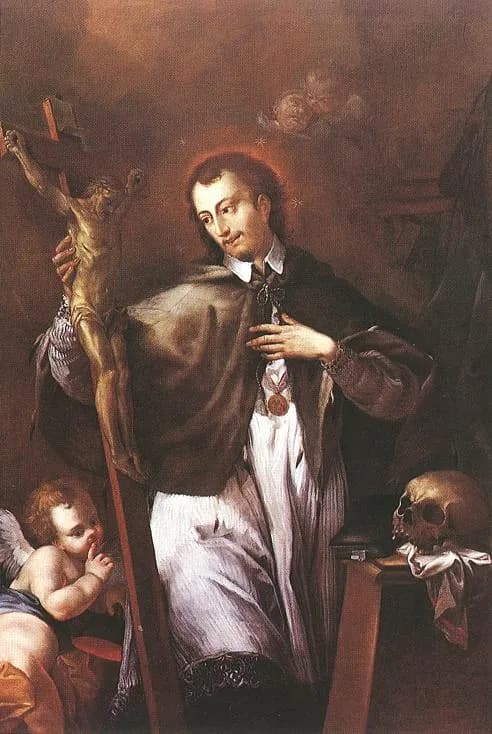
- Patron saint of
- Bohemia, in the 1910 Catholic Encyclopedia; John Paul II calls him the Patron Saint of the Church of Prague and its people 12
- Feast day
- May 16, according to the Catholic Encyclopedia and John Paul II 12; Vatican News lists him under March 20 5
- Born
- At Nepomuk (Pomuk) in Bohemia, about 1340 according to the Catholic Encyclopedia 1; about 1330 according to Butler 6
- Offices
- Parish priest of St. Gallus in Prague, canon, doctor of canon law, and from 1393 vicar general of the Archdiocese of Prague 12
Saint John Nepomucene was the vicar general of Prague, tortured and thrown into the river Moldau on the night of March 20, 1393, on the orders of King Wenceslaus IV. 12 The documents written at the time say he died for defending the Church's law against the king in a dispute over an abbey; the story that he died rather than reveal the queen's confession appears in writing only decades later. 12 He has been venerated in Bohemia as a martyr since the years immediately after his death, and he is the country's patron saint. 12
What the documents of 1393 say
Johann Peter Kirsch, writing the article for the Catholic Encyclopedia in 1910, begins with a warning: the controversy over who John of Nepomuk was "is not yet decided." 1 His method is to set down first what the original sources say, and they say a good deal.
John was the son of Welflin, a burgher of the small Bohemian town of Pomuk, or Nepomuk. 1 He studied theology and law at the University of Prague, took orders in 1373, and worked as a notary and then secretary in the archbishop's chancery. 1 He was parish priest of St. Gallus in Prague, took a doctorate in canon law in 1387, held several canonries, and became archdeacon of Sasz. 1 Archbishop John of Jenstein made him president of the church court and, in 1393, his vicar general. 1 John Paul II, writing in 1979, adds that he had come to Rome as a pilgrim for the jubilee of 1390. 2
The trouble began with an abbey. King Wenceslaus IV wanted a new diocese for one of his favorites, and ordered that when Abbot Rarek of Kladrau died, no successor should be elected, so that the abbey church could become a cathedral. 1 When the abbot died in 1393 the monks elected one of their own at once, and John, as vicar general, confirmed the election "without referring to the wishes of the king." 1
Kirsch says the king "fell into a violent rage." 1 John and three other officials of the archdiocese were imprisoned and tortured. The others gave in. One even proposed "everlasting secrecy concerning all that had occurred." 1 John did not. He was burned on his sides with torches, then chained, led through the city with a block of wood in his mouth, and thrown from the bridge into the Moldau on March 20, 1393. 1 John Paul II writes that the king "took part personally in his torture," and that the river "became his first tomb." 2
Kirsch lists four accounts written within a few years of the death, first among them the formal complaint against the king that the archbishop himself carried to Rome in April 1393. 1 In it the archbishop already calls John "martyr sanctus." 1 His body was taken from the river and buried in the cathedral of Prague, where his grave was honored. 1
How the seal of confession entered the story
The confessional appears for the first time in a chronicle finished in 1459 by Thomas Ebendorfer. 1 He writes that the king had Magister John, his wife's confessor, drowned partly for saying that "only he who rules well is worthy of the name of king," and partly because he would not break the seal of confession. 1 Kirsch notes that Ebendorfer knows of only one John drowned by Wenceslaus, and is plainly writing about the man who died in 1393. 1 From then on, the other chronicles of the late fifteenth century give the same reason: John would not tell the king what the queen had confessed. 1
John Paul II tells it in the same order. Some decades after John's death, he writes, "the rumour spread that the King had had him killed for refusing to violate the secrecy of confession. And thus the martyr of ecclesiastical freedom was venerated also as a witness to the sacramental seal." 2
The fuller version was set down by later writers. Butler's Lives of the Saints, drawing on the Jesuit Bohuslav Balbinus, makes John a celebrated preacher and the confessor of the Empress Jane, a devout woman married to a jealous husband. 6 The emperor demands to know what she confessed; John refuses; he is imprisoned, released, tortured on the rack with burning torches, freed again at the empress's pleading, and finally, after one last silent refusal, ordered to be thrown into the river "as soon as it shall be dark, that his execution may not be known by the people." 6 Butler dates this to May 16, 1383, and says a light appeared over the body on the water. 6 Butler presents all of this as history. Kirsch, reviewing the same tradition, calls the details of the sixteenth- and seventeenth-century writers "more or less legendary." 1
One John or two?
The dates do not agree, and someone tried to reconcile them. Kirsch says the Bohemian historian Hajek, who died in 1553, was the first to speak of two Johns of Nepomuk, both drowned by Wenceslaus: a queen's confessor in 1383, martyred for the seal, and a churchman in 1393, killed over the abbey. 1 Balbinus followed the 1383 dating, and when John was beatified in 1721 and canonized in 1729, the acts of canonization rested on it. 1
Then, in 1752, the archbishop's complaint of 1393 came to light, and in 1777 an Augustinian, Athanasius a Sancto Josepho, used it to argue that John died in 1393 and for the reason the documents give. 1 Kirsch says the controversy "has never ceased" since. 1
He sets out three positions as they stood in his day. Some still defended Hajek's two Johns. Most modern historians, he writes, "are probably correct in regarding the vicar-general murdered in 1393 as the only historical personage." 1 And a few of those held that the abbey election was only the occasion: Wenceslaus was already angry with John over the queen's confession and used the dispute to take revenge. 1 This page does not decide between them.
Kirsch is firm on two further points. None of this, he says, can "affect the validity of the canonization of the vicar-general, who had been recognized as a martyr immediately after his death." 1 And the claim made by some Protestant historians, that the Jesuits invented the cult to replace the memory of John Hus, he calls "unhistorical," since the veneration was widespread "long before the Jesuits ever existed." 1
When the grave was opened in 1719, Kirsch writes, the tongue was found "uncorrupted though shrivelled." 1 Butler says the bones were entire and the tongue alone was free from corruption. 6 John Paul II reports that a commission of experts examined the relics between 1971 and 1973 and confirmed the tortures, "signs of which still remain like a seal in his bones." 2
What is Saint John Nepomucene the patron saint of?
Saint John Nepomucene is the patron saint of Bohemia. The Catholic Encyclopedia says so in those words, and John Paul II, writing to the Archbishop of Prague in 1979, calls him "your Patron Saint" and notes that his cult "has spread beyond the frontiers of Bohemia." 12 Benedict XVI, visiting the Czech Republic in 2009, named him with Wenceslaus, Ludmila and Adalbert among the martyrs of that country. 34
The sources consulted for this page name no other patronage for him, not confessors and not bridges, and so this page names none. What John Paul II does record is the custom that grew from the manner of his death: in Poland, and especially around Krakow, his statues are "usually placed near bridges or rivers to recall his martyrdom." 2
Saint John Nepomucene's feast day
The feast of Saint John Nepomucene is May 16. The Catholic Encyclopedia gives that date, and John Paul II, writing in 1979, calls May 16 "his liturgical feast." 12 Butler also places his feast on May 16. 6
Vatican News, however, lists him in its English Saint of the Day calendar under March 20, as "St. John Nepomucen, priest and Martyr of Prague." 5 That is the date the documents give for his death in 1393. 1 May 16 is also the date that Balbinus and the older tradition gave for the drowning, in 1383. 16
Praying with Saint John Nepomucene
The earliest record of John is administrative. He confirmed an election that the canons of his Church required and the king had forbidden, and when the king demanded that he undo it, he would not. 1 Of the officials tortured with him, he was the only one who did not give way. 1 Whatever else came to be told about him, that much was written down in the year it happened, by the archbishop he served. 1
John Paul II read him chiefly as a priest. He held him up to the clergy of Prague as a parish priest and a vicar general who did his work "in harmony with the will of his Archbishop in the spirit of ecclesial obedience," and asked that he be "the model and protector of the seminarians of his native land." 2 The letter was written to a Church living under a government hostile to it, and its stress on "the rights and the legitimate freedom of the Church" was not abstract. 24
Then there is the story of the confessional, which the Church has carried for more than five hundred years and which its own historians say came later. 12 John Paul II did not discard it; he wrote that the martyr of the Church's freedom "was venerated also as a witness to the sacramental seal." 2 The two accounts describe the same refusal to give a king what he demanded, over different things.
The body went into the river at night, and the king meant it to stay hidden. 16 It did not. The body was found and buried in the cathedral, and in the complaint the archbishop took to Rome that spring, John was already called a holy martyr. 1
Saint John Nepomucene, pray for us.
Sources
- 1.Johann Peter Kirsch, "St. John Nepomucene," The Catholic Encyclopedia, Vol. 8 (New York: Robert Appleton Company, 1910).
- 2.John Paul II, Letter to Cardinal František Tomášek, Archbishop of Prague, on the 250th anniversary of the canonization of St. John Nepomucene, March 2, 1979 (Libreria Editrice Vaticana).
- 3.Benedict XVI, Address at Vespers in the Cathedral of Saints Vitus, Wenceslaus and Adalbert, Prague, September 26, 2009 (Libreria Editrice Vaticana).
- 4.Benedict XVI, Address at the Welcoming Ceremony, Stará Ruzyně International Airport, Prague, September 26, 2009 (Libreria Editrice Vaticana).
- 5."St. John Nepomucen, priest and Martyr of Prague," Saint of the Day, 20 March, Vatican News.
- 6.Alban Butler, "St. John Nepomucen, M.," The Lives of the Fathers, Martyrs and Other Principal Saints, Vol. 5 (D. & J. Sadlier, 1864), EWTN Library.
Saints to turn to next
Others in this collection who are turned to for some of the same things.
- Saint Andrew Kim TaegonAugust 21, 1821 - September 16, 1846CourageWork and vocation
- Saint Ansgar801 - February 865CourageWork and vocation
- Saint Anthony Mary ClaretDecember 23, 1807 - October 24, 1870Work and vocationCourage
- Saint Augustine of CanterburyBirth unknown - 604 or 605CourageWork and vocation