Saint John Cassian
c. 360 - c. 433/435
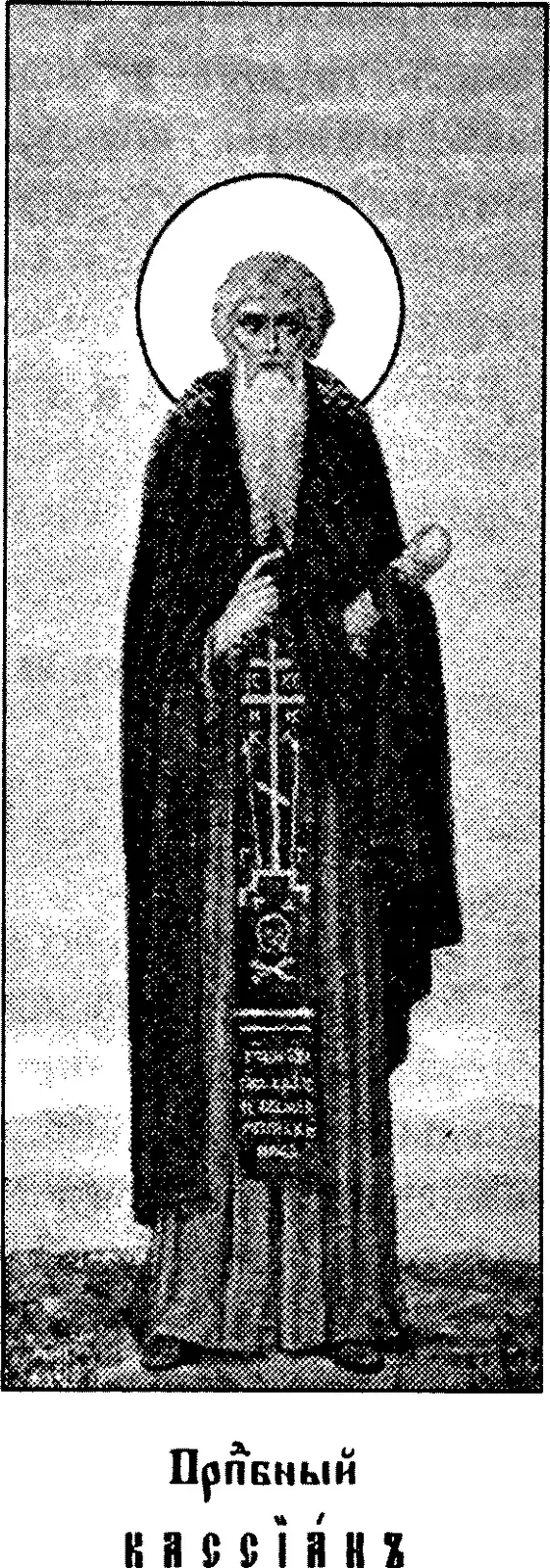
Saint John Cassian spent years among the monks of the Egyptian desert and then wrote down what they had taught him, for the monasteries of Gaul. 12 His Institutes and Conferences became, through Saint Benedict, part of the daily reading of Western monks, and he founded the abbey of Saint Victor at Marseille, where he died about 435. 13 His feast is July 23. 9
Bethlehem and the desert
Where he was born is disputed. The Catholic Encyclopedia says probably Provence, about 360, and treats the old notice that he was "a Scythian by birth" as a slip based on the years he spent in the desert of Scete. 1 The Norwegian bishops' database places his birth in Scythia Minor, in what is now Romania, and Butler calls him "a native of Lesser Scythia." 23 Gennadius, writing later in the same century, simply says "Scythian by race." 4
He was the son of wealthy parents and well educated. 1 As a young man he went to the holy places with an older friend, Germanus, and the two took up the monastic life at Bethlehem. 1 Cassian later said that everybody who knew them "would say that a single heart and soul existed in our two bodies." 6
The pull of the Egyptian monks was too strong for Bethlehem. The friends promised to come back soon and stayed away seven years, returning to Egypt again after a short leave. 1 Butler, from the Conferences, says they went barefoot, dressed so meanly "that their friends would have been ashamed to meet them," and lived by the work of their hands. 3 In the desert of Scete Cassian sought out Abbot Moses, "eminent amid those splendid flowers," and begged him for a discourse, "not without tears." 6
Deacon of John Chrysostom
From Egypt the two came to Constantinople, about 400 by the Norwegian account, in 403 by Butler's. 23 Saint John Chrysostom ordained Cassian a deacon and put him in charge of the treasures of his cathedral. 12
When Chrysostom was driven out, his clergy sent Cassian and Germanus to Rome to plead his case with Pope Innocent I. 13 The pope's reply to the clergy of Constantinople survives in Sozomen's history, and it begins by acknowledging the letters "that you forwarded to me through Germanus, the presbyter, and Cassianus, the deacon." 5
After that Germanus disappears from the record, and of Cassian himself nothing is known for ten years or more. 1 He became a priest somewhere in this period: probably at Rome, says the Catholic Encyclopedia; probably at Marseille, says the Norwegian database; Gennadius calls him "a presbyter at Marseilles." 124
Two monasteries at Marseille
By about 415 he was at Marseille, and there he founded two monasteries: one for men over the tomb of the martyr Victor, and one for women. 12 Gennadius, writing later in the century, says both were "still standing." 4 The Norwegian database adds that Provence was then full of refugees from the barbarian invasions, and that the young monasteries of the region needed someone who could hand on the Egyptian tradition. 2
He did it in writing. The twelve books of the Institutes describe the dress, prayer and training of the Egyptian monks and then take on the eight principal faults: gluttony, impurity, covetousness, anger, dejection, accidie, vainglory and pride. 1 The Catholic Encyclopedia dates them between 420 and 429; the Norwegian database between 419 and 426. 12 The twenty-four Conferences followed, written up as conversations between Cassian, Germanus and the old men of Scete, in three installments that Butler dates 423, two years later, and 428. 13
Purity of heart
The Conferences open with Abbot Moses asking the two young monks what their goal is. They answer, the kingdom of heaven. That is the end, he tells them, but a farmer or an archer needs a nearer mark too, and the monk's mark is "purity of heart, which is charity." 6 Fasting, vigils, reading and solitude are all for the sake of that, and "the gain from fasting will not balance the loss from anger." 6
Cassian does not pretend the mind can be held still. "It is impossible for the mind not to be approached by thoughts," Moses says, "but it is in the power of every earnest man either to admit them or to reject them." 6 In the tenth Conference Abbot Isaac gives the remedy he trusted most: one short verse, said at every turn, "O God, make speed to save me: O Lord, make haste to help me." 7 Butler notes that Cassian recommends it as the aspiration "of the Church." 3
The Institutes are frank about the monk's worst hour. Accidie, Cassian writes, comes "about the sixth hour, like some fever," and fills a man with dislike of his cell and his brothers and with praise for monasteries far away. 8 He tells on himself: early in his stay he told Abbot Moses that a fit of it had left him only by running off to visit another abbot. Moses told him he had not freed himself from it but surrendered to it, and that it must be "overcome by resisting it." 8
Grace and free will
At the request of the Roman archdeacon Leo, later Pope Leo the Great, Cassian wrote seven books on the Incarnation against Nestorius, about 430, defending the title of Mary as Mother of God. 12 The Catholic Encyclopedia judges the work hurried and not equal to the others. 1
His reputation was harmed more by the thirteenth Conference. Reacting against what he took to be Saint Augustine's overstatement of predestination, Cassian held that the first step toward salvation could be taken by the human will, which grace then helps. 12 The Catholic Encyclopedia sums up the three positions: Augustine saw fallen man as dead, Pelagius as quite sound, Cassian as sick. 1 The view, later called Semipelagianism, was condemned by the Council of Orange in 529. 12
He took no part in the controversy that followed. 1 Saint Prosper of Aquitaine wrote against the thirteenth Conference without naming him, and with respect: Butler says Prosper calls him "a catholic doctor." 13 Gennadius, reporting the quarrel, says that Cassian's writings were ones "which the church of God finds salutary." 4
Death and honor at Saint Victor
He died at or near Marseille. The Catholic Encyclopedia says about 435, the Norwegian database 433, Butler "soon after the year 433," and Gennadius in the reign of Theodosius and Valentinian. 1234 The Norwegian database adds that there are no legends about him and no reports of miracles at his grave. 2
He was never formally canonized. 1 Saint Gregory the Great regarded him as a saint, and Pope Urban V, once abbot of Saint Victor, had his head placed in a silver casket engraved "Saint Cassian." 12 Butler writes that his head and right arm were shown in shrines on the altar of Saint Victor's, the rest of his body in a marble tomb in the crypt, together with "his very ancient picture." 3
Saint Benedict drew on him in writing his Rule and had selections from the Conferences read to his monks. 12
What is Saint John Cassian the patron saint of?
Saint John Cassian's feast day
Saint John Cassian's feast day is July 23. The current Roman Martyrology enters him on that day at Marseille, as the priest who founded two monasteries and wrote the Institutes and the Conferences. 9 The Catholic Encyclopedia says Marseille kept July 23 with an octave, and Butler that the abbey of Saint Victor had an office for him that day by special grant. 13
The Norwegian bishops' database gives February 28 as his memorial and says the Greeks honor him on February 29. 2 Its entry, last revised in 1998, says he was not in the Roman Martyrology; the current edition does include him. 29
Praying with Saint John Cassian
Cassian's teachers in the desert kept asking one question: what is all this for? Their answer was purity of heart, which they called charity, and every fast and vigil was to be judged by it. 6
He also left a prayer short enough for any hour: "O God, make speed to save me: O Lord, make haste to help me." 7 The old man who taught it to him used it at supper, in the fear of the night and against wandering thoughts alike. 7
He wrote honestly about the noonday restlessness that makes a person hate where they are and long for somewhere else, and about running from it himself. Abbot Moses's answer to him was to stay. 8
He also got something important wrong, and the Church said so a century later. 1 His books were read anyway, by Benedict and by monks ever since, and the sources treat his error and his holiness together. 12
Saint John Cassian, pray for us.
Sources
- 1.Maurice M. Hassett, "John Cassian," The Catholic Encyclopedia, vol. 3 (New York: Robert Appleton Company, 1908).
- 2."Den hellige Johannes Kassian (~360 - 433)," Den katolske kirke (Catholic Church in Norway), compiled by Per Einar Odden (in Norwegian).
- 3.Alban Butler, note on John Cassian under "St. Victor of Marseilles, M.," July 21, in The Lives of the Fathers, Martyrs, and Other Principal Saints, Vol. VII (New York: P. J. Kenedy, 1908), Project Gutenberg eBook #49604.
- 4.Gennadius of Marseille, Lives of Illustrious Men, chapters 62 and 85, trans. Ernest Cushing Richardson, Nicene and Post-Nicene Fathers, Second Series, vol. 3 (1892), New Advent.
- 5.Sozomen, Ecclesiastical History, Book VIII, chapter 26, trans. Chester D. Hartranft, Nicene and Post-Nicene Fathers, Second Series, vol. 2 (1890), New Advent.
- 6.John Cassian, Conferences, Conference 1 (Abbot Moses), trans. Edgar C. S. Gibson, Nicene and Post-Nicene Fathers, Second Series, vol. 11 (1894), New Advent.
- 7.John Cassian, Conferences, Conference 10 (Abbot Isaac, on prayer), trans. Edgar C. S. Gibson, Nicene and Post-Nicene Fathers, Second Series, vol. 11 (1894), New Advent.
- 8.John Cassian, Institutes, Book X (on accidie), trans. Edgar C. S. Gibson, Nicene and Post-Nicene Fathers, Second Series, vol. 11 (1894), New Advent.
- 9.Roman Martyrology, entry for July 23, "San Giovanni Cassiano, sacerdote," Santo del giorno, Conferenza Episcopale Italiana (in Italian).
Saints to turn to next
Others in this collection who are turned to for some of the same things.