Saint Isidore of Pelusium
Late 4th century - c. 449
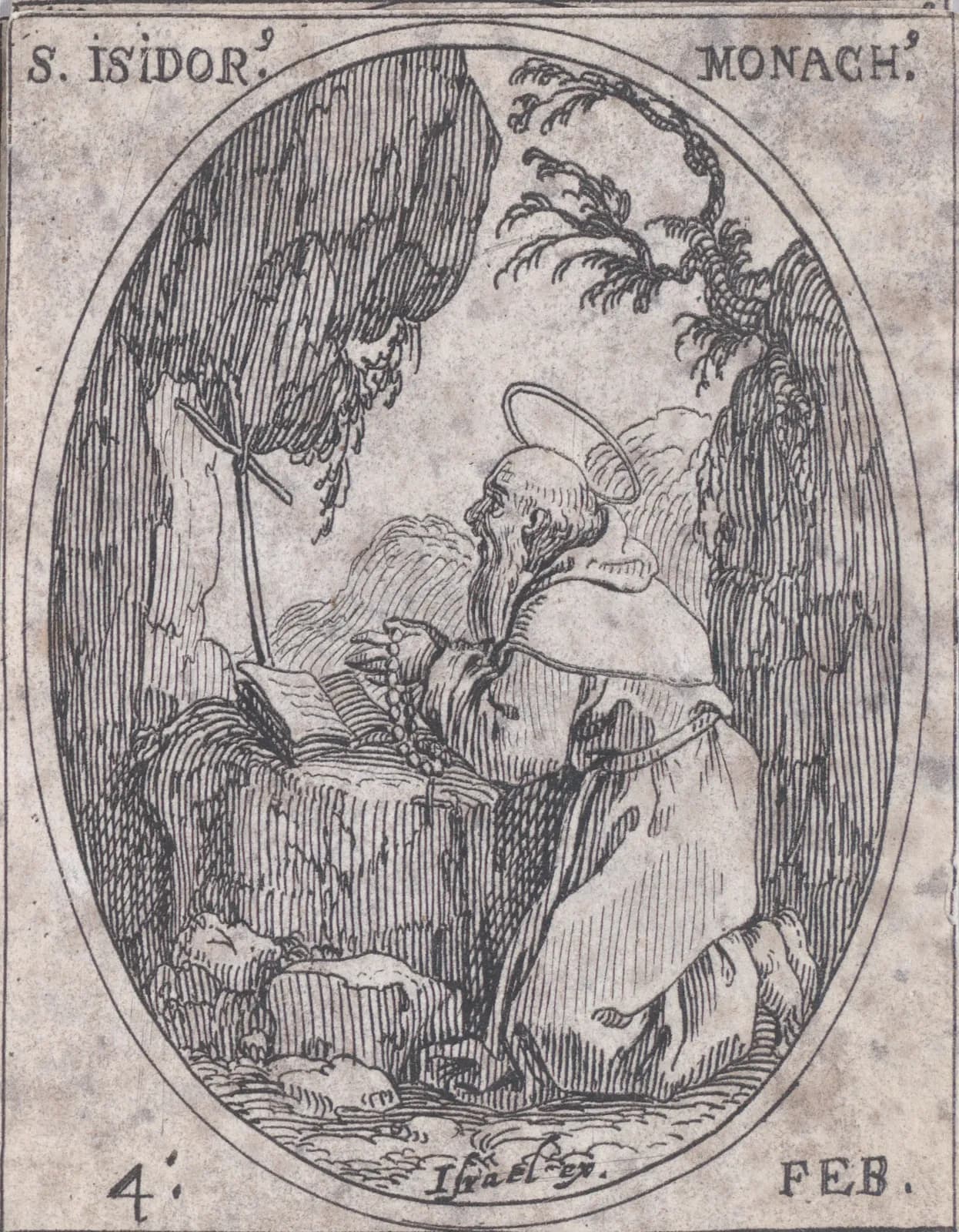
- Born
- At Alexandria, in the second half of the fourth century 1
- Monastery
- Lychnos, on a mountain near Pelusium in Egypt 1
Saint Isidore of Pelusium was an Egyptian monk and priest of the early fifth century whose letters, more than two thousand of them, are nearly all that is left of him. 1 He wrote to bishops, monks, soldiers and laymen, and he wrote to Cyril of Alexandria, urging him to honor John Chrysostom and later to end a quarrel that was splitting the Church. 12 The historian Evagrius called him "a living monument of monastic life and contemplation of God." 3
A monk near Pelusium
Isidore was born at Alexandria in the second half of the fourth century. 1 Henri Leclercq, writing in the 1910 Catholic Encyclopedia, says he left his family and possessions and withdrew to a mountain near the city of Pelusium, in Egypt, and that the city's name was attached to his own from then on. 1 He entered the monastery of Lychnos there, and soon became known for keeping the rule exactly and for his austerities. 1 Leclercq adds that he is sometimes called, by mistake, Isidore of Damietta. 1
How far he rose is not certain. Leclercq says a passage in the letters "affords reason to believe that he held the office of abbot," and Alban Butler, the eighteenth-century hagiographer, states simply that he "became superior of a monastery in the neighborhood of that city." 12 Both note that the later writers Facundus and Suidas speak of him as a priest. 12 Leclercq, who is careful about it, says neither names a church, and that he may have been "only a priest of the monastery." 1
The Roman Martyrology remembers him at Pelusium as a priest, learned in doctrine, who scorned the world and its riches and chose to imitate the life of John the Baptist in the desert by taking the monastic habit. 4 Butler calls him "a living rule of religious perfection," treated by his patriarch Cyril and the other bishops of his day "as their father." 2
Chrysostom, Cyril and the councils
Isidore's letters put him in the middle of the great quarrels of the Egyptian Church. He admired John Chrysostom, the bishop of Constantinople who died in exile; Butler says Isidore "chose St. Chrysostom for his model." 2 Theophilus of Alexandria, Cyril's uncle and teacher, had been one of Chrysostom's enemies, and Butler lists Isidore among the writers who accuse Theophilus of "avarice and oppressions." 2
Cyril inherited his uncle's prejudice against Chrysostom. Leclercq says Isidore's veneration for the dead bishop led him to press Cyril to do full justice to Chrysostom's memory, and Butler says that Cyril "was prevailed on by St. Isidore of Pelusium, and others," to restore Chrysostom's name to the diptychs of his church, the list of those prayed for at the altar, in 419. 12 Butler also records that Isidore praised Chrysostom's thirty-two homilies on the Letter to the Romans in terms that, in Butler's phrase, "all succeeding ages have subscribed" to. 2
He was no partisan of Cyril, though. Isidore opposed the Nestorians, but after the Council of Ephesus in 431, when Cyril and John of Antioch were at odds, Leclercq says Isidore "believed there was too much obstinacy on St. Cyril's side." 1 He wrote to Cyril "in urgent terms imploring him, as his father and as his son, to put an end to this division and not to make a private grievance the pretext for an eternal rupture." 1
He lived long enough to see the next controversy begin. Leclercq says many of his letters argue against the teaching of Eutyches that there is only one nature in Christ. 1 They do not mention the council held at Ephesus in August 449 or the Council of Chalcedon in 451, and Leclercq concludes from that silence that he died not later than 449-50. 1 Butler says "about the year 449." 2
The letters
Isidore wrote other books. He mentions a treatise against the pagans and a work on fate, which he says had a certain success; both are lost. 1 What survives is the correspondence. Leclercq counts 2,182 letters in five books, and notes that Nicephorus, a later Greek historian, spoke of ten thousand. 1 Butler gives "two thousand and twelve." 2 Many are short notes; Leclercq sorts the rest into three groups: dogma and Scripture, the discipline of the Church and of monasteries, and practical morals for laymen of every condition. 1
A few give a sense of the range. A letter to Theologius, written against the Nestorians, contrasts the mother of the pagan gods with the Mother of Christ, who conceived without any man. 1 One to Hierax defends the veneration of relics. 1 Another, to a man named Tuba, shows that it was thought unbecoming for a soldier to carry a sword through a city in peacetime or to appear in public in arms and uniform. 1
Others are hard on the clergy. Leclercq says the correspondence shows Isidore "fighting against unworthy clerics whose elevation to the priesthood and diaconate was a serious peril and scandal to the faithful," and complaining that many laymen had stopped approaching the sacraments to avoid contact with such men. 1
The letters to monks are some of the most practical. He reproached a monk named Thalelaeus for reading the pagan historians and poets, whose fables, Leclercq paraphrases, could reopen wounds that had healed. 1 New monks, he advised, should not feel the full weight of the rule at first, lest they be driven off, nor be left idle, lest they grow lazy, but should be led step by step. 1 Great fasts, he warned, are useless without the mortification of the senses. 1 For Isidore the monastic life rested on retirement from the world and obedience, and a monk was to be guided "by the judgment of his superior, for he must not be governed by his own will, but according to the will of those who have grown old in the practice of the religious life." 1
Leclercq admired the style: "natural, unaffected, and yet not without refinement." 1 What struck him most was the temper of the writer, "an imperturbable equability of temperament," the same moderation whether Isidore was explaining, rebuking or praising. 1 Butler, who called the letters "full of fire and penetration," records that the scholar Possevin lamented that they were not read as a classic of the Greek language. 2
What Evagrius remembered
The ancient historian who describes him is Evagrius Scholasticus, whose church history runs from the Council of Ephesus to the 590s. In a chapter that follows his account of Simeon the Stylite, Evagrius says that "in the same reign" Isidore was "universally celebrated by deed and word," and that he so wasted his flesh by discipline and fed his soul by doctrine "as to pursue upon earth the life of angels." 3 He notes that among Isidore's many writings "there are some addressed to the renowned Cyril; from which it appears that he flourished contemporary with the divine bishop." 3
Leclercq reads the same passage more cautiously. In his account Evagrius mentions one writing to a Cyril and leaves the reader unsure whether that Cyril was the famous bishop of Alexandria or someone of the same name. 1 The letters themselves, as Leclercq describes them, settle the question for the encyclopedia: they show Isidore writing to the bishop about Chrysostom and about Antioch. 1
What is Saint Isidore the patron saint of?
Saint Isidore's feast day
Praying with Saint Isidore
Isidore left almost no story behind him. There is no conversion scene, no martyrdom, no miracle in any of the sources. 12 What there is instead is two thousand letters answering whoever wrote to him, about Scripture, about bad priests, about a soldier's sword in the street. 1
He wrote to his own patriarch as a son and as a father at once, and told him he was being stubborn. 1 He did it, by Leclercq's account, without losing his temper: the same moderation runs through the rebukes as through the praise. 1
His advice to monks is plain and humane. Do not crush beginners and do not let them idle; fasting is worth nothing if the senses run free; obey those who have grown old in the life. 1 Leclercq says Isidore practiced what he taught, holding that "the life should correspond with the words." 1
Evagrius, who never met him, remembered a man who lived "upon earth the life of angels." 3 The letters show what that looked like from close up, which was mostly a monk at his desk, answering the mail. 1
Saint Isidore of Pelusium, pray for us.
Sources
- 1.Henri Leclercq, "St. Isidore of Pelusium," The Catholic Encyclopedia, Vol. 8 (New York: Robert Appleton Company, 1910).
- 2.Alban Butler, "St. Isidore of Pelusium," February 4, with the lives of St. John Chrysostom (January 27) and St. Cyril of Alexandria (January 28), in The Lives of the Fathers, Martyrs, and Other Principal Saints, January, February, March (New York, 1895), via Project Gutenberg.
- 3.Evagrius Scholasticus, Ecclesiastical History, Book I, chapter 15, trans. Edward Walford (1846), as transcribed at tertullian.org.
- 4.Roman Martyrology, entry for February 4, "Sant'Isidoro, sacerdote," as printed in "Santo del giorno," Conferenza Episcopale Italiana (in Italian).
Saints to turn to next
Others in this collection who are turned to for some of the same things.