Saint Ildephonsus of Toledo
c. 608 - January 23, 667
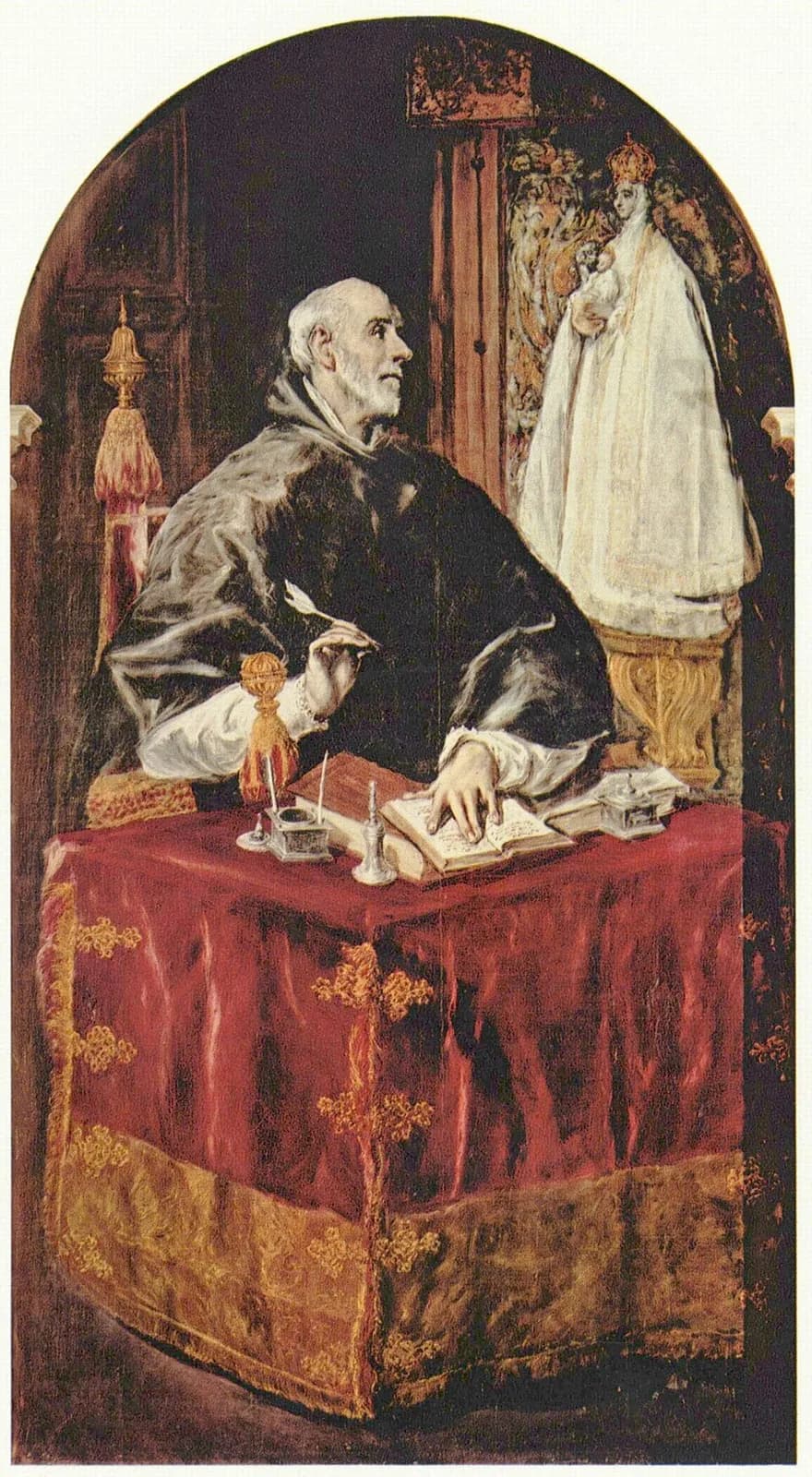
- Archbishop of Toledo
- From late 657 until his death 1
- Best-known work
- On the perpetual virginity of holy Mary, against three unbelievers 1
- Patron of
- The Archdiocese of Toledo 2
Saint Ildephonsus was a monk who became archbishop of Toledo in 657 and wrote a treatise on the perpetual virginity of Mary that earned him, in the Catholic Encyclopedia's words, "a place of honour among the devoted servants of the Blessed Virgin." 1 Popes have gone on quoting it: Pius XII in 1954, Paul VI in 1974, John Paul II in 1997. 567 Toledo honors him as its patron and tells of the Virgin coming down into his cathedral to give him a vestment, a story the Catholic Encyclopedia treats as a later addition to a short and well-attested life. 12 His feast is January 23. 2
What is known for certain
The Catholic Encyclopedia is careful to say where its facts come from. The "scanty but authentic details" of his life rest on Ildephonsus himself and on a short notice written by Julian, his immediate successor at Toledo. 1 From these it is known that he was born of a distinguished family and was a nephew of Saint Eugenius, the archbishop before him. 1 The Archdiocese of Toledo adds a year, 608, a birthplace, Toledo, and his parents' names, Esteban and Lucía, noble Visigoths related to King Athanagild. 2
While still young, and "despite the determined opposition of his father," he became a monk at the monastery of Agli, near Toledo. 1 Toledo calls it the Agaliense and says it was dedicated to Saints Cosmas and Damian. 2 Helladius, who had been his abbot and became archbishop of Toledo, ordained him deacon about 630. 1 In time the monks made Ildephonsus their abbot, and it was as abbot that he signed the acts of the Eighth and Ninth Councils of Toledo, in 653 and 655. 12
He also founded and endowed a convent of nuns. The encyclopedia puts this early, "while he was still a simple monk"; Toledo says he did it with the large inheritance that came to him when his parents died. 12
Toward the end of 657 King Reccesvinth called him to the archbishop's throne. 1 He governed the Church of Toledo for a little more than nine years, died on January 23, 667, and was buried in the basilica of Saint Leocadia. 12 The encyclopedia's separate article on Toledo dates his time as archbishop a little differently, from 659 to 668, and calls him "the most notable prelate of Toledo during the Gothic epoch." 4
The pupil of Isidore?
More than a century after his death another archbishop of Toledo, Cixila, wrote his life, and the encyclopedia says plainly that Cixila "embellished the biography of his predecessor." 14 One of his additions is that Ildephonsus had been the disciple of Isidore of Seville, which the encyclopedia sets among "some doubtful or even legendary anecdotes." 1
The Spanish churches concerned have kept it. The Archdiocese of Toledo says he was taught first by Eugenius and then studied philosophy and the humanities in Isidore's school at Seville before he entered the monastery, and the Archdiocese of Seville, which keeps his memorial too, says he came there as a young man and studied theology. 28 The connection is real in one respect at least. His short book on famous men was written as a supplement to Isidore's book of the same title. 1
The gift of the vestment
Cixila also recalled two wonders. In the first, Ildephonsus was praying before the relics of Saint Leocadia when the martyr rose from her tomb and thanked him for his devotion to the Mother of God. 1 The second is the one the encyclopedia calls "a favourite theme of hagiographers, poets, and artists": the Blessed Virgin appeared to him in person "and presented him with a priestly vestment, to reward him for his zeal in honouring her." 1
Toledo tells it in detail. In an account by Bishop Ángel Fernández Collado that the archdiocese published in 2020, the day is December 18, 665, at dawn, a day the Tenth Council of Toledo had fixed for the feast of the Annunciation. Ildephonsus enters the basilica to sing the office with a procession of clergy carrying candles and finds Mary seated in the bishop's chair; she speaks to him gratefully and lays a heavenly chasuble on his shoulders. 3 The archdiocese's calendar is more reserved and says only that, as Cixila relates, he deserved to receive a gift from heaven from the Mother of God. 2
The encyclopedia tells the story as a legend added to the life. 1 The bishop's account argues for its age: when the basilica was turned into a mosque, he says, the Muslims left untouched the stone on which Mary was believed to have stood, which suggests the tradition was older than the conquest. 3 Toledo keeps a commemoration of the event in its own calendar each January 24, the day after the saint's feast. 3
His writings
His books are better known than his life. 1 Julian reports that Ildephonsus sorted his own works into four parts: treatises; letters; Masses, hymns and sermons; and shorter pieces in prose and verse, epitaphs especially. 1 Much is lost. Of six treatises two survive, and of the letters only an exchange with Quiricus, bishop of Barcelona. 1 He left a good many other works unfinished, Julian says, because his cares gave him no time. 1
The treatise that made his name is on the perpetual virginity of Mary, written against three unbelievers, whom the encyclopedia identifies as Jovinianus, Helvidius and "a Jew." 1 The encyclopedia does not flatter it. It is, in the same sentence that praises him, "a bombastic work which displays however a spirit of ardent piety." 1 The other surviving treatise is on baptism, and scholars had shown by 1910 that its first book is an older work he reissued with a few additions. 1
It is the ardent pages that the popes have quoted. Pius XII, establishing the feast of the Queenship of Mary, wrote that Ildephonsus "gathers together almost all of her titles of honor in this salutation: 'O my Lady, my Sovereign, You who rule over me, Mother of my Lord . . . Lady among handmaids, Queen among sisters.'" 5 Paul VI drew from the same treatise the principle that honor paid to Mary passes to her Son: "what is given to the handmaid is referred to the Lord; thus what is given to the Mother redounds to the Son." 6
Paul VI also quoted a prayer of his, "amazing in its doctrine and prayerful power": "I beg you, holy Virgin, that I may have Jesus from the Holy Spirit, by whom you brought Jesus forth." 6 John Paul II ended his message for World Youth Day 1998 with the same prayer in another translation. 7
What is Saint Ildephonsus of Toledo the patron saint of?
Saint Ildephonsus is the patron of the Archdiocese of Toledo, which lists him in its calendar as patron of the diocese. 2 None of the sources consulted for this page names him patron of a profession or a cause, and the page does not supply one. 12 When John Paul II received pilgrims from Toledo in Rome in December 2000, he blessed them invoking "the protection of the holy Archbishop Ildefonsus of Toledo." 9
Saint Ildephonsus of Toledo's feast day
His feast is January 23, the day of his death in 667. 12 The Archdiocese of Toledo keeps it as the feast of its patron, Vatican News lists "St. Ildefonsus, Bishop of Toledo" on that date, and the Archdiocese of Seville keeps an optional memorial of him the same day. 2810 According to Toledo, his remains were carried to Zamora at the time of the Muslim invasion to keep them from profanation. 2
Praying with Saint Ildephonsus of Toledo
There are two portraits of this saint, and the sources keep them apart. One is the abbot whose signature is on the acts of two councils and whose successor listed his books. 1 The other kneels in a cathedral at dawn while the Mother of God puts a vestment on his shoulders. 3 The encyclopedia trusts the first and reports the second as legend; Toledo holds on to both. 12
The life that is certain is a quiet one. He went into a monastery against his father's wishes, spent decades there, and was sent for by a king when he was already an abbot. 1 He governed for nine years and left a shelf of books half finished because there was no time. 1
His prayer is the best of him, and it is not about Mary alone. He asks her for what she herself received: "May my soul receive Jesus through the Holy Spirit by whom your flesh conceived Jesus." 6 Paul VI quoted it to show how the early writers went to Mary for the Spirit's gift of Christ. 6
He called her "my Lady, my Sovereign, You who rule over me." 5 The sentence Paul VI took from him explains why that was never a rival loyalty: what is given to the Mother redounds to the Son. 6
Saint Ildephonsus of Toledo, pray for us.
Sources
- 1.Albert Poncelet, "St. Ildephonsus," The Catholic Encyclopedia, vol. 7 (New York: Robert Appleton Company, 1910).
- 2."Santoral Diocesano," Archidiócesis de Toledo (in Spanish).
- 3."Hoy se celebra 'La Descensión de la Virgen María': Historia y Significado," Archidiócesis de Toledo, January 24, 2020 (in Spanish).
- 4.Conde de Cedillo, "Toledo," The Catholic Encyclopedia, vol. 14 (New York: Robert Appleton Company, 1912).
- 5.Pius XII, Encyclical Ad Caeli Reginam, October 11, 1954, no. 21.
- 6.Paul VI, Apostolic Exhortation Marialis Cultus, February 2, 1974, nos. 25-26.
- 7.John Paul II, Message for the XIII World Youth Day (1998), November 30, 1997.
- 8."Santoral sevillano," Archidiócesis de Sevilla (in Spanish).
- 9.John Paul II, Address to Jubilee pilgrims from Spain and Italy, December 16, 2000.
- 10."St. Ildefonsus, Bishop of Toledo," Saint of the Day, 23 January, Vatican News.
Saints to turn to next
Others in this collection who are turned to for some of the same things.