Saint Hubert of Liège
c. 656 - May 30, 727 or 728
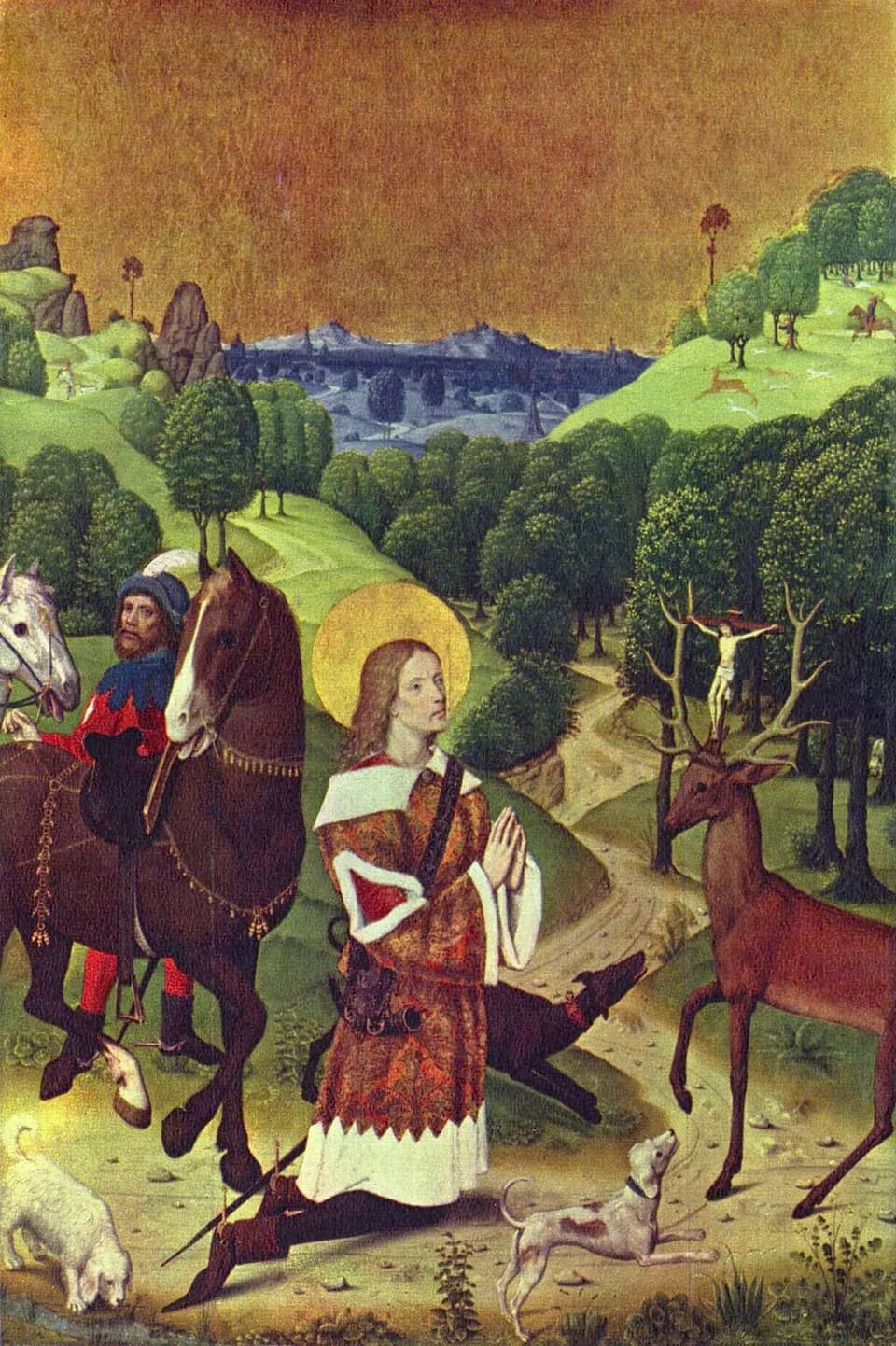
- Patron saint of
- Huntsmen, and invoked against hydrophobia (rabies), according to the Catholic Encyclopedia 1; Catholic Culture also lists archers, dogs, forest workers, furriers, machinists, mathematicians, metal workers, precision instrument makers, smelters and trappers 4
- Born
- About 656 1
- Died
- May 30, 727 or 728, at Fura (Tervuren), Brabant 1
- Bishop of
- Maastricht, and then the first bishop of Liège 1
- Known as
- The Apostle of the Ardennes 1
- Buried
- Liège, then translated in 825 to the Abbey of Amdain, since called Saint-Hubert 1
Saint Hubert was a Frankish courtier whose great passion was hunting, and who became bishop of Maastricht, moved the see to the village of Liège, and spent his last years preaching to the pagans of the Ardennes forest. 1 He died in 727 or 728. 1 Hunters have taken him as their patron since the Middle Ages because of one story, the stag that turned to face him with a crucifix between its antlers, and the 1910 Catholic Encyclopedia tells that story "as the pious legend narrates." 1 An almost identical vision is told of Saint Eustace, a Roman general several centuries earlier. 25
A courtier who lived for the chase
The Catholic Encyclopedia makes Hubert the eldest son of Bertrand, Duke of Aquitaine, born about 656. 1 As a young man he went to the court of Neustria, where his manners won him a place among the courtiers and the title of "count of the palace." 1 C. F. Wemyss Brown, who wrote the article, does not flatter him: Hubert "was a worldling and a lover of pleasure, his chief passion being for the chase, to which pursuit he devoted nearly all his time." 1
When the mayor of the palace, Ebroin, drove many of the nobles out by his conduct, Hubert followed them east to the court of Austrasia. 1 There Pepin of Herstal made him grand master of the household almost at once. 1 Around 682 he married Floribanne, daughter of the count of Louvain, and by Brown's account seemed to have given himself up entirely to "the pomp and vanities of this world." 1
The stag on Good Friday
The story is set on a Good Friday morning, while the faithful were in church and Hubert was out hunting. 1 He was chasing a magnificent stag when, "as the pious legend narrates," the animal turned and he saw a crucifix between its antlers. 1 A voice said: "Hubert, unless thou turnest to the Lord, and leadest an holy life, thou shalt quickly go down into hell." 1 He got down from his horse, fell to the ground and asked what he should do, and was told to go and find Lambert, who would teach him. 1
Brown is careful with his words here. The rest of the article reports the life as history; the vision alone is introduced as legend. 1 Catholic Culture's page for the saint, quoting a 1955 cookbook of feast-day customs, is just as careful, opening "so runs the story," though it sets the hunt "late in the eighth century" and says that afterward Hubert never hunted again. 4 Brown places the conversion around the time of his marriage in 682, and gives his death as 727 or 728. 1
The same story belongs to an older saint. The Catholic Encyclopedia's article on Saint Eustace, a Roman general under Trajan, tells how he too "saw a stag coming towards him, with a crucifix between its horns," heard a voice, and was baptized. 2 It calls the Acts of Eustace "certainly fabulous" and dates them to the seventh century. 2 Philip Kosloski, writing for Aleteia, notes that the two stories are nearly identical and that historians have wondered whether Hubert's was borrowed from Eustace's, which had been told for centuries before. 5 He tells it with a white stag and an illuminated cross. 5 This page does not try to settle the question, and neither do the sources.
Priest and bishop
What the encyclopedia reports as history follows from there. Hubert went to Maastricht, where Lambert was bishop, and Lambert became his spiritual director. 1 His wife died soon afterward. Hubert gave up his honors and military rank, handed his claim to Aquitaine to his younger brother Eudon, and made Eudon guardian of his infant son, Floribert. 1 He gave his personal wealth to the poor, studied for the priesthood, was ordained, and became one of Lambert's chief helpers in running the diocese. 1
On Lambert's advice he went on pilgrimage to Rome, and while he was away Lambert was murdered by followers of Pepin. 1 According to the encyclopedia, the killing was revealed to the pope in a vision at the same hour, with an instruction to make Hubert bishop in his place. 1 Brown adds that Hubert wanted to die a martyr himself and "sought it on many occasions, but unsuccessfully." 1 As bishop he gave his revenues to the poor, fasted and prayed, and was known as a preacher. 1 The Feast Day Cookbook excerpt calls him bishop of Tongres, and describes him crossing his diocese on horseback and by boat, building churches, and leaving food outside prison windows for the men inside. 4
Liège and the Ardennes
In 720, again following a vision, Hubert moved Lambert's remains from Maastricht to Liège, the place where he had been killed. 1 A church was built over the site and became a cathedral the next year, and the see moved with it to what was then a small village. 1 The encyclopedia credits this with laying "the foundation of the future greatness of Liège," and honors Lambert as the city's patron and Hubert as its founder and first bishop. 1
Pagan worship still survived in the Ardennes forest, in the district of Toxandria between Tongres and the Rhine, and in Brabant. 1 Hubert went into those places at the risk of his life and, by Brown's account, brought idol worship to an end in his part of the country. 1 That work is why the encyclopedia calls him the Apostle of the Ardennes. 1
He died at Fura, now Tervuren, between Brussels and Louvain, where he had gone to dedicate a new church. 1 Warned of his death in a vision, he preached a farewell sermon there, fell ill, and died six days later with the opening words of the Our Father on his lips. 1 The cookbook excerpt gives different last words, about stretching the pallium over his mouth and giving back his soul to God. 4 His body lay first in the church of Saint Peter in Liège, was moved in 825 to the Abbey of Amdain, which took his name, and was lost in the sixteenth century. 1
What is Saint Hubert the patron saint of?
Hunters, above all. The Catholic Encyclopedia says he was honored in the Middle Ages "as the patron of huntsmen, and the healer of hydrophobia (rabies)." 1 Kosloski calls him patron of hunters alongside Saint Eustace, Hubert better known in northern Europe and Eustace in the south. 5 The Catholic Encyclopedia also gives Eustace the patronage of hunters. 2
Catholic Culture's list is longer: archers, dog bites, dogs, forest workers, furriers, hunters, huntsmen, hydrophobia, machinists, mad dogs, mathematicians, metal workers, precision instrument makers, rabies, smelters and trappers, and the city of Liège. 4 It gives no source for the individual entries. The encyclopedia names Lambert, not Hubert, as patron of Liège. 1
The devotion was practical. Catholic Culture's excerpt says that in parts of France and Belgium hunters gathered for Mass on his feast before the chase, with a blessing of the men, horses and dogs. 4 Two military orders took his name: one founded in the Duchy of Jülich in 1444 or 1445 to mark a victory won on his feast, and one in the Duchy of Bar placed under his patronage in 1422. 3
Saint Hubert's feast day
The traditional date is November 3. 145 The Catholic Encyclopedia says that day "was probably the date of the translation" of his relics, and gives May 30 as the day he died. 1 Catholic Culture says the 2004 Roman Martyrology moved his commemoration to May 30, which it describes as the anniversary of the translation. 4 The two sources agree on the dates and disagree about which event each one marks, and both are reported here.
He is not on the General Roman Calendar. November 3 there belongs to Saint Martin de Porres, and Catholic Culture lists Hubert on May 30 as a commemoration from the Roman Martyrology. 4 The Order of Saint Hubert in Jülich was founded to remember a victory won on November 3, which shows how long that date has been his. 3
Praying with Saint Hubert
The part of his life the sources treat as history is quieter than the legend. A man with rank and land gave them away, put his son in his brother's care, studied under a bishop, and served that bishop until the bishop was murdered. 1 Then he took up the murdered man's work and carried his body to the place where he had died. 1
The stag is harder to hold. The Catholic Encyclopedia calls it a pious legend, and the same vision is told of a Roman general whose own story the encyclopedia calls fabulous. 12 Hunters who pray to Hubert are honoring a man whose conversion may have been borrowed from someone else's, and that has not stopped them for centuries. 45 What the story keeps hold of is a man interrupted at the thing he loved most, on the one morning he should have been in church. 1
Brown records that Hubert wanted martyrdom and did not get it. 1 He spent his years as bishop instead walking into the forests where the old gods were still worshiped, and died of an illness after dedicating a church. 1
Saint Hubert of Liège, pray for us.
Sources
- 1.C. F. Wemyss Brown, "St. Hubert," The Catholic Encyclopedia, Vol. 7 (New York: Robert Appleton Company, 1910).
- 2.Francis Mershman, "Sts. Eustachius and Companions," The Catholic Encyclopedia, Vol. 5 (New York: Robert Appleton Company, 1909).
- 3.F. M. Rudge, "Military Orders of Saint Hubert," The Catholic Encyclopedia, republished by Catholic Answers.
- 4."St. Hubert of Liege," Liturgical Year, May 30, Catholic Culture, excerpting Katherine Burton and Helmut Ripperger, Feast Day Cookbook (1955).
- 5.Philip Kosloski, "Why St. Eustace and St. Hubert are patron saints of hunters," Aleteia, September 20, 2021.
Saints to turn to next
Others in this collection who are turned to for some of the same things.